


Core Pacific City Co (京華城) has set a floor price of NT$38 billion (US$1.23 billion) for its gigantic central Taipei retail complex, also branded “Living Mall,” targeting buyers at home and abroad, auctioneers said yesterday.
It is the largest private property available for sale in recent decades as most high-profile transactions, including Taipei 101, Regent Taipei (台北晶華酒店), Taipei Nan Shan Plaza (台北南山廣場) and Taipei Garden Hotel (台北花園大酒店) are on leasehold contracts for 50 to 70 years, Cushman & Wakefield Inc told a tender briefing.
“It is not the best timing to sell properties these days, so I recommended a price concession and the owner accepted it,” Cushman & Wakefield Taiwan general manager Billy Yen (顏炳立) said, adding that the property could sell at a much higher price in a boom market.
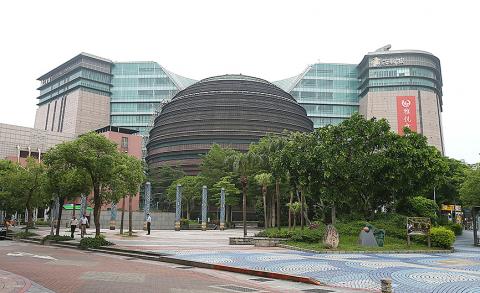
Photo: Hsu Yi-ping, Taipei Times
Core Pacific Group (威京集團), which owns the mall and interests in the civil engineering, construction, petrochemical, financial and entertainment sectors, has decided to dispose of the Living Mall, calling it “a failure,” Yen said.
The mall sits on a 4,986 ping (16,483m2) land plot in the city’s Songshan District (松山) with floor space of 62,000 ping on 12 floors above ground and eight below.
The developer took out a syndicated loan of NT$12 billion two decades ago to finance construction of the L-shaped complex and the debt is due to mature next year, sources said on condition of anonymity.
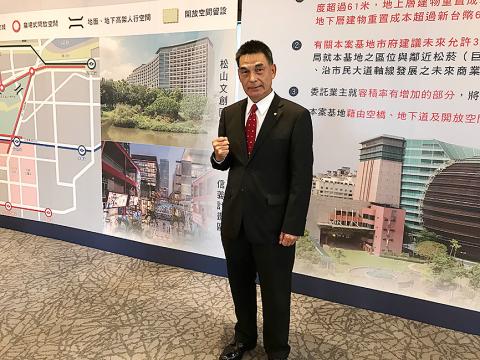
Photo: CNA
Prospective buyers could acquire the property as a whole for NT$38 billion or in four lots for a total of NT$51.7 billion, with the former option preferred and carrying incentives, the property consultancy said.
Land use for the complex is limited to the development of international tourist hotels, office space and department stores, meaning that buyers who wish to develop the property into luxury residential property would have to file rezoning requests.
That would generate rental incomes of 3.6 percent based on average rent prices of NT$2,500 per ping in Taipei, Yen said, adding that the figure is NT$5,000 in the adjacent Xinyi District (信義).
Winning bidders could also wait and file for urban redevelopment in 2031, while gaining bonus floor space in the meantime, Yen said, adding that the Living Mall would be an ideal investment for domestic life insurance companies that want to increase their real-estate stakes and trim idle cash.
Foreign investors in Singapore, Hong Kong and China have expressed strong interest, and the consultancy has set the auction for Dec. 12 to accommodate their fund relocation needs, he said.
Foreign investors would face capital gains taxes of 35 percent to 45 percent if they resell the property within two years of purchase.
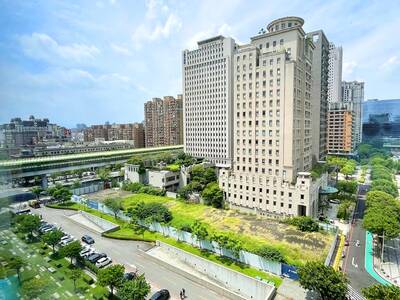
Taichung reported the steepest fall in completed home prices among the six special municipalities in the first quarter of this year, data compiled by Taiwan Realty Co (台灣房屋) showed yesterday. From January through last month, the average transaction price for completed homes in Taichung fell 8 percent from a year earlier to NT$299,000 (US$9,483) per ping (3.3m²), said Taiwan Realty, which compiled the data based on the government’s price registration platform. The decline could be attributed to many home buyers choosing relatively affordable used homes to live in themselves, instead of newly built homes in the city’s prime property market, Taiwan Realty
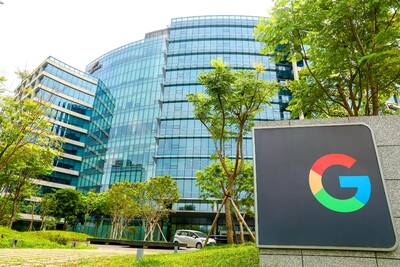
The government yesterday approved applications by Alphabet Inc’s Google to invest NT$27.08 billion (US$859.98 million) in Taiwan, the Ministry of Economic Affairs said in a statement. The Department of Investment Review approved two investments proposed by Google, with much of the funds to be used for data processing and electronic information supply services, as well as inventory procurement businesses in the semiconductor field, the ministry said. It marks the second consecutive year that Google has applied to increase its investment in Taiwan. Google plans to infuse NT$25.34 billion into Charter Investments Ltd (特許投資顧問) through its Singapore-based subsidiary Fructan Holdings Singapore Pte Ltd, and
Micron Technology Inc is a driving force pushing the US Congress to pass legislation that would put new export restrictions on equipment its Chinese competitors use to make their chips, according to people familiar with the matter. A US House of Representatives panel yesterday was to vote on the “MATCH Act,” a bill designed to close gaps in restrictions on chipmaking equipment. It would also pressure foreign companies that sell equipment to Chinese chipmaking facilities to align with export curbs on US companies like Lam Research Corp and Applied Materials Inc. The bill targets facilities operated by China’s ChangXin Memory Technologies Inc

Singapore-based ride-hailing and delivery giant Grab Holdings’ planned acquisition of Foodpanda’s Taiwan operations has yet to enter the formal review stage, as regulators await supplementary documents, the Fair Trade Commission (FTC) said yesterday. Acting FTC Chairman Chen Chih-min (陳志民) told the legislature’s Economics Committee that although Grab submitted its application on March 27, the case has not been officially accepted because required materials remain incomplete. Once the filing is finalized, the FTC would launch a formal probe into the deal, focusing on issues such as cross-shareholding and potential restrictions on market competition, Chen told lawmakers. Grab last month announced that it would acquire


 RSS
RSS