


The TAIEX yesterday tumbled 234.76 points, or 2.14 percent, to 10,748.92 points, as a renewed rout in the Turkish lira triggered a sell-off, with optical and electronics plays being the hardest hit, analysts said.
The plunge came after US President Donald Trump on Friday said he would double tariffs on aluminum and steel imports from Turkey, reigniting fears about the Turkish economy and sending its currency into a nosedive.
“We believe the Turkish issue will not escalate into a global financial crisis, although it has added uncertainty to the global economy and facilitated capital flight from emerging markets,” SinoPac Financial Holdings Co (永豐金控) chief economist Jack Huang (黃蔭基) said.
The local bourse and the New Taiwan dollar have been affected since late in the second quarter — a situation that is likely to persist throughout this year, Huang said.
Turnover was NT$157.474 billion (US$5.11 billion), with foreign players slashing their local holdings by a net NT$2.85 billion, Taiwan Stock Exchange data said.
Mutual funds also trimmed their holdings by a net NT$539 million, while proprietary traders cut their positions by a net NT$1.64 billion.
Hopefully, Turkey’s new fiscal measures would prove helpful, Huang said, as the Turkish currency has lost more than 40 percent this year, while inflation hit nearly 16 percent.
Optical shares bore the brunt of the sell-off, slumping 6.4 percent, followed by electronics, which fell 4.02 percent, Taiwan Stock Exchange (TWSE) statistics showed.
Largan Precision Co (大立光), which supplies camera lenses for Apple Inc’s iPhones, ended down 8.86 percent at NT$4,630, while Yageo Corp (國巨), the nation’s biggest passive component supplier, tumbled 8.29 percent to NT$597, TWSE figures showed.
A weak sentiment trumped the arrival of the high sales season for consumer electronics products, Masterlink Securities Investment Advisory Corp (元富投顧) president Liu Kun-hsi (劉坤錫) said.
The much-tracked global index MSCI is due to unveil its quarterly share weighting adjustments today and analysts believe it would continue to cut Taiwanese shares to accommodate the inclusion of Chinese A-shares.
The Turkish problem fed market jitters, but could prove a more influential factor, Liu said.
However, not all shares suffered, as local cement plays bucked the trend and rose 1.49 percent.
Taiwan Cement Corp (台灣水泥) closed up 1.57 percent at NT$42.15 on the back of strong first-half earnings results and sustained growth momentum for the rest of the year, President Securities Corp (統一證券) said.
In addition, the New Taiwan dollar is likely to soften further against the greenback, which would allow local exporters to book foreign exchange gains, the brokerage house said.

Elon Musk’s lieutenants have reached out to chip industry suppliers, including Applied Materials Inc, Tokyo Electron Ltd and Lam Research Corp, for his envisioned Terafab, early steps in an audacious and likely arduous attempt to break into the production of cutting-edge chips. Staff working for the joint venture between Tesla Inc and Space Exploration Technologies Corp (SpaceX) have sought price quotes and delivery times for an array of chipmaking gear, people familiar with the matter said. In past weeks, they’ve contacted makers of photomasks, substrates, etchers, depositors, cleaning devices, testers and other tools, according to the people, who asked not to
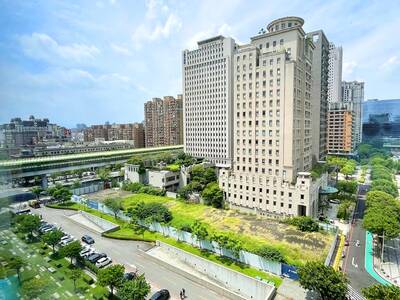
Taichung reported the steepest fall in completed home prices among the six special municipalities in the first quarter of this year, data compiled by Taiwan Realty Co (台灣房屋) showed yesterday. From January through last month, the average transaction price for completed homes in Taichung fell 8 percent from a year earlier to NT$299,000 (US$9,483) per ping (3.3m²), said Taiwan Realty, which compiled the data based on the government’s price registration platform. The decline could be attributed to many home buyers choosing relatively affordable used homes to live in themselves, instead of newly built homes in the city’s prime property market, Taiwan Realty
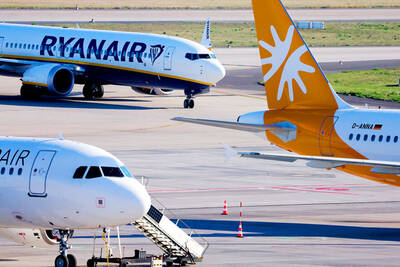
JET JUICE: The war on Iran’s secondary effects have seen fuel prices skyrocket, knocking flight schedules down to earth in return as airlines struggle with costs Airline passengers should brace for more irritation in the next few months as carriers worldwide cancel flights and ground planes to cope with stratospheric increases in jet-fuel prices. Dutch flag carrier KLM is the latest company to cut its schedule, saying on Thursday that it would scrap 80 return flights at Amsterdam’s Schiphol Airport in the coming month. That puts it in the same league as United Airlines Holdings Inc, Deutsche Lufthansa AG and Cathay Pacific Airways Ltd, which have all pruned itineraries to mitigate costs. Global capacity for next month has been reduced by about 3 percentage points, with all

Taiwan is attracting a growing number of foreign jobseekers as companies increasingly recruit overseas talent to ease labor shortages and expand global reach, recruitment platform 104 Job Bank (104人力銀行) said yesterday. More than 40,000 foreign nationals searched for jobs in Taiwan through the platform last year, a 28 percent increase from a year earlier, the company said. Malaysians accounted for the largest share of overseas jobseekers at 12.2 percent, followed by Indonesians at 11.9 percent and Vietnamese at 10.8 percent. Indonesian applicants surged more than 50 percent year-on-year, while Vietnamese jobseekers rose by more than 30 percent. Applicants from the


 RSS
RSS