


Electric car maker Tesla Inc has delivered on its chief executive’s promise to build a lower-priced car at a rate of 5,000 per week by the end of last month.
CEO Elon Musk on Sunday sent an e-mail to employees praising them for producing 5,000 Model 3s, a compact car that is designed to shift Tesla from a niche manufacturer to a mainstream automaker.
Musk said the company had cranked out a combined 2,000 of Model S sedans and Model X sport-utility vehicles, bringing overall production to a record 7,000 for the week.
“We did it!” Musk wrote. “What an incredible job by an amazing team.”
The e-mail was reported by the Web site Electrek, and the company confirmed its authenticity.
Last summer, when the first Model 3s began rolling off the assembly line, Musk promised to build 5,000 per week by December and 10,000 per week this year.
Model 3 sales are critical to Tesla’s future. The company has never posted a full-year profit, and it burned through more than US$1 billion in cash in the first quarter. Wall Street investors, who have pushed the company’s stock beyond US$340 per share, are growing impatient with the losses.
The company reached 5,000 per week as Musk spent many nights inside the Fremont, California, factory that once belonged to a joint venture between General Motors and Toyota. To quickly put another assembly line in place, Tesla built a large tent at the factory site. Musk told investors on a first-quarter earnings conference call that the company relied too heavily on automation. It had to hire more people to work at the factory.
Many have been waiting since March of 2016, when Tesla began taking orders with a US$1,000 refundable deposit.
The company might also have to deal with some safety issues. Investigators from two federal agencies are looking into five crashes of its vehicles, some involving the semi-autonomous Autopilot system or post-crash battery fires that have been difficult to extinguish.

DAMAGE REPORT: Global central banks are assessing war-driven inflation risks as the law of unintended consequences careens around the world, spiking oil prices Central banks from Washington to London and from Jakarta to Taipei are about to make their first assessments of economic damage after more than two weeks of conflict between the US and Iran. Decisions this week encompassing every member of the G7 and eight of the world’s 10 most-traded currency jurisdictions are likely to confirm to investors that the specter of a new inflation shock is already worrying enough to prompt heightened caution. The US Federal Reserve is widely expected to do exactly what everyone anticipated weeks ahead of its March 17-18 policy gathering: hold rates steady. The narrative surrounding that

Taiwan Semiconductor Manufacturing Co’s (TSMC, 台積電) share of the global foundry market rose to almost 70 percent last year amid booming demand for artificial intelligence (AI), market information advisory firm TrendForce Corp (集邦科技) said on Thursday. The contract chipmaker posted US$122.54 billion in revenue, up 36.1 percent from a year earlier, accounting for 69.9 percent of the global market, TrendForce said. Its share was up from 64.4 percent in 2024, it said. TSMC’s closest rival, Samsung Electronics, was a distant second, posting US$12.63 billion in sales, down 3.9 percent from a year earlier, for a 7.2 percent share of the global market. In the
HEADWINDS: The company said it expects its computer business, as well as consumer electronics and communications segments to see revenue declines due to seasonality Pegatron Corp (和碩) yesterday said it aims to grow its artificial intelligence (AI) server revenue more than 10-fold this year from last year, driven by orders from neocloud solutions clients and large cloud service providers. The electronics manufacturing service provider said AI server revenue growth would be driven primarily by the Nvidia Corp GB300 server platform. Server shipments are expected to increase each quarter this year, with the second half likely to outperform the first half, it said. The AI server market is expected to broaden this year as more inference applications emerge, which would drive demand for system-on-chip, application-specific integrated circuits
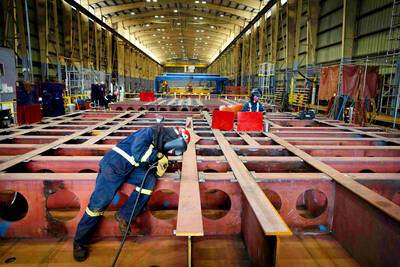
At a massive shipyard in North Vancouver, Canadian workers grind metal beams for a powerful new icebreaker crucial to cementing the country’s presence in the increasingly contested arctic. Icebreakers are specialized, expensive vessels able to navigate in the frozen far north. And “this is the crown jewel,” said Eddie Schehr, vice president of production at the Seaspan shipyard. For Canadian Prime Minister Mark Carney, who heads to Norway next Friday to observe arctic defense drills involving troops from 14 NATO states, Canada’s extreme north has emerged as a strategic priority. “Canada is and forever will be an Arctic nation,” he said ahead of


 RSS
RSS