


Macronix International Co (旺宏電子), which supplies read-only memory (ROM) chips to Japan’s Nintendo Co, yesterday said it is contemplating a US$1.5 billion expansion after this year, as brisk demand is to keep its factories running at full capacity for the next few years.
The Hsinchu-based chipmaker said there are supply constraints on all of its products, including ROM, NOR flash and NAND flash memory chips, thanks to the boom in the memorychip industry.
“We believe this situation will continue for a few years, as we are to roll out new products that will consume more capacity. I believe it will last for quite a long period of time,” Macronix chairman and chief executive officer Miin Wu (吳敏求) told reporters after the company’s annual shareholders’ meeting.
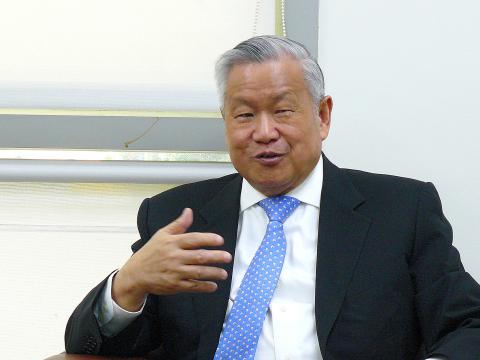
Photo: CNA
The company is scheduled to ramp up production of new memory chips — flash memory chips for embedded multimedia card storage and 3D ROM — in the first half of next year, Wu said.
“The problem now is that we cannot even find [sufficient] capacity to produce those new products,” Wu said. “We will be short of [capacity] if demand for our new products goes up.”
Initial feedback from customers regarding the new chips is quite good, given the strong cost-performance ratio of the chips, he added.
The most likely scenario is that the firm would add 20,000 wafers a month to an existing 12-inch fab at a cost of US$1.5 billion, instead of building a new fab, Wu said.
Macronix operates one 8-inch fab and one 12-inch fab.
Wu declined to give a timeline for the capacity expansion plan, but said that it would not happen this year.
Macronix plans to spend NT$5.8 billion (US$193.73 million) on technological improvements this year, which would enable it to switch production between 19-nanometer NAND flash memory chips and 55-nanometer NOR flash memory chips, the company said.
Two months ago, it predicted that revenue would be either flat or decline 5 percent quarterly from NT$9.06 billion in the first quarter.
“Now, we think the second quarter will be better than our forecast,” Wu said. “The main reason is that demand for ROM is better than in the first quarter.”
Overall, the second quarter’s earnings would be stronger than the first quarter, as the company is allocating more capacity to producing higher-margin products, such as those used in cars, industrial devices and medical devices, he said.
Macronix said it expects the combined revenue from chips used in cars, and industrial and medical devices to contribute more than 30 percent of its total revenue this year, up from 26 percent last quarter.
Macronix reported NT$1.88 billion in net profit for the first quarter, or NT$1.06 per share.
The company’s shareholders yesterday approved the distribution of a cash dividend of NT$1 per common share, the first distribution in five years. It also plans to distribute a stock dividend of 2 percent.

GROWING OWINGS: While Luxembourg and China swapped the top three spots, the US continued to be the largest exposure for Taiwan for the 41st consecutive quarter The US remained the largest debtor nation to Taiwan’s banking sector for the 41st consecutive quarter at the end of September, after local banks’ exposure to the US market rose more than 2 percent from three months earlier, the central bank said. Exposure to the US increased to US$198.896 billion, up US$4.026 billion, or 2.07 percent, from US$194.87 billion in the previous quarter, data released by the central bank showed on Friday. Of the increase, about US$1.4 billion came from banks’ investments in securitized products and interbank loans in the US, while another US$2.6 billion stemmed from trust assets, including mutual funds,
Micron Memory Taiwan Co (台灣美光), a subsidiary of US memorychip maker Micron Technology Inc, has been granted a NT$4.7 billion (US$149.5 million) subsidy under the Ministry of Economic Affairs A+ Corporate Innovation and R&D Enhancement program, the ministry said yesterday. The US memorychip maker’s program aims to back the development of high-performance and high-bandwidth memory chips with a total budget of NT$11.75 billion, the ministry said. Aside from the government funding, Micron is to inject the remaining investment of NT$7.06 billion as the company applied to participate the government’s Global Innovation Partnership Program to deepen technology cooperation, a ministry official told the

AI TALENT: No financial details were released about the deal, in which top Groq executives, including its CEO, would join Nvidia to help advance the technology Nvidia Corp has agreed to a licensing deal with artificial intelligence (AI) start-up Groq, furthering its investments in companies connected to the AI boom and gaining the right to add a new type of technology to its products. The world’s largest publicly traded company has paid for the right to use Groq’s technology and is to integrate its chip design into future products. Some of the start-up’s executives are leaving to join Nvidia to help with that effort, the companies said. Groq would continue as an independent company with a new chief executive, it said on Wednesday in a post on its Web
Taiwan Semiconductor Manufacturing Co (TSMC, 台積電), the world’s leading advanced chipmaker, officially began volume production of its 2-nanometer chips in the fourth quarter of this year, according to a recent update on the company’s Web site. The low-key announcement confirms that TSMC, the go-to chipmaker for artificial intelligence (AI) hardware providers Nvidia Corp and iPhone maker Apple Inc, met its original roadmap for the next-generation technology. Production is currently centered at Fab 22 in Kaohsiung, utilizing the company’s first-generation nanosheet transistor technology. The new architecture achieves “full-node strides in performance and power consumption,” TSMC said. The company described the 2nm process as


 RSS
RSS