


China Synthetic Rubber Corp (CSRC, 中橡), the world’s fifth-largest carbon black supplier, said its board has approved a plan to spin off its carbon black and biotech units, as the 45-year-old company considers transforming into a holding firm.
The planned spin-off, intended to improve the company’s operating efficiency and raise its competitiveness, is scheduled to take effect on Sept. 30, CSRC said in a filing with the Taiwan Stock Exchange on Thursday last week.
CSRC, a major subsidiary of the nation’s largest cement maker, Taiwan Cement Corp (台灣水泥), said it would remain listed on the local bourse after the move and would rename itself International CSRC Investment Holdings Co Ltd (國際中橡投資控股).
The existing shareholders’ interests would not be affected by the restructuring, it added.
However, the plan still needs to be approved by shareholders at an annual meeting on June 26, the filing said.
In a separate filing, the company said the board gave the nod to raising capital through the issuance of 180 million new shares in the near term to fund investments in India and the US.
CSRC said it plans to inject US$155 million into Continental Carbon India Ltd, which would be used to expand manufacturing capacity of carbon black at the unit’s plants in India’s Gujarat State.
As for the US investment, CSRC proposed a capital injection of US$52 million to Continental Carbon Co, headquartered in Houston, Texas, to replenish its operating capital, the filing showed.
The firm operates plants in the US, China and India, with a combined capacity of about 790,000 tonnes of carbon black per year, company data showed.
In the first four months of this year, the company’s cumulative revenue grew 15.99 percent to NT$7.49 billion from NT$6.46 billion (US$251.6 million from US$217 million) a year earlier.
Although the fundraising might allow CSRC to financially strengthen its Indian and US units, it could dilute earnings per share in the near term, and its effects would not materialize by 2020, KGI Securities Investment Advisory Co (凱基投顧) analyst Tom Hsu (許家源) said in a note on Thursday last week.
KGI Securities lowered its 12-month target share price to NT$48 from NT$53, valuing CSRC at 1.4 times its estimated net value of NT$34 following the execution of the recapitalization scheme.
CSRC shares on Friday last week closed up 3.27 percent at NT$44.2 in Taipei trading. The stock is up 0.8 percent this year, underperforming the broader market’s 2.03 percent rise.
SECOND-RATE: Models distilled from US products do not perform the same as the original and undo measures that ensure the systems are neutral, the US’ cable said The US Department of State has ordered a global push to bring attention to what it said are widespread efforts by Chinese companies, including artificial intelligence (AI) start-up DeepSeek (深度求索), to steal intellectual property from US AI labs, according to a diplomatic cable. The cable, dated Friday and sent to diplomatic and consular posts around the world, instructs diplomatic staff to speak to their foreign counterparts about “concerns over adversaries’ extraction and distillation of US AI models.” Distillation is the process of training smaller AI models using output from larger, more expensive ones to lower the costs of training a powerful new
Shares of Taiwan Semiconductor Manufacturing Co (TSMC, 台積電) have repeatedly hit new highs, but an equity analyst said the stock’s valuation remains within a reasonable range and any pullback would likely be technical. The contract chipmaker’s historical price-to-earnings (P/E) ratio has ranged between 20 and 30, Cathay Futures Consultant Co (國泰證期) analyst Tsai Ming-han (蔡明翰) told Central News Agency. With market consensus projecting that TSMC would post earnings per share of about NT$100 (US$3.17) this year, supported by strong global demand for artificial intelligence (AI) applications, and the stock currently trading at a P/E ratio of below 25, Tsai said the valuation
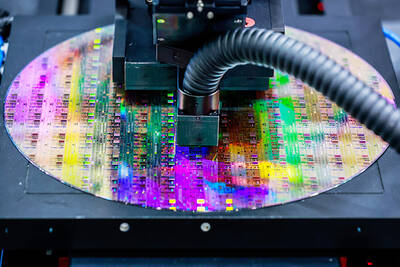
The artificial intelligence (AI) boom has triggered a seismic reshuffling of global equity markets, with Taiwan and South Korea muscling past European nations one by one. With its stock market now valued at nearly US$4.3 trillion, Taiwan surpassed the UK, Europe’s biggest market, earlier this month, data compiled by Bloomberg showed. South Korea is about US$140 billion away from doing the same. The tech-heavy Asian markets have shot past Germany and France in the past seven months. The shift is largely down to massive gains in shares of three companies that provide essential hardware for AI: Taiwan Semiconductor Manufacturing Co (TSMC, 台積電),
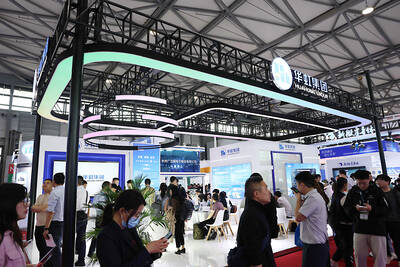
The US Department of Commerce last week ordered multiple chip equipment companies to halt shipments of certain tools to China’s second-largest chipmaker, Hua Hong Semiconductor Ltd (華虹半導體), its latest action to slow the country’s development of advanced chips, two people familiar with the matter said. The department sent letters to at least a handful of companies informing them of restrictions on tools and other materials destined for two Hua Hong facilities US officials believe make China’s most sophisticated chips, the people said. Top US chip equipment companies Lam Research Corp, Applied Materials Inc and KLA Corp, each of which has significant


 RSS
RSS