


HSBC Taiwan Ltd yesterday organized a volunteer event simultaneously at its 30 branches nationwide with an aim to allow elementary school children first-hand experience of its banking facilities and services.
President and chief executive officer Adam Chen (陳志堅) led 350 employees to take part in the high-profile event “Little Banker Experience Day” where 500 elementary school children, most from disadvantaged family, had the opportunity to go through banking operations and services.
“HSBC Taiwan has long been concerned about the education issue and the event is intended to underscore the importance of financial education,” Chen told reporters at the Neihu branch in Taipei.
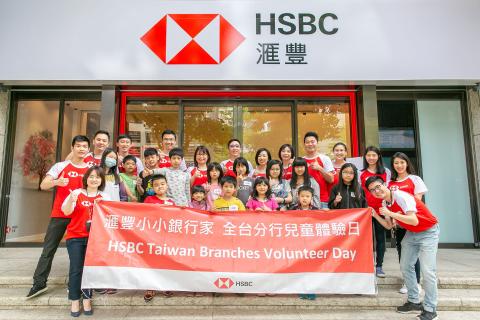
The half-day experience may help participating children to develop some financial sense and draw career plans later in their life, Chen said.
In April each year, HSBC Taiwan will arrange volunteer activity for its employees to visit students in remote schools and prepare fun and educative games to demonstrate their love and concern for the children, Chen said.
For this year, all 30 branches set aside a business day for the “little banker” event, which is an unprecedented practice as other companies carry out volunteer activity on weekends, Chen said.

The “little banker” event consists of three main parts: digital banking, banknote recognition and counter service experiences.
At the digital banking station, volunteers use iPads to demonstrate the bank’s online banking capability and introduce its global account integration functions and high standardization of confidentiality technology.
Children learned to use the devices to check interest rates, foreign exchange rates and other financial management tools.
A boy student Hiao Yen (小彥), 12, said the digital banking experience was fun as it enabled him to gain immediate knowledge of foreign exchange rates for major currencies.
At the banknote recognition station, volunteers taught children to recognize paper currencies of major countries and differentiate between counterfeit and authentic New Taiwan dollars. Volunteers also allowed the children to use money counting machines to highlight the importance of accuracy in their work.
In addition, the children played banking guests and went through counter services on making deposits, withdrawals, transfers, credit card fee payments and currency exchange transactions to understand the bank’s daily operations.
Hsiao Fang (小帆), a girl student, said she loved the experience of the money counting machine the best.
HSBC Taiwan are long-time sponsor of children’s welfare causes with Boyo Social Welfare Foundation (博幼社會福利基金會), Eden Social Welfare Foundation (伊甸社會福利基金會), and HSBC Kids Read project (匯豐兒童英語悅讀計畫), among others.


The domestic unit of the Chinese-owned, Dutch-headquartered chipmaker Nexperia BV will soon be able to produce semiconductors locally within China, according to two company sources. Nexperia is at the center of a global tug-of-war over critical semiconductor technology, with a Dutch court in February ordering a probe into alleged mismanagement at the company. The geopolitical tussle has disrupted supply chains, with some carmakers reportedly forced to cut production due to chip shortages. Local production would allow Nexperia’s domestic arm, Nexperia Semiconductors (China) Ltd (安世半導體中國), to bypass restrictions in place since October on the supply of silicon wafers — etched with tiny components to

Taiwan’s foreign exchange reserves fell below the US$600 billion mark at the end of last month, with the central bank reporting a total of US$596.89 billion — a decline of US$8.6 billion from February — ending a three-month streak of increases. The central bank attributed the drop to a combination of factors such as outflows by foreign institutional investors, currency fluctuations and its own market interventions. “The large-scale outflows disrupted the balance of supply and demand in the foreign exchange market, prompting the central bank to intervene repeatedly by selling US dollars to stabilize the local currency,” Department of Foreign

Taiwan is open to joining a global liquefied natural gas (LNG) program if one is created, but on the condition that countries provide delivery even in a scenario where there is a conflict with China, an energy department official said yesterday. While Taiwan’s priority is to have enough LNG at home, the nation is open to exploring potential strategic reserves in other countries such as Japan or South Korea, Energy Administration Deputy Director-General Chen Chung-hsien (陳崇憲) said. While the LNG market does not have a global reserve for emergencies like that of oil, the concept has been raised a few times —
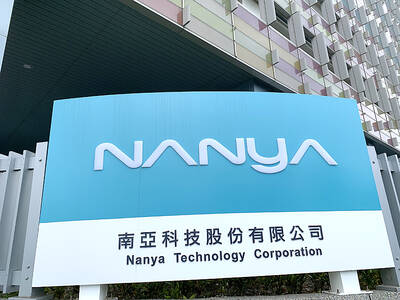
AI-FUELED DEMAND: The company has been benefiting from the skyrocketing prices for DRAM chips amid the AI frenzy, especially its core product — DDR4 DRAM chips DRAM chipmaker Nanya Technology Corp (南亞科技) yesterday reported that its revenue for the first quarter surged 582.91 percent to NT$49.09 billion (US$1.54 billion) from NT$7.19 billion a year earlier, as the supply crunch caused chip price spikes. Last quarter’s figure is the highest on record. On a quarterly basis, revenue jumped 63.14 percent from NT$30.09 billion, the company said. In January, Nanya Technology expected global DRAM supply scarcity to continue through the first half of 2028, thanks to strong demand for artificial intelligence (AI) applications. Market researcher TrendForce Corp (集邦科技) forecast prices of standard DRAM chips would rise between 58 percent and 63


 RSS
RSS