


Memorychip tester and packager Powertech Technology Inc (力成科技) yesterday said that its first-quarter net profit declined 22 percent sequentially mainly due to foreign-exchange losses and seasonal weakness, but that it expects revenue to pick up this quarter as demand recovers.
Net profit fell to NT$1.29 billion (US$43.56 million) last quarter, compared with NT$1.66 billion in the final quarter last year. That translated into earnings per share of NT$1.66, down from NT$2.12.
Powertech said it booked NT$200 million in foreign-exchange losses last quarter as the New Taiwan dollar appreciated 2.35 percent versus the US dollar during the period.
Gross margin slid to 20.4 percent from 21.5 percent as its two Japanese acquisitions and a new fab in Xian, China, dragged down overall margins, the company said.
The Xian fab is a joint venture with US memorychip maker Micron Technology Inc.
However, Powertech expects a recovery amid rising demand in the mobile phone and ultra-thin laptop sectors this quarter.
“The first quarter was the most painful period. It is over now,” Powertech general manager Hung Chia-yu told an investor conference. “Overall, we are positive about the second quarter. Customer orders for the second and third quarters look quite sturdy.”
Stronger revenue last month points to a recovery, Hung said.
Sales hit a record NT$5.65 billion last month, up 16 percent from February, a company filing with the Taiwan Stock Exchange showed.
First-quarter revenue shrank 4.8 percent sequentially to NT$15.91 billion, of which 39 percent came from flash memory chips and 34 percent from DRAM.
However, prospects are improving on rising demand for mobile DRAM ahead of new model launches by the world’s major brands as well as for flash memory chips due to rising penetration of solid-state drives in notebook computers.
Demand from the automotive, consumer electronics and communications segments is also gaining traction, Hung said.
For the full year, the memory industry should see a healthy supply and demand balance, but key component supply constraints could be a major downside risk, Hung said.
The company has experienced a short supply of passive components, substrates and 8-inch wafers since last year, he said.
On top of that, the US-China trade row poses another uncertainty, Hung said.
To cope with rising demand, Powertech is increasing its capital expenditure this year. It plans to invest NT$15 billion on new equipment and facilities this year, with 30 percent of the amount going into capacity expansion.

GROWING OWINGS: While Luxembourg and China swapped the top three spots, the US continued to be the largest exposure for Taiwan for the 41st consecutive quarter The US remained the largest debtor nation to Taiwan’s banking sector for the 41st consecutive quarter at the end of September, after local banks’ exposure to the US market rose more than 2 percent from three months earlier, the central bank said. Exposure to the US increased to US$198.896 billion, up US$4.026 billion, or 2.07 percent, from US$194.87 billion in the previous quarter, data released by the central bank showed on Friday. Of the increase, about US$1.4 billion came from banks’ investments in securitized products and interbank loans in the US, while another US$2.6 billion stemmed from trust assets, including mutual funds,

AI TALENT: No financial details were released about the deal, in which top Groq executives, including its CEO, would join Nvidia to help advance the technology Nvidia Corp has agreed to a licensing deal with artificial intelligence (AI) start-up Groq, furthering its investments in companies connected to the AI boom and gaining the right to add a new type of technology to its products. The world’s largest publicly traded company has paid for the right to use Groq’s technology and is to integrate its chip design into future products. Some of the start-up’s executives are leaving to join Nvidia to help with that effort, the companies said. Groq would continue as an independent company with a new chief executive, it said on Wednesday in a post on its Web
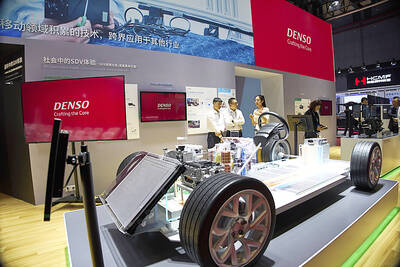
JOINT EFFORTS: MediaTek would partner with Denso to develop custom chips to support the car-part specialist company’s driver-assist systems in an expanding market MediaTek Inc (聯發科), the world’s largest mobile phone chip designer, yesterday said it is working closely with Japan’s Denso Corp to build a custom automotive system-on-chip (SoC) solution tailored for advanced driver-assistance systems and cockpit systems, adding another customer to its new application-specific IC (ASIC) business. This effort merges Denso’s automotive-grade safety expertise and deep vehicle integration with MediaTek’s technologies cultivated through the development of Media- Tek’s Dimensity AX, leveraging efficient, high-performance SoCs and artificial intelligence (AI) capabilities to offer a scalable, production-ready platform for next-generation driver assistance, the company said in a statement yesterday. “Through this collaboration, we are bringing two

Even as the US is embarked on a bitter rivalry with China over the deployment of artificial intelligence (AI), Chinese technology is quietly making inroads into the US market. Despite considerable geopolitical tensions, Chinese open-source AI models are winning over a growing number of programmers and companies in the US. These are different from the closed generative AI models that have become household names — ChatGPT-maker OpenAI or Google’s Gemini — whose inner workings are fiercely protected. In contrast, “open” models offered by many Chinese rivals, from Alibaba (阿里巴巴) to DeepSeek (深度求索), allow programmers to customize parts of the software to suit their


 RSS
RSS