


Taiwan Semiconductor Manufacturing Co (TSMC, 台積電) yesterday saw its market value shed NT$400 billion (US$13.6 billion) after the chipmaker unexpectedly cut its revenue growth forecast for this year to 10 percent annually on weak demand for Apple Inc’s iPhones and uncertainty over cryptocurrency mining demand.
Three months ago, TSMC estimated that its revenue would grow between 10 and 15 percent this year in US dollar terms.
TSMC shares tumbled 6.34 percent to NT$229 yesterday, the lowest they have been in four months. That slashed the company’s market value to about NT$5.94 trillion from NT$6.34 trillion on Thursday.
Turnover of the stock nearly quadrupled on the Taiwan Stock Exchange, with about 128 million shares changing hands, up from 33 million shares the previous session.
“TSMC management expects demand for cryptocurrency mining devices in the second half of this year to be stronger than the first half, suggesting most of the [revenue growth forecast] cut will be from the new iPhones,” Yuanta Securities Co (元大證券) semiconductor analyst George Chang (張家麒) said in a research report.
TSMC’s forecast that advanced 7-nanometer technology revenue contribution this year is likely to be 1 percentage point lower than its previous estimate of 10 percent, is more evidence of a weakening demand for premium smartphones — mainly the new iPhone, Chang said.
Apple is the Taiwanese chipmaker’s biggest client. Based on TSMC’s annual financial report released yesterday, Apple contributed NT$214.2 billion to TSMC last year, accounting for 22 percent of the firm's total revenue.
TSMC, which counts Nvidia Corp and HiSilicon Technologies Co (海思) among its clients for advanced technologies, on Thursday also reduced its annual growth forecast for the global semiconductor industry to 5 percent this year, compared with an earlier estimate of between 5 and 7 percent.
Yuanta lowered TSMC’s target share price to NT$260 from NT$265, while CGS-CIMB Securities (Hong Kong) Ltd (銀河-聯昌證券) reduced its price to NT$224 from NT$257.
CGS-CIMB analyst Peter Chan (詹逸群) said in a report that he is “concerned about the volatility of cryptocurrency. Cryptocurrency mining is done using application-specific integrated circuits or graphics processing units, and TSMC has exposure to both.”
The brokerage would not assign much of a contribution from cryptocurrency mining demand to its earnings estimate for TSMC, until global economic powers agree on a regulated virtual currency, Chan said.
TSMC gained enough market share over the past eight years to seize 56 percent of the world’s semiconductor market last year, despite escalating competition from rivals, the company said in the annual report.
Separately, the firm’s board of directors yesterday approved the nomination of nine board directors, excluding incumbent chairman Morris Chang (張忠謀), in anticipation of Chang’s retirement on June 5.
Cochief executive officer C.C. Wei (魏哲家) is to succeed Chang as the company’s sole chief executive officer and cochief executive officer Mark Liu (劉德音) is to become the company’s chairman. Wei and Liu were nominated as company board members.

SECOND-RATE: Models distilled from US products do not perform the same as the original and undo measures that ensure the systems are neutral, the US’ cable said The US Department of State has ordered a global push to bring attention to what it said are widespread efforts by Chinese companies, including artificial intelligence (AI) start-up DeepSeek (深度求索), to steal intellectual property from US AI labs, according to a diplomatic cable. The cable, dated Friday and sent to diplomatic and consular posts around the world, instructs diplomatic staff to speak to their foreign counterparts about “concerns over adversaries’ extraction and distillation of US AI models.” Distillation is the process of training smaller AI models using output from larger, more expensive ones to lower the costs of training a powerful new

Singapore-based ride-hailing and delivery giant Grab Holdings’ planned acquisition of Foodpanda’s Taiwan operations has yet to enter the formal review stage, as regulators await supplementary documents, the Fair Trade Commission (FTC) said yesterday. Acting FTC Chairman Chen Chih-min (陳志民) told the legislature’s Economics Committee that although Grab submitted its application on March 27, the case has not been officially accepted because required materials remain incomplete. Once the filing is finalized, the FTC would launch a formal probe into the deal, focusing on issues such as cross-shareholding and potential restrictions on market competition, Chen told lawmakers. Grab last month announced that it would acquire
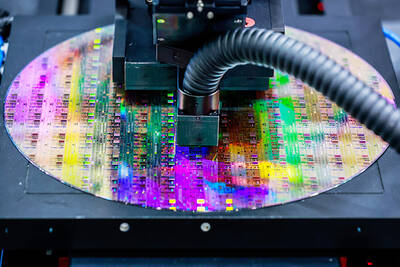
The artificial intelligence (AI) boom has triggered a seismic reshuffling of global equity markets, with Taiwan and South Korea muscling past European nations one by one. With its stock market now valued at nearly US$4.3 trillion, Taiwan surpassed the UK, Europe’s biggest market, earlier this month, data compiled by Bloomberg showed. South Korea is about US$140 billion away from doing the same. The tech-heavy Asian markets have shot past Germany and France in the past seven months. The shift is largely down to massive gains in shares of three companies that provide essential hardware for AI: Taiwan Semiconductor Manufacturing Co (TSMC, 台積電),
Shares of Taiwan Semiconductor Manufacturing Co (TSMC, 台積電) have repeatedly hit new highs, but an equity analyst said the stock’s valuation remains within a reasonable range and any pullback would likely be technical. The contract chipmaker’s historical price-to-earnings (P/E) ratio has ranged between 20 and 30, Cathay Futures Consultant Co (國泰證期) analyst Tsai Ming-han (蔡明翰) told Central News Agency. With market consensus projecting that TSMC would post earnings per share of about NT$100 (US$3.17) this year, supported by strong global demand for artificial intelligence (AI) applications, and the stock currently trading at a P/E ratio of below 25, Tsai said the valuation


 RSS
RSS