


Volkswagen AG replaced chief executive officer Matthias Mueller with core brand head Herbert Diess on Thursday and said it is creating a new management structure to enable faster decisionmaking as autonomous and electric cars transform the industry.
The German automaker said in a statement that it would reorganize its management into six broad business areas plus China.
The new structure would streamline decisionmaking in the individual operating units, it added.
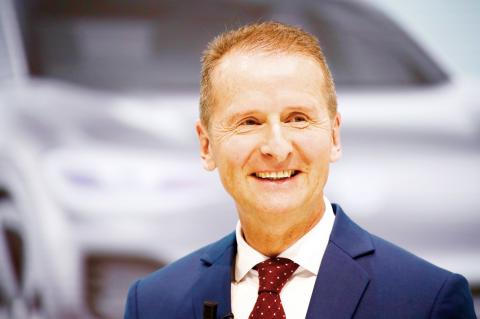
Photo: AFP
Diess, a former BMW AG executive, has had the difficult task of negotiating restructuring and cost-cutting with German worker representatives since becoming head of the Volkswagen brand in 2015.
Mueller, who formerly headed Porsche, unexpectedly took over as chief executive officer in September 2015 when Martin Winterkorn resigned over cars that had been rigged to cheat on emissions tests.
He led the Wolfsburg-based company through the aftermath of the scandal and turned in record sales and strong profits last year. The company sold 10.74 million vehicles and made 11.6 billion euros (US$14.3 billion) in profit.
Board chairman Hans Dieter Poetsch said Mueller, 64, had done “outstanding work” at a time when the company “faced the greatest challenge in its history.”
The new structure is to include three brand groups: volume products, premium and super premium. The company makes mass-market cars under the Volkswagen, SEAT and Skoda brands, luxury cars under the Audi nameplate and highly priced vehicles under the Lamborghini and Bentley brands.
The truck and bus division, the fourth business group, would be made ready for capital markets, a step that could include selling shares in the division, the statement said.
The company did not detail the fifth and sixth business divisions ahead of a news conference scheduled for 10:30am yesterday.
Diess is not only to head the management board, the top executive body at German companies that reports to the supervisory board, or board of directors; he is also to be in charge of vehicle development and research, as well as vehicle-related information technology.
The company made other changes in top posts.
Head of purchasing Francisco Javier Garcia Sanz is leaving at his own request and his post is to be filled on an acting basis by Volkswagen brand purchasing head Ralf Brandstaetter, the company said.
Human resources head Karlheinz Blessing is being replaced by Gunnar Kilian, until now an official with the company’s works council — or employee representatives — and Porsche sports car division head Oliver Blume is being promoted to the top management body of the entire group, Volkswagen said.
The company is controlled by the Piech and Porsche families, who hold 52 percent of the voting rights. Other big shareholders are the German state of Lower Saxony, where Volkswagen is headquartered, with 20 percent of the voting rights, and Qatar Holding with 17 percent.
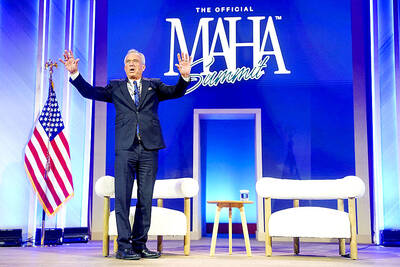
Sweeping policy changes under US Secretary of Health and Human Services Robert F. Kennedy Jr are having a chilling effect on vaccine makers as anti-vaccine rhetoric has turned into concrete changes in inoculation schedules and recommendations, investors and executives said. The administration of US President Donald Trump has in the past year upended vaccine recommendations, with the country last month ending its longstanding guidance that all children receive inoculations against flu, hepatitis A and other diseases. The unprecedented changes have led to diminished vaccine usage, hurt the investment case for some biotechs, and created a drag that would likely dent revenues and
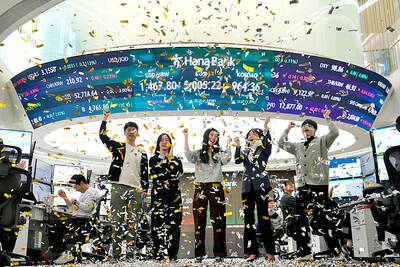
Global semiconductor stocks advanced yesterday, as comments by Nvidia Corp chief executive officer Jensen Huang (黃仁勳) at Davos, Switzerland, helped reinforce investor enthusiasm for artificial intelligence (AI). Samsung Electronics Co gained as much as 5 percent to an all-time high, helping drive South Korea’s benchmark KOSPI above 5,000 for the first time. That came after the Philadelphia Semiconductor Index rose more than 3 percent to a fresh record on Wednesday, with a boost from Nvidia. The gains came amid broad risk-on trade after US President Donald Trump withdrew his threat of tariffs on some European nations over backing for Greenland. Huang further
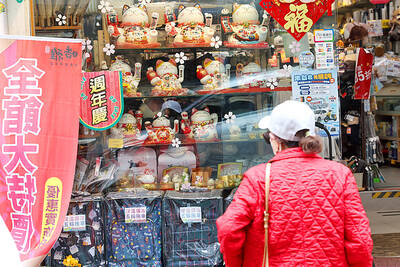
CULPRITS: Factors that affected the slip included falling global crude oil prices, wait-and-see consumer attitudes due to US tariffs and a different Lunar New Year holiday schedule Taiwan’s retail sales ended a nine-year growth streak last year, slipping 0.2 percent from a year earlier as uncertainty over US tariff policies affected demand for durable goods, data released on Friday by the Ministry of Economic Affairs showed. Last year’s retail sales totaled NT$4.84 trillion (US$153.27 billion), down about NT$9.5 billion, or 0.2 percent, from 2024. Despite the decline, the figure was still the second-highest annual sales total on record. Ministry statistics department deputy head Chen Yu-fang (陳玉芳) said sales of cars, motorcycles and related products, which accounted for 17.4 percent of total retail rales last year, fell NT$68.1 billion, or
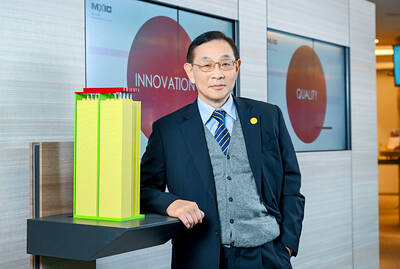
Macronix International Co (旺宏), the world’s biggest NOR flash memory supplier, yesterday said it would spend NT$22 billion (US$699.1 million) on capacity expansion this year to increase its production of mid-to-low-density memory chips as the world’s major memorychip suppliers are phasing out the market. The company said its planned capital expenditures are about 11 times higher than the NT$1.8 billion it spent on new facilities and equipment last year. A majority of this year’s outlay would be allocated to step up capacity of multi-level cell (MLC) NAND flash memory chips, which are used in embedded multimedia cards (eMMC), a managed


 RSS
RSS