


The Financial Supervisory Commission (FSC) yesterday downplayed the ramifications of Hon Hai Precision Industry Co’s (鴻海精密) decision to list a subsidiary on the Shanghai Stock Exchange and its speedy approval by Chinese regulators.
The China Securities Regulatory Commission on Sunday announced that it would begin reviewing the listing application of the subsidiary, Foxconn Industrial Internet Co (FII, 富士康工業互聯網).
However, the Chinese commission yesterday approved the application — less than 60 days after Hon Hai Precision’s shareholders in January gave the green light to the listing plan.
FII, with paid-in capital of 17.72 billion yuan (US$2.8 billion), is to hold its A-share initial public offering next month.
The company gained fast-track approval in China as part of Beijing’s plans to promote “unicorn” companies in new economy sectors, such as biotechnology, cloud computing, artificial intelligence and high-end manufacturing, the FSC said.
Beijing is not explicitly aiming to poach Taiwan’s top enterprises to its capital markets, the FSC said.
FII, which is registered in China, is not eligible to seek listing in Taiwan, it said, adding that as of the September quarter last year, it earnings represented only 0.5 percent of Hon Hai’s bottom line.
Under tight capital controls imposed by Beijing, Taiwanese subsidiaries based in China can reduce the strain on their parent companies by seeking funding from the Chinese capital market, the FSC said.
While the Chinese market is significantly larger and has more attractive price-to-earnings valuation, Taiwan’s market offers more transparency and lenient capital controls, it said.
The FSC said it has instructed the Taiwan Stock Exchange and the Taipei Exchange to seek opportunities in China and Southeast Asia, as well as to devise alternative listing standards for local businesses.
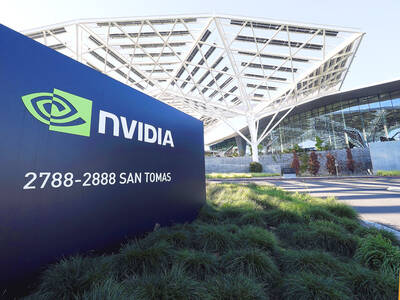
CHIP RACE: Three years of overbroad export controls drove foreign competitors to pursue their own AI chips, and ‘cost US taxpayers billions of dollars,’ Nvidia said China has figured out the US strategy for allowing it to buy Nvidia Corp’s H200s and is rejecting the artificial intelligence (AI) chip in favor of domestically developed semiconductors, White House AI adviser David Sacks said, citing news reports. US President Donald Trump on Monday said that he would allow shipments of Nvidia’s H200 chips to China, part of an administration effort backed by Sacks to challenge Chinese tech champions such as Huawei Technologies Co (華為) by bringing US competition to their home market. On Friday, Sacks signaled that he was uncertain about whether that approach would work. “They’re rejecting our chips,” Sacks

NATIONAL SECURITY: Intel’s testing of ACM tools despite US government control ‘highlights egregious gaps in US technology protection policies,’ a former official said Chipmaker Intel Corp has tested chipmaking tools this year from a toolmaker with deep roots in China and two overseas units that were targeted by US sanctions, according to two sources with direct knowledge of the matter. Intel, which fended off calls for its CEO’s resignation from US President Donald Trump in August over his alleged ties to China, got the tools from ACM Research Inc, a Fremont, California-based producer of chipmaking equipment. Two of ACM’s units, based in Shanghai and South Korea, were among a number of firms barred last year from receiving US technology over claims they have

It is challenging to build infrastructure in much of Europe. Constrained budgets and polarized politics tend to undermine long-term projects, forcing officials to react to emergencies rather than plan for the future. Not in Austria. Today, the country is to officially open its Koralmbahn tunnel, the 5.9 billion euro (US$6.9 billion) centerpiece of a groundbreaking new railway that will eventually run from Poland’s Baltic coast to the Adriatic Sea, transforming travel within Austria and positioning the Alpine nation at the forefront of logistics in Europe. “It is Austria’s biggest socio-economic experiment in over a century,” said Eric Kirschner, an economist at Graz-based Joanneum

BUBBLE? Only a handful of companies are seeing rapid revenue growth and higher valuations, and it is not enough to call the AI trend a transformation, an analyst said Artificial intelligence (AI) is entering a more challenging phase next year as companies move beyond experimentation and begin demanding clear financial returns from a technology that has delivered big gains to only a small group of early adopters, PricewaterhouseCoopers (PwC) Taiwan said yesterday. Most organizations have been able to justify AI investments through cost recovery or modest efficiency gains, but few have achieved meaningful revenue growth or long-term competitive advantage, the consultancy said in its 2026 AI Business Predictions report. This growing performance gap is forcing executives to reconsider how AI is deployed across their organizations, it said. “Many companies


 RSS
RSS