

The nation’s industrial production index last month rose a better-than-expected 10.86 percent annually to a record high of 115.98, driven mainly by demand for crytocurrency mining and automotive electronics, the Ministry of Economic Affairs said yesterday.
The result was more than double the ministry’s estimate of 5 percent annual growth and marked the ninth straight month of year-on-year expansion, it said.
The index reading of 115.98 represented the highest monthly performance since the ministry began collecting such data in 1953, it said.
“Thanks to the trending technological applications, including crytocurrency mining, the production activity of Taiwan’s semiconductor industry last month was even better than in December last year, despite it being the traditional slow season,” ministry Deputy Director-General Wang Shu-chuan (王淑娟) told a news conference in Taipei.
Inventory building demand ahead of the Lunar New Year holidays in the technology and traditional industries also lent support to last month’s performance, Wang said.
The electronic components sector, the pillar of the nation’s industrial production, climbed 10.28 percent year-on-year last month, as production of semiconductors and flat panels grew from the same period the previous year, the ministry’s report showed.
Production of computers and optical products increased 12.74 percent annually, the first time a double-digit percentage year-on-year growth had been recorded in the past one year, the report showed.
Wang attributed the expansion to the surging production of smartphone casings, smartphone cameras and computer cooling fans that offset a continued weakness in a domestic smartphone company’s handset production.
The automobile and automotive components industry recorded strong production, with 17.25 percent annual growth last month, driven by the increasing repair and maintenance orders caused by heavy snowfalls and stormy weather in North America, Wang said.
The production of chemicals and basic metals grew 1.32 percent and 6.15 percent year-on-year respectively, while machinery goods were boosted 22.94 percent annually on the continued recovery of the global economy, which benefited production activity in traditional industry, Wang said.
In related news, the ministry said wholesale revenue added 10 percent to a record monthly high of NT$882.9 billion (US$30.14 billion) last month, supported by inventory building demand ahead of the Lunar New Year holidays.
However, revenue in the retail sector and restaurant and beverages sector contracted by 4.4 percent and 12.1 percent annually to NT$362.3 billion and NT$37.9 billion respectively last month, due to a higher comparison base because Lunar New Year shopping demand was in January last year, Wang said.
After factoring in the Lunar New Year, the combined revenue of the retail sector and restaurant and beverages sector in the first two months of this year is expected to grow from the same period last year, as domestic demand shows steady expansion, Wang said.
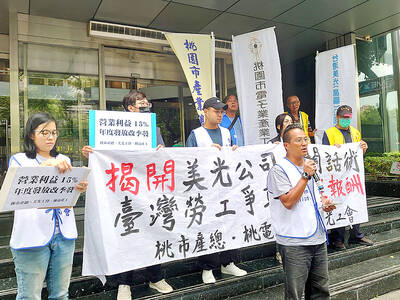
UNION DETERMINATION: Rejecting an offer for a one-time payout as an attempt to influence opinion, the union said a strike at the memory chip manufacturer is possible The Micron Taiwan workers’ union yesterday rejected a one-time payout unveiled by US-based Micron Technology Inc last week, saying it wants a long-term mechanism under which employees would share 15 percent of the company’s operating profits. While the union and the company are still in talks over the dispute, the reward package was proposed unilaterally by the employer without reaching an agreement with the union, union head Jerry Lin (林哲瑞) told reporters. Lin said he suspected the company was seeking to influence public opinion with the move. On Friday last week, Micron announced a reward package under which employees in Taiwan would receive
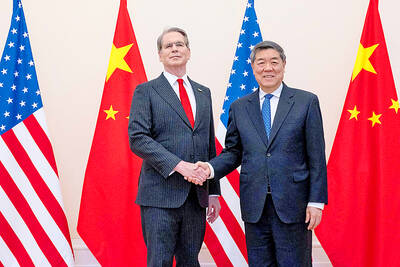
MINIMAL EXPECTATIONS: Analysts think that the two sides are likely to aim for ‘status quo’-level agreements, maintaining civility, without major trade breakthroughs US Secretary of the Treasury Scott Bessent and Chinese Vice Premier He Lifeng (何立峰) were set to meet yesterday to try to set up potential agreements on artificial intelligence (AI), tariffs and critical minerals for a summit in Washington this week between US President Donald Trump and Chinese President Xi Jinping (習近平). The meetings at JPMorgan Chase & Co’s headquarters in Manhattan, which included US Trade Representative Jamieson Greer, were due to start at about 10:30am on Sunday morning and were expected to run all day. Key topics would be the status of a US-China trade truce that is set to expire
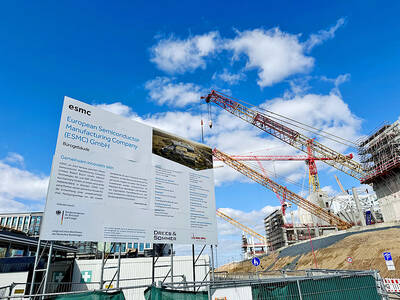
BUILDER’s RITES: The topping out ceremony is held when a project being built has its highest point laid out, a sure sign that TSMC’s European project is making solid progress A “topping out” ceremony was held on Monday at a plant under construction in Germany by Taiwan Semiconductor Manufacturing Co (TSMC, 台積電), indicating that the fab is progressing as planned and within budget, the head of a joint-venture company in charge of the project said. A topping out ceremony is the construction milestone of laying the final beam or structural piece at the highest point of a building, and it honors the construction crew, architects and engineers. European Semiconductor Manufacturing Co (ESMC) president Christian Koitzsch said that about 2,000 workers from 106 countries are working around the clock at the site in

APPEAL: Any agreement to produce advanced memory such as HBM or DRAM could run into opposition from Seoul as those technologies are sensitive, sources said South Korea’s SK Hynix Inc is in talks with Intel Corp about a deal that would see it manufacture memory chips on US soil for the first time, three people familiar with the discussions said. Under one potential scenario, SK Hynix would lease part of Intel’s long-planned chipmaking facility in Ohio, they said. Under another scenario, it could form a venture with Intel and major cloud firms that are keen to lock in memory supplies, two of the people said. A deal would relieve pressure on Intel, which has been struggling, and mark a big win for US President Donald


 RSS
RSS