


Audio electronics maker Merry Electronics Co (美律) yesterday said revenue would drop drastically this quarter as demand freezes due to the consumer electronics sector entering a slow season.
The seasonal weakness will take a heavy toll on headsets for entertainment devices and speakers for mobile phones, the two biggest revenue sources for Merry, in the first three months of this year, company spokesman Allen Huang (黃朝豊) told investors in Taipei.
“Revenue will hit the bottom in February,” he said. “First-quarter revenue will be flat, or slightly lower than in the same period last year.”
Merry posted NT$4.52 billion (US$154.64 million) in revenue for the first quarter of last year.
Huang did not provide a detailed revenue forecast.
Capital Investment Management Corp (群益投顧) early this month projected that Merry would see revenue tumble 33.19 percent to NT$6.88 billion this quarter, compared with last quarter’s NT$10.21 billion.
As revenue scale shrinks, gross margin will dwindle this quarter as well, Huang said.
Gross margin last quarter stood at 16.1 percent, a company financial statement showed.
Huang said he expects handset speakers to contribute greater growth to the company this year than last year.
However, headsets used in entertainment devices will grow at a slower pace of about 10 percent annually following rapid increases of 80 percent last year and 60 percent in 2016, he said.
Merry supplies entertainment headsets, handset speakers, battery packs and hands-free devices to clients such as Apple Inc, Sony Corp, Bose Corp, Logitech Co and Beats Electronics LLC.
Merry shares rose to NT$192, their highest level in about two months, after a 6.67 percent rally yesterday.
The firm’s board on Monday approved a cash dividend distribution of NT$16.442 per common share, representing a payout ratio of 86.81 percent.
Net profit last year jumped to a record-high NT$3.62 billion, or NT$18.94 per share, company data showed.
Merry on Monday announced two merger-and-acquisition deals to step up its expansion into hearing aids and “smart” speakers.
The smart speaker market is expected to enjoy an annual compound growth rate of 35 percent to US$10.2 billion in the 2017-2020 period, Huang said, citing a CITIC CLSA Ltd forecast.
Merry plans to invest 61.6 million yuan (US$9.8 million) to acquire an 82.5 percent stake in China’s largest hearing aid supplier, Austar Hearing Science and Technology (Xiamen) Co Ltd (歐仕達聽力科技廈門), through its subsidiaries, Huang told a media briefing on Monday.
In addition to China, the acquisition of Austar will help Merry quickly enter the US and other markets abroad, as the US Food and Drug Administration has lowered the threshold by adding the new, separate category of over-the-counter wearable hearing aids for adults with mild to moderate hearing loss, allowing the purchase of such devices from a retailer or online, Merry said.
Austar designs and makes hearing aids and sells its branded hearing aids through its own sales channel, Huang said.
Merry also plans to invest US$45.8 million to fully take over Sonavox Group’s Suzhou, China-based subsidiary, Sonavox Canada Inc and Seas Fabrikker.
Sonavox develops and manufactures premium speakers.


The domestic unit of the Chinese-owned, Dutch-headquartered chipmaker Nexperia BV will soon be able to produce semiconductors locally within China, according to two company sources. Nexperia is at the center of a global tug-of-war over critical semiconductor technology, with a Dutch court in February ordering a probe into alleged mismanagement at the company. The geopolitical tussle has disrupted supply chains, with some carmakers reportedly forced to cut production due to chip shortages. Local production would allow Nexperia’s domestic arm, Nexperia Semiconductors (China) Ltd (安世半導體中國), to bypass restrictions in place since October on the supply of silicon wafers — etched with tiny components to
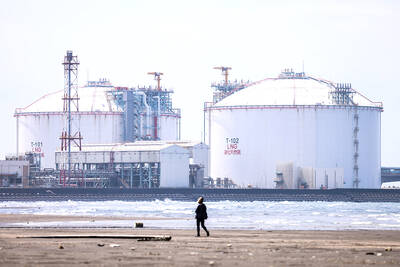
Taiwan is open to joining a global liquefied natural gas (LNG) program if one is created, but on the condition that countries provide delivery even in a scenario where there is a conflict with China, an energy department official said yesterday. While Taiwan’s priority is to have enough LNG at home, the nation is open to exploring potential strategic reserves in other countries such as Japan or South Korea, Energy Administration Deputy Director-General Chen Chung-hsien (陳崇憲) said. While the LNG market does not have a global reserve for emergencies like that of oil, the concept has been raised a few times —

Taiwan Semiconductor Manufacturing Co (TSMC, 台積電) yesterday received government approval to deploy its advanced 3-nanometer (3nm) process at its second fab currently under construction in Japan, the Ministry of Economic Affairs said in a news release. The ministry green-lit the plan for the facility in Kumamoto, which is scheduled to start installing equipment and come online in 2028 with a monthly production capacity of 15,000 12-inch wafers, the ministry said. The Department of Investment Review in June 2024 authorized a US$5.26 billion investment for the facility, slated to manufacture 6- to 12nm chips, significantly less advanced than 3nm process. At a meeting with
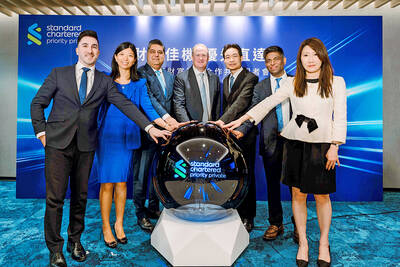
Standard Chartered Taiwan on March 26 announced that it has partnered with international fintech firm FinIQ to build an “Automated Structured Products Pricing Platform.” The bank is also introducing products from global issuers including Goldman Sachs Group Inc, Barclays PLC and BNP Paribas SA. The new platform enables an end-to-end process whereby it finds the most competitive pricing across multiple issuers in a matter of minutes, followed by automated documentation and transaction execution, which significantly shortens time-to-market and delivers a superior wealth management experience. Standard Chartered Bank Taiwan CEO Anthony Yu (游天立) said: “Standard Chartered is increasingly leveraging its wealth management


 RSS
RSS