


The TAIEX yesterday rallied 2.81 percent, or 293.35 points, to close at 10,714.44, as investors rebuilt their positions to catch up with gains on Wall Street over the Lunar New Year holiday, traders said.
The Dow Jones industrial average picked up more than 700 points during the Lunar New Year break in Taiwan, despite a 254-point drop on Tuesday after disappointing earnings results from major US corporations, while pressure over interest rate hikes escalated.
“The rebound in the TAIEX might be sustainable as the global economy improves, although uncertainty over capital movements and a potential market correction remains,” Yuanta Securities Investment Consulting Co (元大投顧) senior manager Lee Cheng-yen (李政諺) said.
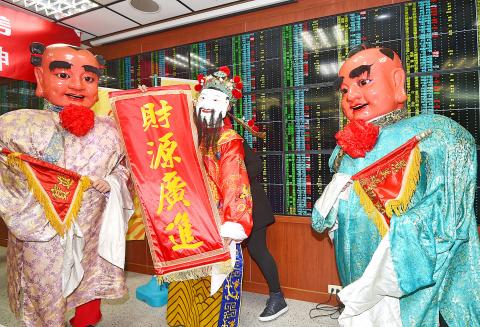
Photo: Fang Pin-chao, Taipei Times
Yields on US 10-year bonds rose to 2.87 percent last week, driving fund managers to slash investment-grade corporate debts by US$2 billion and emerging market debts by US$2.9 billion, the worst capital flight in 60 and 64 weeks respectively, JPMorgan Asset Management Taiwan said.
Unease is gathering strength amid worries that the US Federal Reserve might raise borrowing costs more quickly this year after US consumer prices climbed more than expected last month, which could be read as signs the US economy is overheating, the US fund house said.
Monetary tightening moves would suggest less funds available for equity markets across the world.
However, foreign institutional players increased holdings in local shares by a net NT$9.21 billion (US$314.9 million) yesterday, while mutual funds and proprietary traders recorded net purchases of NT$473.47 million and NT$82.98 billion, Taiwan Stock Exchange data showed.
Turnover rose to NT$145.13 billion, a 36 percent increase from NT$106.59 billion on Monday last week, the last trading day before the holiday break, according to the Taiwan Stock Exchange (TWSE).
The TAIEX is likely to consolidate between 10,500 and 10,800 points, with a positive bias in the short term, Yuanta Securities said.
Technology shares led yesterday’s rebound, with optical plays seeing the biggest advance of 5.26 percent.
Shares of Largan Precision Co (大立光), which supplies camera lenses for international smartphone brands, ended up 7.34 percent at NT$3,950, while Taiwan Semiconductor Manufacturing Co (台積電), the world’s largest contract chipmaker, gained 2.54 percent to NT$242.50, TWSE data showed.
The food sector picked up 3.89 percent, with shares of food and retail conglomerate Uni-President Enterprises Corp (統一企業) rising 5.65 percent to NT$69.20 and shares of Wei Chuan Foods Corp (味全食品) advancing 3.02 percent to NT$22.20, data showed.
Food makers usually benefit from a surge in business over the holiday.

In Italy’s storied gold-making hubs, jewelers are reworking their designs to trim gold content as they race to blunt the effect of record prices and appeal to shoppers watching their budgets. Gold prices hit a record high on Thursday, surging near US$5,600 an ounce, more than double a year ago as geopolitical concerns and jitters over trade pushed investors toward the safe-haven asset. The rally is putting undue pressure on small artisans as they face mounting demands from customers, including international brands, to produce cheaper items, from signature pieces to wedding rings, according to interviews with four independent jewelers in Italy’s main

Japanese Prime Minister Sanae Takaichi has talked up the benefits of a weaker yen in a campaign speech, adopting a tone at odds with her finance ministry, which has refused to rule out any options to counter excessive foreign exchange volatility. Takaichi later softened her stance, saying she did not have a preference for the yen’s direction. “People say the weak yen is bad right now, but for export industries, it’s a major opportunity,” Takaichi said on Saturday at a rally for Liberal Democratic Party candidate Daishiro Yamagiwa in Kanagawa Prefecture ahead of a snap election on Sunday. “Whether it’s selling food or

CONCERNS: Tech companies investing in AI businesses that purchase their products have raised questions among investors that they are artificially propping up demand Nvidia Corp chief executive officer Jensen Huang (黃仁勳) on Saturday said that the company would be participating in OpenAI’s latest funding round, describing it as potentially “the largest investment we’ve ever made.” “We will invest a great deal of money,” Huang told reporters while visiting Taipei. “I believe in OpenAI. The work that they do is incredible. They’re one of the most consequential companies of our time.” Huang did not say exactly how much Nvidia might contribute, but described the investment as “huge.” “Let Sam announce how much he’s going to raise — it’s for him to decide,” Huang said, referring to OpenAI
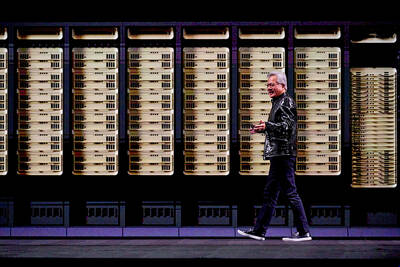
The global server market is expected to grow 12.8 percent annually this year, with artificial intelligence (AI) servers projected to account for 16.5 percent, driven by continued investment in AI infrastructure by major cloud service providers (CSPs), market researcher TrendForce Corp (集邦科技) said yesterday. Global AI server shipments this year are expected to increase 28 percent year-on-year to more than 2.7 million units, driven by sustained demand from CSPs and government sovereign cloud projects, TrendForce analyst Frank Kung (龔明德) told the Taipei Times. Demand for GPU-based AI servers, including Nvidia Corp’s GB and Vera Rubin rack systems, is expected to remain high,


 RSS
RSS