


Germany’s powerful metalworking union IG Metall on Tuesday agreed with bosses on a new right to switch temporarily to a 28-hour workweek.
Could the example from Europe’s largest economy — often a trailblazer in labor relations — be echoed by other countries?
As well as a pay rise, metalworkers in prosperous southwestern Baden-Wuerttemberg state agreed with bosses that they can in the future temporarily switch to shorter hours.
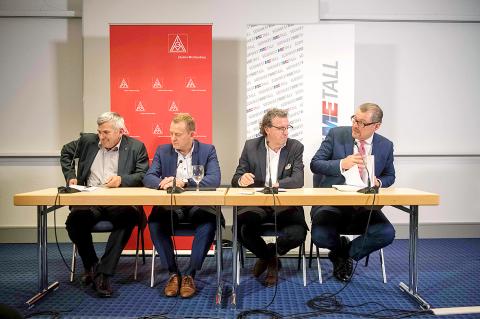
Photo: AFP
Part-time working is not a new concept in German labor law, but it is the first time employers will not have a veto, even if they fear it will disrupt business.
Employees would switch from a 35-hour limit to 28 hours per week for up to two years before a return to full-time work.
Until now, those switching temporarily to shorter hours have enjoyed no guarantee they could reclaim their full-time post.
Their salary will fall in line with the shorter number of hours, but some beneficiaries, such as young parents, those caring for elderly relatives or people doing shift work, will be able to take more paid holidays.
Baden-Wuerttemberg’s deal is likely to be extended to the rest of Germany, as the state is often used as a test case by employers and unions.
Germany is basking in a period of high growth, unemployment at a historic low of 5.4 percent last month and a shortage of skilled labor, meaning workers could bring maximalist demands to talks with employers.
However, the deal “is not transplantable to France,” where unemployment is close to double its neighbor’s rate, despite accelerating growth, employers’ association Mouvement des Entreprises de France president Pierre Gattaz said.
With unemployment at 8.7 percent across the 19-nation eurozone — and almost 18 percent among under-25s — the same pressure on wages does not exist elsewhere, analysts have said.
“Germany is the only one of the big countries where total slack in the labor market has fallen well below the precrisis levels of 2007-2008,” ABN AMRO Bank NV economist Aline Schulling said.
“Germany can afford pay rises,” European Trade Union Confederation deputy general secretary Peter Scherrer said.
However, the deal “encourages workers and trade unions to organize for a fairer deal in all EU countries,” he added.
“This agreement should inspire pay rises and better working time conditions, not only across Germany, but in companies across Europe,” Scherrer said.
IG Metall reportedly has almost 2.3 million members, making it Europe’s largest trade union.
It negotiates the employment rules for as many as 3.9 million workers in sectors ranging from engineering to textile manufacturing and car production.
In Germany, the deals it strikes with bosses usually set the tone for labor relations in other parts of the economy, especially public-sector employees.
The union has long broken new ground in Europe, striking in 1982 for a 35-hour workweek for the first time using the slogan: “More time to live, love and laugh.”
It took until 1995 to wring a 35-hour deal out of bosses, but Germans were still five years ahead of France’s adoption of a shorter week.
IG Metall has also adapted its demands to the changing work-life balance of the digital economy, clinching a deal with Volkswagen AG in 2011 to ban e-mail outside of office hours.
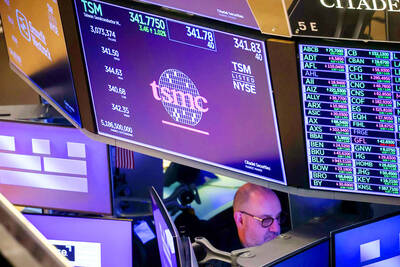
STRONG INTEREST: Analysts have pointed to optimism in TSMC’s growth prospects in the artificial intelligence era as the cause of the rising number of shareholders The number of people holding shares of chipmaker Taiwan Semiconductor Manufacturing Co (TSMC, 台積電) hit a new high last week despite a decline in its stock price, the Taiwan Depository and Clearing Corp (TDCC, 台灣集保) said. The number of TSMC shareholders rose to 2.46 million as of Friday, up 75,536 from a week earlier, TDCC data showed. The stock price fell 1.34 percent during the same week to close at NT$1,840 (US$57.55). The decline in TSMC’s share price resulted from volatility in global tech stocks, driven by rising international crude oil prices as the war against Iran continues. Dealers said
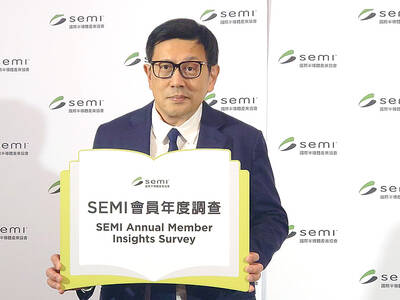
PRICE HIKES: The war in the Middle East would not significantly disrupt supply in the short term, but semiconductor companies are facing price surges for materials Taiwan’s semiconductor companies are not facing imminent supply disruptions of essential chemicals or raw materials due to the war in the Middle East, but surges in material costs loom large, industry association SEMI Taiwan said yesterday. The association’s comments came amid growing concerns that supplies of helium and other key raw materials used in semiconductor production could become a choke point after Qatar shut down its liquefied natural gas (LNG) production and helium output earlier this month due to the conflict. Qatar is the second-largest LNG supplier in the world and accounts for about 33 percent of global helium output. Helium is
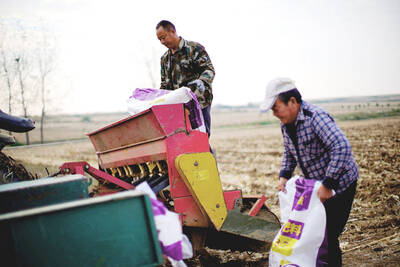
China is clamping down on fertilizer exports to protect its domestic market, industry sources said, putting an additional strain on global markets that were already grappling with shortages caused by the US-Israeli war on Iran. China is among the largest fertilizer exporters — shipping more than US$13 billion of it last year — and it has a history of controlling exports to keep prices low for farmers. Shipments through the war-blocked Strait of Hormuz account for about one-third of the sea-borne supply. This month, Beijing banned exports of nitrogen-potassium fertilizer blends and certain phosphate varieties, sources said. The ban, which has not
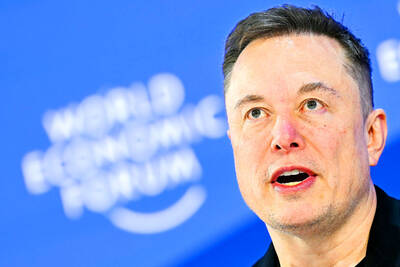
AMAZING ABUNDANCE: Elon Musk has announced plans for a new facility in Texas which would manufacture chips for Tesla and SpaceX to use in robotics and AI Elon Musk said his Terafab project — a grand plan to eventually manufacture his own chips for robotics, artificial intelligence (AI) and space data centers — would be built in Austin and jointly run by Tesla Inc and Space Exploration Technologies Corp (SpaceX). Musk, the chief executive officer of the two companies, said he would start off with an “advanced technology fab” in Austin that would have all of the equipment necessary to make chips of any kind. The project would call for one day supporting 1 terawatt (TW) of computing power per year, the amount Musk expects the companies to


 RSS
RSS