


Taiwan’s manufacturing purchasing managers’ index (PMI) rose to 58 last month from 57.2 a month earlier, as demand for all product categories remained strong amid global economic improvement, the Chung-Hua Institution for Economic Research (CIER, 中華經濟研究院) said yesterday.
The economic barometer has expanded for 22 straight months and could expand further without signs of a turnaround on the horizon, with the exception of seasonal disruptions during the Lunar New Year holidays, the Taipei-based think tank said.
“The healthy PMI reading came despite sales of Apple Inc’s latest iPhone series proving weaker than expected, thanks to a more diversified portfolio among local manufacturers,” CIER president Wu Chung-shu (吳中書) told a news conference.
PMI figures seek to capture the pulse of local manufacturers, which play a critical role in Taiwan’s export-oriented economy, with values above 50 suggesting expansion and below indicating contraction.
In the past, Taiwanese buyers have had to wait for weeks for the latest iPhone gadgets, but no wait is necessary for the iPhone X or iPhone 8 models, indicating a slowdown in sales worldwide, Wu said.
Taiwan is home to suppliers of iPhone chips, camera lenses, casings and other critical components, as well as assemblers.
Lackluster sales accounted for a slump in shares of local suppliers, such as Largan Precision Co (大立光) and Hon Hai Precision Industry Co (鴻海精密), after Apple reportedly cut orders by 30 to 40 percent, Supply Management Institute in Taiwan (中華採購與供應管理協會) executive director Steve Lai (賴樹鑫) said.
Sales could deteriorate further after Apple admitted to slowing down the performance of older iPhone models to force upgrades, a move that could alienate users, Lai said.
“The trend demands close attention,” Lai said, as Apple suppliers make up a significant share of the local economy.
The sub-index of new orders advanced from 57.2 to 58.1 last month, while the output measure grew from 57.7 to 62.3, a CIER report showed.
Export orders rose marginally to 55.6, while headcount levels held virtually steady at 54.3, the report found.
Firms generally maintained low inventory with the sub-index standing at 45.2 to avoid unnecessary production costs, the CIER said.
The practice reflects a lack of management skills and confidence, although firms are upbeat about their business prospects in light of the six-month outlook gauge that showed 58.8, Wu and Lai said.
Non-manufacturing firms also reported a pickup in business activity with the non-manufacturing index holding firm at 53.3 last month, compared with 53.4 a month earlier.
Taiwan Semiconductor Manufacturing Co (TSMC, 台積電) yesterday reported record revenue of NT$416.975 billion (US$13.17 billion) for last month, putting the world’s largest contract chipmaker on track to set a record for quarterly revenue. Last month’s figure surpassed March’s record NT$415.19 billion and represented increases of 1.5 percent from April and 30.1 percent from a year earlier. For the first five months of the year, TSMC generated NT$1.96 trillion in revenue, up 30 percent year-on-year, it said in a statement. TSMC has forecast second-quarter revenue of between US$39 billion and US$40.2 billion, representing sequential growth of about 10 percent and year-on-year growth of about
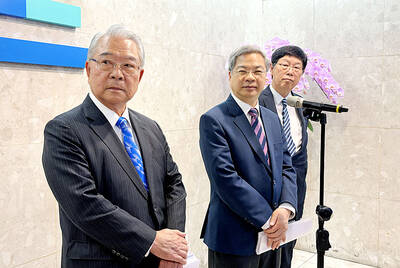
PATENT PROBE: US lawmakers called for a ban on imports of chips made by TSMC if they are found to infringe on US patents, with a preliminary ruling expected soon Minister of Economic Affairs Kung Ming-hsin (龔明鑫) yesterday expressed confidence in Taiwan Semiconductor Manufacturing Co’s (TSMC, 台積電) compliance with patent regulations after reports linked the company to a patent infringement lawsuit in the US. US Representative Ryan Zinke, and US senators Tim Sheehy, Roger Marshall and Bernie Moreno urged the US International Trade Commission in a May 22 letter to ban imports of chips made by TSMC if they are found to infringe on US patents, Axios reported on Wednesday. An administrative law judge is expected to issue a preliminary ruling this month, with the commission potentially making a final decision in

Infineon Technologies AG is preparing to open its largest single investment, a 5 billion euro (US$5.8 billion) semiconductor factory built with the help of EU subsidies, as the bloc seeks to boost chip production. The power chip fab, which is an extension of the German company’s Dresden campus, is scheduled to open on July 2, Infineon chief operating officer Alexander Gorski said this week at the site. The project is a major recipient of EU Chips Act funds, receiving about 1 billion euros in subsidies. The new plant represents a rare success for the bloc’s flagship semiconductor law, which was drawn up during

Taiwanese authorities are considering much stricter export controls on artificial intelligence (AI) chip sales to China to further align with US measures, according to people familiar with the matter, an effort to address semiconductor smuggling that risks drawing a rebuke from Beijing. The idea is to give authorities more legal tools to address diversion of advanced hardware, like AI servers with Nvidia Corp chips, from Taiwan to China. Such sales are already banned under US regulations unless companies get Washington’s permission, per curbs the US first imposed in 2022 to prevent Beijing from using advanced Nvidia processors to gain a military


 RSS
RSS