


The nation’s unemployment rate stood at 3.75 percent last month, down 0.02 percentage points from September and the lowest level for October in 17 years, the Directorate-General of Budget, Accounting and Statistics (DGBAS) said yesterday.
Firms in service sectors might also hire more staffers ahead of the holiday season next month, lending support to the job market, it said.
“The job market is better this year compared with the same time last year due to continued economic improvement,” DGBAS Deputy Director Pan Ning-hsin (潘寧馨) told a media briefing.
Taiwan’s GDP increased by 3.11 percent in the third quarter, better than forecasts by research institutes at home and abroad, DGBAS said.
The increase was due to strong inventory demand for electronic components used in smartphones, personal computers, connected vehicles and Internet of Things devices, it said.
It is expected to pick up further ahead of the Christmas and Lunar New Year holidays, officials said.
The third-quarter showing might allow the agency to raise GDP growth for this year when it issues its update it tomorrow.
After seasonal adjustments, the unemployment rate was 3.69 percent, also down 0.02 percentage points from a month earlier, yesterday’s report showed.
That means a decline of 2,000 to reach a total of 443,000 unemployed people, the agency said.
Among them, the number of first-time jobseekers dropped by 3,000 and people who lost jobs to business downsizing or closures fell by 2,000.
However, people who quit their jobs increased by 2,000 and people who lost jobs because of temporary hiring and seasonal reasons increased by 1,000, the report said.
People with a university degree had the highest unemployment rate of 5.2 percent, followed by people with a high-school qualification at 3.7 percent. People with a graduate education had an unemployment rate of 2.88 percent, it said.
The unemployment rate was highest at 12.33 percent among people aged 20 to 24, followed by the 15 to 19 age group at 8.03 percent, and 6.55 percent for those between 25 and 29, it said.
For the first 10 months of this year, the unemployment rate averaged 3.77 percent, down 0.17 percentage points from the same period last year, the report said.
The economic improvement allowed firms to raise wages modestly for employees in September, compared with last year.
Total monthly wages including overtime pay, bonuses and other compensation averaged NT$45,814 in September, while monthly take-home pay stood at NT$40,116, the DGBAS said in a separate report.
That represents increases of 1.35 percent and 2.51 percent respectively from a year earlier.
For the first nine months, take-home pay averaged NT$39,829 per month, an increase of 1.75 percent from the same period last year, it said, adding that the real gain is 1.06 percent after factoring in the 0.69 percent inflation.
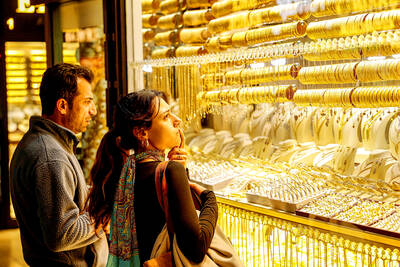
In Italy’s storied gold-making hubs, jewelers are reworking their designs to trim gold content as they race to blunt the effect of record prices and appeal to shoppers watching their budgets. Gold prices hit a record high on Thursday, surging near US$5,600 an ounce, more than double a year ago as geopolitical concerns and jitters over trade pushed investors toward the safe-haven asset. The rally is putting undue pressure on small artisans as they face mounting demands from customers, including international brands, to produce cheaper items, from signature pieces to wedding rings, according to interviews with four independent jewelers in Italy’s main

Japanese Prime Minister Sanae Takaichi has talked up the benefits of a weaker yen in a campaign speech, adopting a tone at odds with her finance ministry, which has refused to rule out any options to counter excessive foreign exchange volatility. Takaichi later softened her stance, saying she did not have a preference for the yen’s direction. “People say the weak yen is bad right now, but for export industries, it’s a major opportunity,” Takaichi said on Saturday at a rally for Liberal Democratic Party candidate Daishiro Yamagiwa in Kanagawa Prefecture ahead of a snap election on Sunday. “Whether it’s selling food or

CONCERNS: Tech companies investing in AI businesses that purchase their products have raised questions among investors that they are artificially propping up demand Nvidia Corp chief executive officer Jensen Huang (黃仁勳) on Saturday said that the company would be participating in OpenAI’s latest funding round, describing it as potentially “the largest investment we’ve ever made.” “We will invest a great deal of money,” Huang told reporters while visiting Taipei. “I believe in OpenAI. The work that they do is incredible. They’re one of the most consequential companies of our time.” Huang did not say exactly how much Nvidia might contribute, but described the investment as “huge.” “Let Sam announce how much he’s going to raise — it’s for him to decide,” Huang said, referring to OpenAI

The global server market is expected to grow 12.8 percent annually this year, with artificial intelligence (AI) servers projected to account for 16.5 percent, driven by continued investment in AI infrastructure by major cloud service providers (CSPs), market researcher TrendForce Corp (集邦科技) said yesterday. Global AI server shipments this year are expected to increase 28 percent year-on-year to more than 2.7 million units, driven by sustained demand from CSPs and government sovereign cloud projects, TrendForce analyst Frank Kung (龔明德) told the Taipei Times. Demand for GPU-based AI servers, including Nvidia Corp’s GB and Vera Rubin rack systems, is expected to remain high,


 RSS
RSS