


Phison Electronics Corp (群聯電子), a designer of NAND flash memory controllers and modules, yesterday said it is prepared to counter a potential hostile takeover and vulture investors’ attacks on its stock price.
Phison shares have over the past three months sunk more than 20 percent to NT$330.5 yesterday, valuing the company at NT$65.11 billion (US$2.17 billion) and exposing it as vulnerable to a takeover.
“We have found abnormal trading of the company’s stock over the past months. We are worried about a possible hostile takeover or an attack by vulture investors,” Phison founding chairman Pua Khein-seng (潘健成) told a media briefing.
“It would be costly to launch a hostile takeover of the company,” Pua added.
The company’s fundamentals are healthy, as Phison’s revenue and net profits have hit record highs over the past few quarters, he said.
The company’s cumulative profit in the first three quarters surged 35 percent to NT$4.55 billion, or NT$22.69 per share, from NT$3.37 billion, or NT$17.18 per share, over the same period last year.
Short-selling investors sell stock they do not hold in the expectation that the cost is likely to fall due to weak fundamentals.
“We are optimistic about next year’s outlook as we have built three major growth pillars — flash memory controllers, industrial flash memory modules and chips for consumer electronics,” Pua said.
To deter a potential buyout, Phison might consider issuing the 20 million new shares that shareholders approved in June to increase the cost, Pua said.
Phison has a strong investor structure, given that its managers and strategic partners — including Toshiba Corp and Kingston Technology Co (金士頓) — hold about 30 percent of the firm, Pua said.
Phison might also consider convening an extraordinary shareholders’ meeting to force short-selling investors to buy back shares and return them to the brokerages from which they were borrowed, he said.
The last resort would be launching a share buyback program to safeguard shareholders’ interests, Pua said, adding that the company plans to allocate NT$3 billion to a share repurchase plan if the abnormal trading becomes exacerbated.
Pua also said allegations that he violated the Securities Exchange Act (證券交易法) should not affect the company’s operations.
Pua and others were questioned by the Hsinchu District Prosecutors’ Office over allegations of embezzlement through transactions between Phison and its subsidiaries, and filing of inaccurate corporate financial statements between 2009 and 2014.
After a year-long investigation, prosecutors did not charge Pua, as they determined that he did not benefit from the transactions.
However, the Taiwan High Prosecutors’ Office ordered investigators to re-examine the case due to insufficient information.

In Italy’s storied gold-making hubs, jewelers are reworking their designs to trim gold content as they race to blunt the effect of record prices and appeal to shoppers watching their budgets. Gold prices hit a record high on Thursday, surging near US$5,600 an ounce, more than double a year ago as geopolitical concerns and jitters over trade pushed investors toward the safe-haven asset. The rally is putting undue pressure on small artisans as they face mounting demands from customers, including international brands, to produce cheaper items, from signature pieces to wedding rings, according to interviews with four independent jewelers in Italy’s main

Japanese Prime Minister Sanae Takaichi has talked up the benefits of a weaker yen in a campaign speech, adopting a tone at odds with her finance ministry, which has refused to rule out any options to counter excessive foreign exchange volatility. Takaichi later softened her stance, saying she did not have a preference for the yen’s direction. “People say the weak yen is bad right now, but for export industries, it’s a major opportunity,” Takaichi said on Saturday at a rally for Liberal Democratic Party candidate Daishiro Yamagiwa in Kanagawa Prefecture ahead of a snap election on Sunday. “Whether it’s selling food or

CONCERNS: Tech companies investing in AI businesses that purchase their products have raised questions among investors that they are artificially propping up demand Nvidia Corp chief executive officer Jensen Huang (黃仁勳) on Saturday said that the company would be participating in OpenAI’s latest funding round, describing it as potentially “the largest investment we’ve ever made.” “We will invest a great deal of money,” Huang told reporters while visiting Taipei. “I believe in OpenAI. The work that they do is incredible. They’re one of the most consequential companies of our time.” Huang did not say exactly how much Nvidia might contribute, but described the investment as “huge.” “Let Sam announce how much he’s going to raise — it’s for him to decide,” Huang said, referring to OpenAI
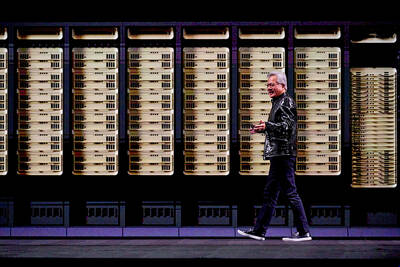
The global server market is expected to grow 12.8 percent annually this year, with artificial intelligence (AI) servers projected to account for 16.5 percent, driven by continued investment in AI infrastructure by major cloud service providers (CSPs), market researcher TrendForce Corp (集邦科技) said yesterday. Global AI server shipments this year are expected to increase 28 percent year-on-year to more than 2.7 million units, driven by sustained demand from CSPs and government sovereign cloud projects, TrendForce analyst Frank Kung (龔明德) told the Taipei Times. Demand for GPU-based AI servers, including Nvidia Corp’s GB and Vera Rubin rack systems, is expected to remain high,


 RSS
RSS