


Apple Inc is grateful to Taiwan Semiconductor Manufacturing Co’s (TSMC, 台積電) capital investment of US$9 billion in the Taiwanese firm’s first initiative with Apple to supply all the processors used in iPhones and iPads, Apple chief operating officer Jeff Williams said yesterday.
Williams made the remarks at a panel discussion in Taipei organized by TSMC as part of a series of activities celebrating the 30th anniversary of the foundation of the world’s biggest contract chipmaker.
Williams did not specify which iPhone he was referring to.
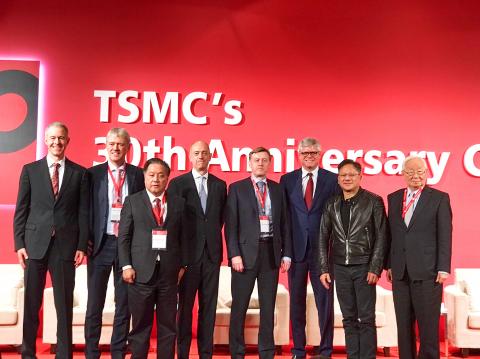
Photo: Hung You-fang, Taipei Times
“TSMC invested US$9 billion and had 6,000 people working around the clock to bring up the Tainan fab in just 11 months, and in the end, the execution was flawless,” Williams said. “Companies in the world spent US$9 billion in capital across everything, not a single bet.”
In that short period of time, Apple and TSMC together shipped more than 500 million chips, Williams said.
However, the first seed of the partnership between Apple and TSMC was planted in 2010, the Apple executive said.
TSMC’s leading technology position and its long-term strategy of being the trusted capacity supplier for semiconductor companies helped it secure the first orders from Apple, beating rival Samsung Electronics Co.
“We want leading-edge technology, but we want it at established technology kind of volume,” Williams said. “And what seems obvious right now wasn’t then because the risk was very substantial.”
For TSMC, it was a huge capital investment and meant ramping up production faster than the industry is used to, Williams said. “But, together, we decided to take the bet... Apple decided to have 100 percent of our new iPhone and new iPad application processors sourced to TSMC.”
TSMC chairman Morris Chang (張忠謀) said the company’s partnership with Apple has been intense and is important, even though it did not go back very far.
TSMC is still the sole chip supplier for Apple’s latest A11 Bionic chip used in the latest iPhones.
To produce and develop advanced process technologies such as 7-nanometer and 5-nanometer chips, TSMC budgeted a record capital expenditure of US$10.8 billion this year, and its annual budget is to stay above US$10 billion over the next few years.
Chang yesterday gave a bullish outlook about revenue growth in the global semiconductor industry.
He predicted that the industry will post a compound annual growth rate of between 4.5 and 5.5 percent in the next decade, exceeding global GDP growth.
TSMC will outgrow the global semiconductor industry as it aims to increase revenue by between 5 and 10 percent a year, he said.
Broadcom president and chief executive officer Hock Tan forecast that the industry’s growth would match the global GDP growth, which could be in the range of between 2.5 and 3 percent a year.
Answering an analyst’s question about when Moore’s law will come to an end, Chang said that the original version of Moore’s law is no longer valid, as it has a time element.
“The doubling of density is continuing, but not every 18 to 24 months [as the law says],” Chang said.
The economic feasibility of density doubling will be tested in 2025 before geometry shrinking reaches its physical limit, Chang said.
TSMC will continue to work on density doubling for another eight years, Chang said.
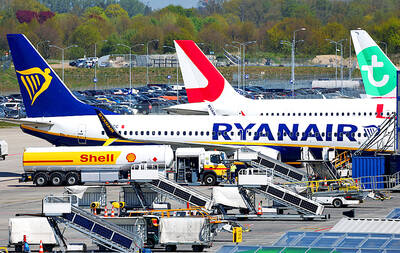
Ryanair, Transavia, Volotea and other low-cost airlines are feeling the financial pain from high jet fuel prices as a result of the Middle East war and are cutting flights. The closure of the Strait of Hormuz has taken a huge chunk of oil supplies off the market, sending the price of jet fuel soaring and triggering fears of shortages that could force airlines to cancel flights. Airlines are not waiting for a lack of supplies to react. “Travel alert: Airlines are cutting thousands of flights right now,” Travel Therapy host Karen Schaler said in an Instagram reel this past weekend.
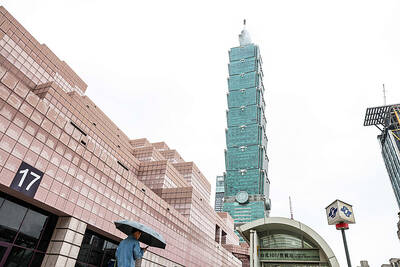
MANAGING RISKS: Taiwan has secured LNG sufficient to cover 95 percent of electricity demand for next month, UBS said, describing the government’s approach as proactive UBS Group AG has raised its forecast for Taiwan’s economic growth this year to 8 percent, up from 6.9 percent previously, and said expansion could reach as high as 8.6 percent if external energy shocks are avoided. The upgrade reflects a stronger-than-expected first-quarter performance and sustained momentum in artificial intelligence (AI)-driven exports, which UBS said are providing a firm foundation for growth despite geopolitical and energy risks. Taiwan’s GDP expanded 13.69 percent year-on-year in the first quarter, the fastest growth since the second quarter of 1987, the Directorate-General of Budget, Accounting and Statistics (DGBAS) reported on Thursday. On a seasonally
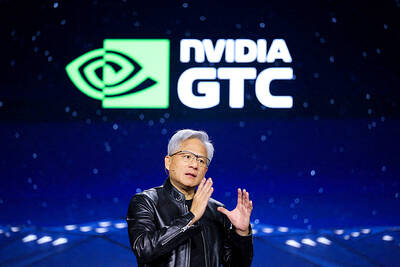
The list of Asian stocks that benefit from business partnership with Nvidia Corp is getting longer, as the region further integrates into the artificial intelligence (AI) chip giant’s business ecosystem. Just in the past week, South Korea’s LG Electronics Inc, Taiwan’s Nanya Technology Corp (南亞科技), as well as China’s Huizhou Desay SV Automotive Co (德賽西威) and Pateo Connect Technology Shanghai Corp (博泰車聯) have become the latest to rally on news of tie-ups, supply-chain participation or product collaboration with the US chip designer. Asian suppliers account for about 90 percent of Nvidia’s production costs, up from about 65 percent last year, data compiled
The Fair Trade Commission’s (FTC) ongoing review of Grab Holdings Ltd’s US$600 million acquisition of Foodpanda Taiwan’s operations, announced on March 23, has taken on fresh urgency as industry experts warn that the transaction could embed significant Chinese cybersecurity vulnerabilities into Taiwan’s digital infrastructure through Grab’s deep ties to autonomous-driving firm WeRide (文遠知行). Less than 16 months after the FTC blocked Uber Eats’ direct attempt to acquire Foodpanda Taiwan — citing potential combined market shares of 80 to 90 percent — the emergence of Grab as the buyer has prompted questions about whether the same competitive harm is simply being rerouted


 RSS
RSS