


The Securities and Futures Investors Protection Center (SFIPC) yesterday confirmed that the Taipei District Court had imposed a provisional seizure of former Taipei deputy mayor Lee Yong-ping’s (李永萍) assets in a move to protect the interests of investors in XPEC Entertainment Inc (樂陞科技).
Lee is one of three former independent board directors at XPEC.
“I cannot elaborate on the details. All I can say is that it is a necessary move for the SFIPC to impose the asset seizure to keep defendants from eluding compensation payments,” SFIPC chairman Chiu Chin-ting (邱欽庭) said by telephone.
NOT AFFECTED
Chiu’s remarks came after XPEC on Thursday night posted a filing with the Taiwan Stock Exchange, saying that the company would hire lawyers to defend the company, board directors and accountants against the SFIPC’s lawsuits.
The company said in the filing that the SFIPC’s legal action would not affect the company’s finance or operation.
The SFIPC on Thursday last week filed civil lawsuits against more than 10 defendants who allegedly violated the Company Act (公司法) and the Securities and Exchange Act (證券交易法) in the XPEC affair, which includes allegations of financial fraud, dubious stock trading and insider trading, Chiu said
BIG NAMES
Chiu said the defendants include XPEC chairman Arron Hsu (許金龍), several board directors and two other former independent board directors: former minister of economic affairs Yiin Chii-ming (尹啟銘) and media personality Sisy Chen (陳文茜).
The defendants also include XPEC acting chairman Ho Chia-hsing (何嘉興), Gamania Digital Entertainment Co (遊戲橘子) chief executive officer Albert Liu (劉柏園), who is a former XPEC board director and the legal representatives of Ernest & Young Taiwan and Concord Securities Co (康和證券), the Chinese-language Apple Daily reported yesterday, citing a court document.
MORE SEIZURES
Chiu said the SFIPC is seeking a total of NT$3.95 billion (US$131 million) in compensation from more than 10 defendants on behalf of 19,620 investors affected by the affair.
Citing sources from the court, the Liberty Times (the Taipei Times’ sister newspaper) reported that the SFIPC had requested the court to seize the assets of the three former XPEC independent directors, but the court only granted permission for action to be taken against Lee, as she showed signs she might transfer her assets.
The court seized Lee’s assets that values more than NT$10 million, the Liberty Times reported.
Lee yesterday afternoon was quoted by the Central News Agency as saying that she is to file a counter-appeal against the court seizure order for her assets.
SUSPENSION
Trading in XPEC shares has been suspended since Nov. 17 last year at the Taipei Exchange, as the company did not resubmit its quarterly financial statements of 2014, 2015, and the first, second and third quarter of last year in accordance with the exchange’s demands.
FAILED SALE
The game developer landed in trouble following a controversial stake sale to Bai Chi Gan Tou Digital Entertainment Co (百尺竿頭) that failed in August last year.
Bai Chi Gan Tou in May last year announced it would acquire a 25.17 percent stake in XPEC for NT$4.86 billion, but dropped the deal on Aug 30 last year, a day before it was supposed to pay investors who agreed to sell their shares, affecting nearly 20,000 investors.

In Italy’s storied gold-making hubs, jewelers are reworking their designs to trim gold content as they race to blunt the effect of record prices and appeal to shoppers watching their budgets. Gold prices hit a record high on Thursday, surging near US$5,600 an ounce, more than double a year ago as geopolitical concerns and jitters over trade pushed investors toward the safe-haven asset. The rally is putting undue pressure on small artisans as they face mounting demands from customers, including international brands, to produce cheaper items, from signature pieces to wedding rings, according to interviews with four independent jewelers in Italy’s main

Japanese Prime Minister Sanae Takaichi has talked up the benefits of a weaker yen in a campaign speech, adopting a tone at odds with her finance ministry, which has refused to rule out any options to counter excessive foreign exchange volatility. Takaichi later softened her stance, saying she did not have a preference for the yen’s direction. “People say the weak yen is bad right now, but for export industries, it’s a major opportunity,” Takaichi said on Saturday at a rally for Liberal Democratic Party candidate Daishiro Yamagiwa in Kanagawa Prefecture ahead of a snap election on Sunday. “Whether it’s selling food or

CONCERNS: Tech companies investing in AI businesses that purchase their products have raised questions among investors that they are artificially propping up demand Nvidia Corp chief executive officer Jensen Huang (黃仁勳) on Saturday said that the company would be participating in OpenAI’s latest funding round, describing it as potentially “the largest investment we’ve ever made.” “We will invest a great deal of money,” Huang told reporters while visiting Taipei. “I believe in OpenAI. The work that they do is incredible. They’re one of the most consequential companies of our time.” Huang did not say exactly how much Nvidia might contribute, but described the investment as “huge.” “Let Sam announce how much he’s going to raise — it’s for him to decide,” Huang said, referring to OpenAI
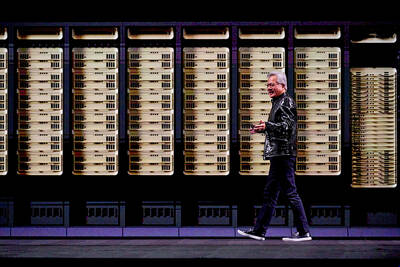
The global server market is expected to grow 12.8 percent annually this year, with artificial intelligence (AI) servers projected to account for 16.5 percent, driven by continued investment in AI infrastructure by major cloud service providers (CSPs), market researcher TrendForce Corp (集邦科技) said yesterday. Global AI server shipments this year are expected to increase 28 percent year-on-year to more than 2.7 million units, driven by sustained demand from CSPs and government sovereign cloud projects, TrendForce analyst Frank Kung (龔明德) told the Taipei Times. Demand for GPU-based AI servers, including Nvidia Corp’s GB and Vera Rubin rack systems, is expected to remain high,


 RSS
RSS