


Given the government’s New Southbound Policy, Indonesia and the Philippines are the ideal markets in ASEAN for Taiwanese companies, DBS Bank Ltd officials said on Friday.
Indonesia is backed up with stable demand in its vast domestic market, and its imports of capital goods are expected to begin to recover and post growth in the second half of this year, DBS economist Irvin Seah (謝光威) told a news conference in Taipei.
While Indonesia’s inflation rate is expected to rise from 3.5 percent last year to 4.5 percent this year, the increase is within the target range of its central bank, Seah said.
The strength of the Indonesian rupiah would remain stable this year, as the Indonesian central bank has been building up its foreign currency reserves while aiming to prevent excessive appreciation, Seah said.
He expects Indonesia’s GDP growth to reach 5.4 percent next year, up from 5.1 percent this year.
Consumption and investment growth have also stayed robust in the Philippines, after foreign direct investment into the country last year rose 40 percent annually to US$7.9 billion.
Despite concerns about political uncertainty in the country, its government has proven to be effective in implementing policies, such as infrastructure investments that would further boost its economy, Seah said.
However, the bank’s analysts have predicted GDP growth in the Philippines would slide slightly from 6.7 percent this year to 6.4 percent next year, he said.
The bank’s outlook for Vietnam is more reserved because of rising concerns about systemic risks as Hanoi tries to stimulate GDP growth.
After missing its growth target last year, the Vietnamese government initiated a wave of credit expansion that could lead to asset quality deterioration for lenders, Seah said.
The Vietnamese central bank estimates the nation’s overall debt delinquency rate is 8.9 percent, even though official agencies have said it is just 2.9 percent, Seah said.
In the first half of this year, Vietnam’s trade deficit soared three times higher than it was a year ago, which is likely to lead to further depreciation of the Vietnamese dong, he said.
Foreign firms would be affected by elevated controls over foreign fund outflows as the government reacts to further weakening of the dong, he said.
Overall, Taiwanese companies should examine their competitive advantages before venturing into ASEAN markets, Seah said.
Companies should first set up representative offices to gather intelligence and learn the lay of the land, as market landscapes vary greatly between ASEAN members, he said.
The service sector is an ideal sector for Taiwanese firms looking to venture into the region, given that a number of food processing, beverage and restaurant operators with strong brand images have done well in ASEAN markets, he said.
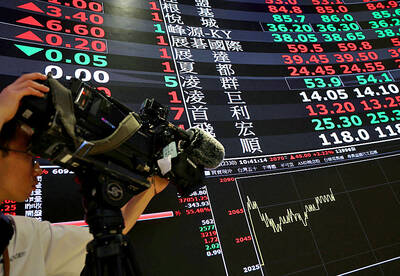
After several years flying high as Asia’s best Nvidia Corp proxy, Taiwan Semiconductor Manufacturing Co (TSMC, 台積電) is increasingly vying with other artificial intelligence (AI) stocks for investor attention. Stock traders are chasing a wider array of beneficiaries as mainstream usage of AI creates demand for hardware beyond the most-advanced chips TSMC makes for Nvidia. Subthemes from the deepening memory crunch to advances in robotics are also luring bids. At the same time, investment caps on single stocks are pushing funds to diversify, while retail investors long familiar with TSMC through its US depositary receipts are being offered a broader set of
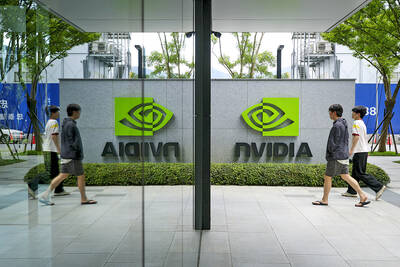
UNDER MICROSCOPE: Taiwan detained three people who allegedly conspired to buy servers in Taiwan and export them using fraudulent documentation, prosecutors said Nvidia Corp chief executive officer Jensen Huang (黃仁勳) on Saturday urged Super Micro Computer Inc to tighten up on compliance after Taiwan detained three people this week for allegedly making fraudulent declarations about artificial intelligence (AI) servers made by its US partner. The development marked the nation’s first crackdown on semiconductor smuggling, which grew after the US slapped restrictions on exports of high-end chips such as Nvidia AI accelerators to China. Nvidia is “rigorous” in explaining regulations to all of its partners, Huang told reporters after arriving in Taipei. “Ultimately Super Micro has to run their own company,” he said in response to
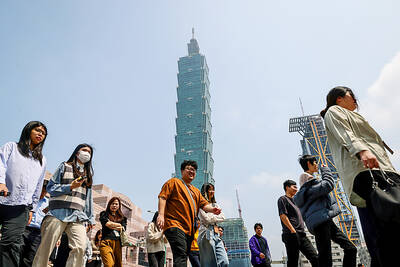
TECH RELIANCE: Growth is increasingly reflecting an unequal K-shaped distribution, where technology sectors outperform and other industries struggle, an expert said Standard Chartered Bank has significantly raised its forecast for Taiwan’s economic growth to 9.5 percent this year, up from 7.6 percent previously, citing surging artificial intelligence (AI) demand driving exports, semiconductor production and investment. The upgrade reflects a sustained AI supercycle that continues to fuel demand for advanced chips and technology infrastructure, which form the backbone of Taiwan’s exports, the bank said in a report this week. “We raise our 2026 growth forecast to reflect a much stronger-than-expected first-quarter GDP figure,” Standard Chartered senior economist for greater China and Asia Tommy Wu (胡東安) said in the report. Driven largely by a 35.3 percent
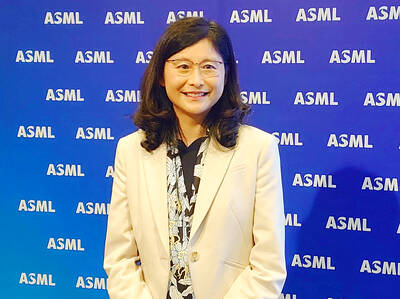
Netherlands-based semiconductor equipment supplier ASML Holding NV yesterday said that it is planning to hire an additional 1,000 people in Taiwan this year in response to growing demand from clients. ASML had previously planned to recruit 600 people this year, but that the plan has been adjusted upward, ASML vice president and ASML Taiwan general manager Grace Wang (汪佳慧) told reporters. ASML has a workforce of more than 4,500 in Taiwan, accounting for about 10 percent of its global total, Wang said. This year’s recruitment campaign would focus on adding people in the customer support, manufacturing and supply chain domains to assist ASML


 RSS
RSS