


The official manufacturing purchasing managers’ index (PMI) accelerated to 59 last month, rising for the 17th consecutive month as global smartphone brands gear up for new product launches, boosting demand for electronics components, the Chung-Hua Institution for Economic Research (CIER,中華經濟研究院) said yesterday.
The private Nikkei Taiwan Manufacturing PMI reached a similar conclusion with a score of 53.6, suggesting a strong start for the nation’s manufacturing-driven economy in the current quarter.
“The latest PMI figure bodes well for exports last month and beyond, but it is too early to tell if forthcoming smartphone models will prove to be successful and benefit local firms in their supply chain,” CIER president Wu Chung-shu (吳中書) told a news conference.
Apple Inc is likely to introduce its iPhone 8 next month, but might have to put off mass production until the fourth quarter to resolve technology bottlenecks, Wu said.
Taiwanese firms supply chips, camera lenses, batteries, casings and other critical components for the handheld device that is said to have major feature redesigns to mark its 10th anniversary this year.
The sub-index for new orders came in at 61.2 last month, up 2.9 points from one month earlier, the institute’s report showed.
A PMI reading greater than 50 indicates expansion and scores less than the neutral mark suggests a contraction.
Local electronics suppliers should also benefit from upcoming smartphone launches by Samsung Electronics Co, China’s Oppo Mobile Telecommunications Corp (歐珀移動), Taiwan’s Asustek Computer Inc (華碩) and other brands, Supply Management Institute in Taiwan (中華採購與供應管理協會) executive director Steve Lai (賴樹鑫) said.
Robust inventory demand elevated the input price gauge to 63.2 and the industrial production sub-index to 61.8, the report said.
“PMI values above 60 tend to trigger corrections and expectations often lead to disappointment,” Lai said, adding that the new iPhone might be priced much higher because of new costly features.
A much more expensive iPhone would limit its popularity to loyal fans, Lai said.
However, most firms are upbeat about their business prospects, with the six-month outlook sub-index standing at 63.9, the report showed.
Annabel Fides, principal economist at IHS Markit, which compiled the private PMI, said purchasing activity could remain strong in the coming months on the back of robust business demand that pushed up input charges last month and some firms passed on the cost burden to buyers.
Non-manufacturing sectors also reported a business pickup, with the non-manufacturing index gaining 1.8 points to 54.8 last month, the institute said.
The improvement was uneven as firms involved in retail sales and telecommunications services saw operations decline, the report said.
Most service-oriented firms expect operations to remain resilient in the coming six months, except for the hospitality industry, which might continue to take a hit from the cross-strait stalemate, Wu said.
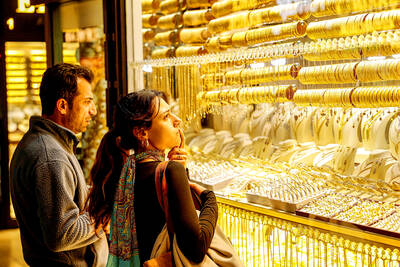
In Italy’s storied gold-making hubs, jewelers are reworking their designs to trim gold content as they race to blunt the effect of record prices and appeal to shoppers watching their budgets. Gold prices hit a record high on Thursday, surging near US$5,600 an ounce, more than double a year ago as geopolitical concerns and jitters over trade pushed investors toward the safe-haven asset. The rally is putting undue pressure on small artisans as they face mounting demands from customers, including international brands, to produce cheaper items, from signature pieces to wedding rings, according to interviews with four independent jewelers in Italy’s main

Japanese Prime Minister Sanae Takaichi has talked up the benefits of a weaker yen in a campaign speech, adopting a tone at odds with her finance ministry, which has refused to rule out any options to counter excessive foreign exchange volatility. Takaichi later softened her stance, saying she did not have a preference for the yen’s direction. “People say the weak yen is bad right now, but for export industries, it’s a major opportunity,” Takaichi said on Saturday at a rally for Liberal Democratic Party candidate Daishiro Yamagiwa in Kanagawa Prefecture ahead of a snap election on Sunday. “Whether it’s selling food or

CONCERNS: Tech companies investing in AI businesses that purchase their products have raised questions among investors that they are artificially propping up demand Nvidia Corp chief executive officer Jensen Huang (黃仁勳) on Saturday said that the company would be participating in OpenAI’s latest funding round, describing it as potentially “the largest investment we’ve ever made.” “We will invest a great deal of money,” Huang told reporters while visiting Taipei. “I believe in OpenAI. The work that they do is incredible. They’re one of the most consequential companies of our time.” Huang did not say exactly how much Nvidia might contribute, but described the investment as “huge.” “Let Sam announce how much he’s going to raise — it’s for him to decide,” Huang said, referring to OpenAI
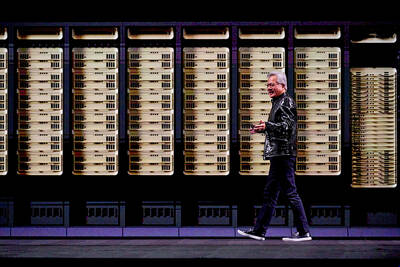
The global server market is expected to grow 12.8 percent annually this year, with artificial intelligence (AI) servers projected to account for 16.5 percent, driven by continued investment in AI infrastructure by major cloud service providers (CSPs), market researcher TrendForce Corp (集邦科技) said yesterday. Global AI server shipments this year are expected to increase 28 percent year-on-year to more than 2.7 million units, driven by sustained demand from CSPs and government sovereign cloud projects, TrendForce analyst Frank Kung (龔明德) told the Taipei Times. Demand for GPU-based AI servers, including Nvidia Corp’s GB and Vera Rubin rack systems, is expected to remain high,


 RSS
RSS