


Sitting on US$1 trillion in cash and emerging from years of caution, European companies are now showing the strongest year-on-year growth in capital spending plans in the world.
The revival is another sign of renewed optimism in the region and will be a relief to investors looking to capture rebounding growth.
European firms, weighed down by sovereign debt crises, sluggish earnings and political uncertainties, hunkered down and put spending plans on hold over the past few years.
Now, with the earnings outlook at its brightest in more than 7 years, borrowing costs still low and an economy gathering momentum, firms are once again looking to replace machinery and plants while governments are keen on infrastructure upgrades.
Year-on-year growth in capital expenditures, or capex, for European companies is currently about 3 percent, easily outpacing other major regions globally.
“I do think we are beginning to see a pick-up in capex as earnings improve,” Natixis Global Asset Management LP chief market strategist Dave Lafferty said.
In a recent report, credit ratings agency Moody’s found that European, Middle Eastern and African companies’ cash pile rose to nearly 1 trillion euros at the end of last year, with the ratio of cash to revenues at a seven-year high.
European companies are “warming to a culture of capex,” Bank of America Merrill Lynch strategists said in a note, adding that they expected the median capex at large European corporate borrowers to rise by 20 percent this year.
The possibility that borrowing costs, held down by ultra-loose monetary policy by the European Central Bank, might start to rise as the bank prepares to roll back stimulus measures could further see companies lock in cheap financing.
“If ... there are maintenance, capex projects that the company knows it’s got to undertake in the next few years, it’s probably not a bad idea to try and get the financing in place while the cost of debt is still very low by historical standards,” manager of the Old Mutual European Equity (ex. UK) Fund manager Liam Nunn said.
A shift in investor sentiment is also spurring capex.
Until last year, when the growth outlook for Europe was at best murky, investors were loathe to reward expansion plans and instead favored companies that paid out earnings in dividends or buybacks. However, with equity valuations now above long-term averages, buying back shares is becoming expensive.
“CEOs have become very addicted to the buyback phenomenon and I think almost by definition that needs to fade a little bit, because CEOs aren’t going to get the same bang for their buck,” Lafferty said.
Some firms’ unwillingness to spend big stems from unhappier times. The mining sector’s rout in 2015 and last year is still too fresh a reminder of what can go wrong if firms take on too much debt and grow aggressively.
Analysts also do not expect the commodity sectors to provide the fillip for capex this time around. Instead, the pick-up in capex is expected to focus on infrastructure spending, with firms investing in new equipment and technology.
Infrastructure spending in particular is at the fore of governments’ minds as a way to boost growth. Earlier this month Spain announced a 5 billion euro public-private investment program for highways, its biggest since an economic slump ended four years ago.
German Chancellor Angela Merkel has been under pressure to boost investment in infrastructure to reduce the country’s record surplus ahead of a federal election in September.
French President Emmanuel Macron has pledged to cut corporate taxes and ease regulations as part of a business-friendly agenda, pledging 50 billion euros for public investment over five years in his manifesto.
Some skeptics remain, however.
European capex plans have had a false dawn before. A recovery in spending plans in 2015 was cut short by worries around Brexit, Greece and bad debts in Italy’s banking system.
Morgan Stanley acknowledges that European firms certainly have the ability to splash the cash a little more, but sees them pursuing mergers and acquisitions to grow rather than spending money on capex.
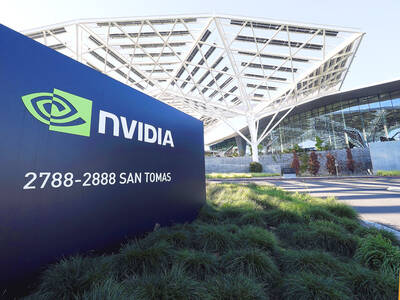
CHIP RACE: Three years of overbroad export controls drove foreign competitors to pursue their own AI chips, and ‘cost US taxpayers billions of dollars,’ Nvidia said China has figured out the US strategy for allowing it to buy Nvidia Corp’s H200s and is rejecting the artificial intelligence (AI) chip in favor of domestically developed semiconductors, White House AI adviser David Sacks said, citing news reports. US President Donald Trump on Monday said that he would allow shipments of Nvidia’s H200 chips to China, part of an administration effort backed by Sacks to challenge Chinese tech champions such as Huawei Technologies Co (華為) by bringing US competition to their home market. On Friday, Sacks signaled that he was uncertain about whether that approach would work. “They’re rejecting our chips,” Sacks
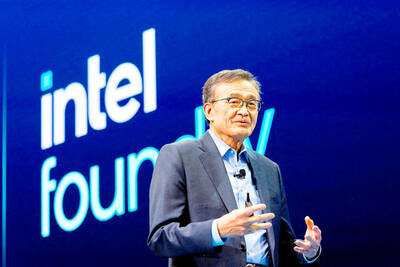
NATIONAL SECURITY: Intel’s testing of ACM tools despite US government control ‘highlights egregious gaps in US technology protection policies,’ a former official said Chipmaker Intel Corp has tested chipmaking tools this year from a toolmaker with deep roots in China and two overseas units that were targeted by US sanctions, according to two sources with direct knowledge of the matter. Intel, which fended off calls for its CEO’s resignation from US President Donald Trump in August over his alleged ties to China, got the tools from ACM Research Inc, a Fremont, California-based producer of chipmaking equipment. Two of ACM’s units, based in Shanghai and South Korea, were among a number of firms barred last year from receiving US technology over claims they have
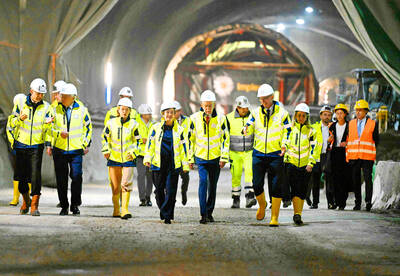
It is challenging to build infrastructure in much of Europe. Constrained budgets and polarized politics tend to undermine long-term projects, forcing officials to react to emergencies rather than plan for the future. Not in Austria. Today, the country is to officially open its Koralmbahn tunnel, the 5.9 billion euro (US$6.9 billion) centerpiece of a groundbreaking new railway that will eventually run from Poland’s Baltic coast to the Adriatic Sea, transforming travel within Austria and positioning the Alpine nation at the forefront of logistics in Europe. “It is Austria’s biggest socio-economic experiment in over a century,” said Eric Kirschner, an economist at Graz-based Joanneum

BUBBLE? Only a handful of companies are seeing rapid revenue growth and higher valuations, and it is not enough to call the AI trend a transformation, an analyst said Artificial intelligence (AI) is entering a more challenging phase next year as companies move beyond experimentation and begin demanding clear financial returns from a technology that has delivered big gains to only a small group of early adopters, PricewaterhouseCoopers (PwC) Taiwan said yesterday. Most organizations have been able to justify AI investments through cost recovery or modest efficiency gains, but few have achieved meaningful revenue growth or long-term competitive advantage, the consultancy said in its 2026 AI Business Predictions report. This growing performance gap is forcing executives to reconsider how AI is deployed across their organizations, it said. “Many companies


 RSS
RSS