


Indonesian state firms are courting foreign pension funds by offering a share in future revenue from toll roads, power stations and other infrastructure projects, as part of a presidential drive to secure US$10 billion in additional inflows.
The state budget is not enough to fund Indonesian President Joko Widodo’s ambitious plan to expand infrastructure in Southeast Asia’s biggest economy, a sprawling archipelago where the costs of moving goods are among Asia’s highest.
Widodo this week told reporters that he had instructed ministers to market the country aggressively to investors, capitalizing on Standard & Poor’s May 19 upgrade of its credit rating to investment grade.
Indonesia is hoping to attract the likes of the Canada Pension Plan, Japan’s Government Pension Investment Fund (GPIF) and other institutional investors, Indonesia Investment Coordinating Board chairman Thomas Lembong told reporters.
“We cannot just sit back and wait for people to come, because competition to attract capital flows is ferocious,” Lembong said. “Everything from toll roads to power plants, to airports to ports should be securitized to capital markets.”
Indonesian Finance Minister Sri Mulyani Indrawati ahead of the G20 summit in Hamburg on Thursday told reporters that the government plans to securitize projects that are “already active and revenue-generating.”
That way, pension funds will not be involved in “the nitty-gritty of the new project or a project already being built, so they can see the risk in a much better way,” she said.
Under a securitization model, a company typically issues a trust-like investment structure that is backed by future revenue from a project or an asset, with investors earning a certain rate of return.
Indonesia’s biggest toll road operator, PT Jasa Marga Tbk, has begun working to securitize about half of the 4 trillion rupiah (US$300 million) in revenue expected over five years from a road linking Jakarta to cities in West Java province.
The securities — expected to offer annual returns of 8 to 9 percent over five years — have received a positive initial response from potential investors including pension funds, Jasa Marga finance director Donny Arsal said.
State-controlled electricity firm Perusahaan Listrik Negara (PLN) is issuing securities backed by the projected five-year income of 10 trillion rupiah from a power plant operated by its unit.
PLN decided on this new investment structure as it had already raised funds from bonds, bank loans and other sources, finance director Sarwono Sudarto said.
“There is already a limit to the existing models of funding,” Sudarto said, adding that under asset securitization, there is no transfer of ownership of its physical asset.
There is no guarantee the securitization plans will succeed.
Andre Varian, a portfolio manager at BNI Asset Management, said the securities issued by state firms are relatively new in Indonesia and their returns are not much higher than those offered by other fixed-income assets.
The lack of liquidity in the domestic market may also deter foreign investors, Varian said.
“Foreign demand would be very limited since there is no liquidity,” he said.
However, Varian added that liquidity might be boosted over time partly because domestic pension funds and insurance firms are required to have a certain portion of investments in government bonds or infrastructure-linked securities.
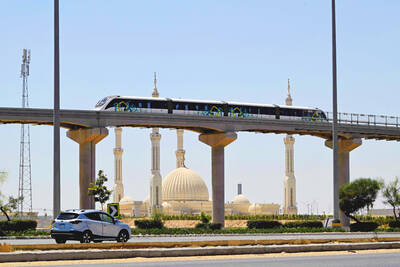
Cairo’s new monorail slices across the city skyline, running above the familiar chaos of blaring horns and aging buses’ exhaust fumes that mark rush hour below. The US$4.5 billion monorail, opened this month, is among Egypt’s most prominent new transport projects, part of a debt-funded infrastructure drive criticized for sapping state finances while bringing limited benefits to most of the country’s 109 million people. “It feels like you’re in a different country,” said Ramy Sayed, a restaurant manager, aboard a driverless Innovia 300 train. “No noise, no traffic, we’re not used to this.” The eastern line runs 56km from the bustling middle-class

Taiwanese firms have increased investment in the Philippines in recent years as Manila’s ties with Washington deepen and global supply chains continue to shift away from China, an expert at the Chung-Hua Institution for Economic Research (CIER, 中華經濟研究院) said yesterday. The Philippines had not been among Taiwanese investors’ top choices in Southeast Asia, CIER Taiwan ASEAN Studies Center director Kristy Hsu (徐遵慈) said at a seminar in Taipei. However, Taiwan’s investment in the country has grown significantly since the COVID-19 pandemic, reaching US $257 million last year, a high in recent years, she said. Although Taiwan’s total investment in the Philippines still lags
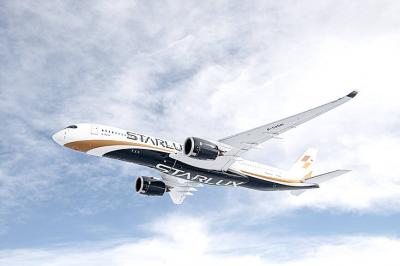
Starlux Airlines Co (星宇航空) today unveiled a long-haul network expansion plan at a shareholders’ meeting in Taipei, including direct flights to Barcelona, Spain, and Zurich, Switzerland, as well as a service connecting Taipei, Sydney and New Zealand. Starlux is to become the first Taiwanese carrier to offer non-stop services to the two European cities, while the inaugural oceanic route is expected to expand transit opportunities within the Australia-New Zealand market, Starlux said. Flight services to Chicago, Dallas, Washington and New York are under evaluation, the airline added. Prior to the shareholders’ meeting, the airline earlier this year announced that it would be

Intel Corp regards Taiwan Semiconductor Manufacturing Co (TSMC, 台積電) as a longstanding partner, as the US chipmaker would continue outsourcing production of advanced chips to TSMC, Intel chief executive officer Lip-Bu Tan (陳立武) said yesterday. “I don’t look at people as competitors. I look at the collaboration... Nvidia is also, you know, a good friend,” Tan told a news conference following his keynote speech at the Computex trade show in Taipei. “It’s a very trusted partnership for us... We are a big, top customer for them, and we’re going to continue doing that,” he said, referring to TSMC, the world’s largest foundry


 RSS
RSS