


The government’s business climate monitor was “yellow-blue” last month for the second consecutive month, dragged by soft shipments in the manufacturing sector, the National Development Council (NDC) said yesterday.
The leading and coincident indices pointed slightly downward, affirming that the pace of recovery has slowed, the council said.
“The latest data showed that the nation’s economy has continued to improve this year, compared with last year, but the pace appears wanting in terms of strength,” NDC Director Wu Ming-huei (吳明蕙) told a media briefing.
The overall monitoring score was 20 last month, one point less than in April, as manufacturing shipments slid into a recession.
The slowdown is related to inventory adjustments by global technology brands ahead of next-generation product launches in the fall, rather than a sign of a downturn in the global economy, analysts have said.
Taiwan is home to the world’s largest contract chipmakers, chip designers and supplier of critical components used in smartphones, laptops, connected vehicles and Internet of Things applications, they said.
The council uses a five-color system to indicate the nation’s economic state, with “green” indicating steady growth, “red” suggesting overheating and “blue” signaling a recession. Dual-color signs reflect a transition.
With the exception of closing stock prices and electrical and machinery equipment imports, the system’s other constituent indices — money supply, nonfarm payrolls, exports and industrial output — all registered negative cyclical movements, a council report said.
The index of leading indicators, which is used to measure the economic outlook for the next six months, stood at 99.84, a 0.6 percentage point decrease from April, the report said.
Export orders, semiconductor equipment imports and business sentiment contributed to the retreat, it said.
“The government will pay close attention to changes in the economy,” Wu said.
Wu expressed confidence that major bellwethers would improve in the second half of this year with the advent of the high sales season in the summer.
Plans by global technology brands to introduce innovative features in their next-generation products will spur demand, benefiting local firms in their supply chains, Wu said.
The index of coincident indicators, which reflects the current economic condition, last month dropped 1.24 percentage points to 98.8, weight by negative electricity usage; retail and restaurant sales; industrial output; and customs-cleared exports, the report said.
People will spend more money in the summer, Wu said, adding that the government would help boost demand by speeding up the execution of public construction projects.

AI TALENT: No financial details were released about the deal, in which top Groq executives, including its CEO, would join Nvidia to help advance the technology Nvidia Corp has agreed to a licensing deal with artificial intelligence (AI) start-up Groq, furthering its investments in companies connected to the AI boom and gaining the right to add a new type of technology to its products. The world’s largest publicly traded company has paid for the right to use Groq’s technology and is to integrate its chip design into future products. Some of the start-up’s executives are leaving to join Nvidia to help with that effort, the companies said. Groq would continue as an independent company with a new chief executive, it said on Wednesday in a post on its Web
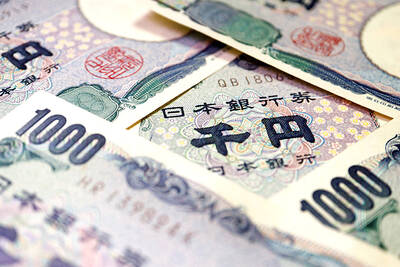
RESPONSE: The Japanese Ministry of Finance might have to intervene in the currency markets should the yen keep weakening toward the 160 level against the US dollar Japan’s chief currency official yesterday sent a warning on recent foreign exchange moves, after the yen weakened against the US dollar following Friday last week’s Bank of Japan (BOJ) decision. “We’re seeing one-directional, sudden moves especially after last week’s monetary policy meeting, so I’m deeply concerned,” Japanese Vice Finance Minister for International Affairs Atsushi Mimura told reporters. “We’d like to take appropriate responses against excessive moves.” The central bank on Friday raised its benchmark interest rate to the highest in 30 years, but Bank of Japan Governor Kazuo Ueda chose to keep his options open rather than bolster the yen,

Even as the US is embarked on a bitter rivalry with China over the deployment of artificial intelligence (AI), Chinese technology is quietly making inroads into the US market. Despite considerable geopolitical tensions, Chinese open-source AI models are winning over a growing number of programmers and companies in the US. These are different from the closed generative AI models that have become household names — ChatGPT-maker OpenAI or Google’s Gemini — whose inner workings are fiercely protected. In contrast, “open” models offered by many Chinese rivals, from Alibaba (阿里巴巴) to DeepSeek (深度求索), allow programmers to customize parts of the software to suit their

Global server shipments are expected to surge to 15 million units next year, from 4 million units this year, with artificial intelligence (AI) servers accounting for about 30 percent, driven by massive capital spending by major cloud service providers, the Market Intelligence and Consulting Institute (MIC) said on Thursday last week. Major cloud service providers — including Google’s parent company Alphabet Inc, Microsoft Corp, Amazon.com Inc and Meta Platforms Inc — are projected to budget US$450 million for capital expenditure next year, up from US$400 million this year, MIC ICT [information and communications technology] Industry Research Center director Edward Lin


 RSS
RSS