


Phison Electronics Corp (群聯電子), a supplier of NAND flash memory controllers and modules, yesterday held a ceremony to celebrate the completion of a NT$800 million (US$26.33 million) facility in Miaoli County’s Jhunan Township (竹南).
The construction of the facility, which could house 2,300 employees, took less than seven months to complete, Phison said.
The company has said it plans to increase its Taiwanese workforce of about 1,200 people.
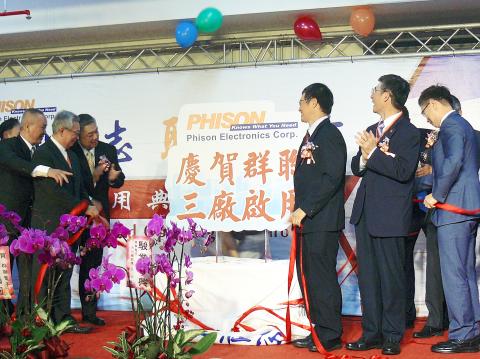
Photo: CNA
“Demand has come back this week — our major customers have placed big orders to meet growing demand for USBs and solid-state drives,” Phison chairman Pua Khein-seng (潘健成) told a news briefing following the ceremony.
“China shows the strongest growth momentum among all areas,” Pua said. “We feel demand is improving month-by-month.”
Phison in November last year forecast solid NAND flash demand for the whole of this year.
Pua yesterday said NAND chip supply continues to be tight this year based on messages from the company’s major chip suppliers, including Toshiba Corp.
The company as of last month had built inventories totaling NT$9 billion in preparation for the peak season in the second half, Pua said.
He attributed the mismatched supply and demand to increasingly larger memory space for smartphones, servers and gaming PCs as well as to the bumpy technology upgrade to 3D NAND chips.
For instance, a South Korean NAND chipmaker suffered a setback in a technology upgrade to 64-layer 3D chips and was forced to produce less-advanced 48-layer chips instead, he said.
Pua said the disparity between supply and demand is expected to catalyze moderate price hikes for NAND chips next quarter, after a short break this quarter.
That would be a boon for Phison’s business, as robust demand and better prices might carry the company’s net profit to a record high this year, he said.
Yuanta Securities Investment Consulting Co (元大投顧) said in a report on Tuesday that Phison is to be a major beneficiary of the uptrend in the NAND chip industry.
Yuanta projected that Phison’s net profit would reach an all-time high this quarter at NT$1.49 billion, or NT$7.52 per share.
This year as a whole, Phison is to grow its net profit by 19 percent to NT$5.73 billion, or NT$29.03 per share, compared with last year’s NT$4.8 billion, or NT$24.67 per share, Yuanta said.
Phison shares have surged 37 percent this year, outperforming the broader market’s 7.62 percent rise over the period.
Its stock closed at NT$345.5 yesterday.
Separately, Minister of Science and Technology Chen Liang-gee (陳良基) yesterday at the ceremony said that the ministry plans to invest NT$4 billion in developing artificial intelligence (AI)-related technologies over the next four years.
The investment would be used to develop new chips to power AI on end devices and to develop next-generation memory chips that could be used for nonvolatile storage featuring ultra-low power usage and quick read and access, Chen said.
The semiconductor budget is part of the government’s NT$882.49 billion Forward-looking Infrastructure Development Program.

In Italy’s storied gold-making hubs, jewelers are reworking their designs to trim gold content as they race to blunt the effect of record prices and appeal to shoppers watching their budgets. Gold prices hit a record high on Thursday, surging near US$5,600 an ounce, more than double a year ago as geopolitical concerns and jitters over trade pushed investors toward the safe-haven asset. The rally is putting undue pressure on small artisans as they face mounting demands from customers, including international brands, to produce cheaper items, from signature pieces to wedding rings, according to interviews with four independent jewelers in Italy’s main

Japanese Prime Minister Sanae Takaichi has talked up the benefits of a weaker yen in a campaign speech, adopting a tone at odds with her finance ministry, which has refused to rule out any options to counter excessive foreign exchange volatility. Takaichi later softened her stance, saying she did not have a preference for the yen’s direction. “People say the weak yen is bad right now, but for export industries, it’s a major opportunity,” Takaichi said on Saturday at a rally for Liberal Democratic Party candidate Daishiro Yamagiwa in Kanagawa Prefecture ahead of a snap election on Sunday. “Whether it’s selling food or

CONCERNS: Tech companies investing in AI businesses that purchase their products have raised questions among investors that they are artificially propping up demand Nvidia Corp chief executive officer Jensen Huang (黃仁勳) on Saturday said that the company would be participating in OpenAI’s latest funding round, describing it as potentially “the largest investment we’ve ever made.” “We will invest a great deal of money,” Huang told reporters while visiting Taipei. “I believe in OpenAI. The work that they do is incredible. They’re one of the most consequential companies of our time.” Huang did not say exactly how much Nvidia might contribute, but described the investment as “huge.” “Let Sam announce how much he’s going to raise — it’s for him to decide,” Huang said, referring to OpenAI
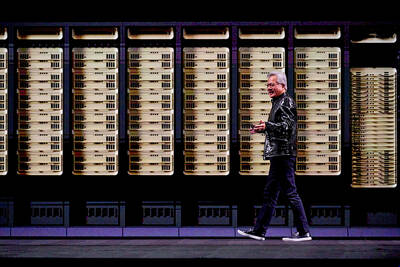
The global server market is expected to grow 12.8 percent annually this year, with artificial intelligence (AI) servers projected to account for 16.5 percent, driven by continued investment in AI infrastructure by major cloud service providers (CSPs), market researcher TrendForce Corp (集邦科技) said yesterday. Global AI server shipments this year are expected to increase 28 percent year-on-year to more than 2.7 million units, driven by sustained demand from CSPs and government sovereign cloud projects, TrendForce analyst Frank Kung (龔明德) told the Taipei Times. Demand for GPU-based AI servers, including Nvidia Corp’s GB and Vera Rubin rack systems, is expected to remain high,


 RSS
RSS