


MediaTek Inc (聯發科) yesterday said it is seeking to recoup its market position in the next one to two years by improving its handset chip’s cost structure and increasing its penetration into telecoms beyond China by tapping into new co-chief executive officer Rick Tsai’s (蔡力行) semiconductor experience.
The world’s No. 3 chip designer last year suffered a setback in terms of market share and gross margin, which it attributed to a host of factors, including chip supply constraints, key component price hikes and product planning flaws.
Unveiling its “recovery plan,” MediaTek chairman and co-chief executive officer Tsai Ming-kai (蔡明介) told a media briefing in Hsinchu that the company is developing a new cost-effective modem architecture to go with its mid-range mobile phone chips, dubbed Helio P series, and entry-level 4G chips.
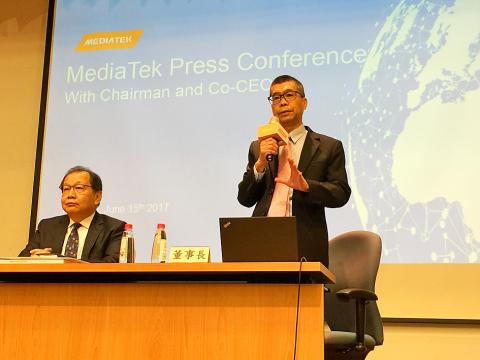
Photo: Cho I-chun, Taipei Times
The new modem architecture is scheduled to hit the market in the second half of this year, which is expected to significantly improve the firm’s chip cost structure, Tsai Ming-kai said.
“The chips have been adopted by China’s first-tier handset vendors,” he said. “We hope the company’s gross margin and market share will pick up as a result.”
However, he said he does not expect “a V-shaped recovery” soon, because it usually takes one to one-and-a-half years to see a new chip’s yield results.
“This is a norm in the technology sector,” he said.
On top of that, MediaTek is working with key telecom companies in Japan and North America to broaden its customer portfolio beyond China, Rick Tsai said.
Last year, MediaTek clinched its first handset chip orders from Samsung Electronics Co and shipped its LTE smartphone chips to the US, the company said.
MediaTek shipped a total of 550 million chips used in smartphones and tablets last year, setting an all-time high.
Rick Tsai said he would help MediaTek find new growth drivers as smartphone growth slows down.
“The company needs to search for new growth engines beyond traditional application processors and system-on-chip solutions,” he said.
The catalyst for growth over the next two to five years would be total semiconductor content and applications for mobile phones, he added.
Asked when the company decided to recruit Rick Tsai, Tsai Ming-kai said he approached him in December last year after learning from news reports that he was to leave his post as chairman of Chugnhwa Telecom Co (中華電信).
Rick Tsai had previously served as president and chief executive officer of Taiwan Semiconductor Manufacturing Co (TSMC, 台積電), the world’s top contract chipmaker, from 2005 to 2009.
“I made a decision any chairman from the world’s top 10 semiconductor companies would do no matter what situation MediaTek was facing, good or bad,” Tsai Ming-kai said.

Taiwan Semiconductor Manufacturing Co (TSMC, 台積電) last week recorded an increase in the number of shareholders to the highest in almost eight months, despite its share price falling 3.38 percent from the previous week, Taiwan Stock Exchange data released on Saturday showed. As of Friday, TSMC had 1.88 million shareholders, the most since the week of April 25 and an increase of 31,870 from the previous week, the data showed. The number of shareholders jumped despite a drop of NT$50 (US$1.59), or 3.38 percent, in TSMC’s share price from a week earlier to NT$1,430, as investors took profits from their earlier gains

In a high-security Shenzhen laboratory, Chinese scientists have built what Washington has spent years trying to prevent: a prototype of a machine capable of producing the cutting-edge semiconductor chips that power artificial intelligence (AI), smartphones and weapons central to Western military dominance, Reuters has learned. Completed early this year and undergoing testing, the prototype fills nearly an entire factory floor. It was built by a team of former engineers from Dutch semiconductor giant ASML who reverse-engineered the company’s extreme ultraviolet lithography (EUV) machines, according to two people with knowledge of the project. EUV machines sit at the heart of a technological Cold
Taiwan’s long-term economic competitiveness will hinge not only on national champions like Taiwan Semiconductor Manufacturing Co. (TSMC, 台積電) but also on the widespread adoption of artificial intelligence (AI) and other emerging technologies, a US-based scholar has said. At a lecture in Taipei on Tuesday, Jeffrey Ding, assistant professor of political science at the George Washington University and author of "Technology and the Rise of Great Powers," argued that historical experience shows that general-purpose technologies (GPTs) — such as electricity, computers and now AI — shape long-term economic advantages through their diffusion across the broader economy. "What really matters is not who pioneers
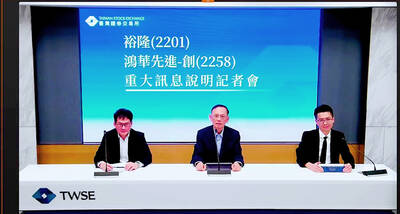
TAIWAN VALUE CHAIN: Foxtron is to fully own Luxgen following the transaction and it plans to launch a new electric model, the Foxtron Bria, in Taiwan next year Yulon Motor Co (裕隆汽車) yesterday said that its board of directors approved the disposal of its electric vehicle (EV) unit, Luxgen Motor Co (納智捷汽車), to Foxtron Vehicle Technologies Co (鴻華先進) for NT$787.6 million (US$24.98 million). Foxtron, a half-half joint venture between Yulon affiliate Hua-Chuang Automobile Information Technical Center Co (華創車電) and Hon Hai Precision Industry Co (鴻海精密), expects to wrap up the deal in the first quarter of next year. Foxtron would fully own Luxgen following the transaction, including five car distributing companies, outlets and all employees. The deal is subject to the approval of the Fair Trade Commission, Foxtron said. “Foxtron will be


 RSS
RSS