


Formosa Plastics Corp (台灣塑膠) yesterday gave a bright outlook for the petrochemical sector on the back of improving economic growth momentum worldwide.
Earnings in the first half of this year are expected to improve from a year ago, Formosa Plastics president Jason Lin (林健男) said on the sidelines of a shareholders’ meeting in Taipei.
In the first quarter, the company saw its pretax earnings rise 62 percent annually to NT$10.7 billion (US$353.99 million), Lin said.
The company, the nation’s largest producer of polyvinyl chloride, posted a net profit of NT$9.89 billion, or earnings per share of NT$1.55, for last quarter, a 73.1 percent increase from NT$5.71 billion in the same period last year, buoyed by soaring oil prices and improving demand, he said.
Gains made last quarter coincided with a number of policies implemented by the Chinese government aiming to cut oversupply and environmental impacts, Lin said, adding that the operations of some of the company’s peers were disrupted by equipment failures, leading to higher product prices that helped offset rising material costs.
Sales this quarter will receive a boost during the yearly high season on the back of rising shipments of polyvinyl chloride and acrylonitrile products, he added.
Shareholders approved plans to distribute a cash dividend of NT$4.6, the highest in six years, the firm said, adding that the distribution is based on last year’s record-high net profit of NT$39.39 billion, or earnings per share of NT$6.19.
It also represented a 5.12 percent dividend yield based on the stock’s closing price of NT$89.8 yesterday.
Asked about Hon Hai Precision Industry Co (鴻海精密) chairman Terry Gou’s (郭台銘) strong criticism yesterday of the government’s inefficiency, Lin said that each company has its own perspective, adding that Taiwan remains the preferred investment destination of Formosa Plastics and its parent, Formosa Plastics Group (FPG, 台塑集團).
The firm’s investments in the US were driven by a need to access cheaper petrochemical materials produced by the US’ shale oil industry, he added.
Formosa Petrochemical Corp (台塑石化), an oil refining subsidiary of FPG, intends to continue applying for approval to carry out a NT$17 billion fourth-phase expansion at its naphtha cracker in Yunlin County, after the plan was halted by the Environmental Protection Administration.
The agency in March ordered the company to conduct a new environmental impact assessment, following six years of assessment by the government.
Lin said the expansion plans include a partnership to build carbon fiber composites with Asahi Kasei, a Japanese chemical company that also found the agency’s directive baffling.
The plant could help with the government’s goals of developing its own military aircraft and warships, he added.

Taiwan Semiconductor Manufacturing Co (TSMC, 台積電) last week recorded an increase in the number of shareholders to the highest in almost eight months, despite its share price falling 3.38 percent from the previous week, Taiwan Stock Exchange data released on Saturday showed. As of Friday, TSMC had 1.88 million shareholders, the most since the week of April 25 and an increase of 31,870 from the previous week, the data showed. The number of shareholders jumped despite a drop of NT$50 (US$1.59), or 3.38 percent, in TSMC’s share price from a week earlier to NT$1,430, as investors took profits from their earlier gains

In a high-security Shenzhen laboratory, Chinese scientists have built what Washington has spent years trying to prevent: a prototype of a machine capable of producing the cutting-edge semiconductor chips that power artificial intelligence (AI), smartphones and weapons central to Western military dominance, Reuters has learned. Completed early this year and undergoing testing, the prototype fills nearly an entire factory floor. It was built by a team of former engineers from Dutch semiconductor giant ASML who reverse-engineered the company’s extreme ultraviolet lithography (EUV) machines, according to two people with knowledge of the project. EUV machines sit at the heart of a technological Cold
Taiwan’s long-term economic competitiveness will hinge not only on national champions like Taiwan Semiconductor Manufacturing Co. (TSMC, 台積電) but also on the widespread adoption of artificial intelligence (AI) and other emerging technologies, a US-based scholar has said. At a lecture in Taipei on Tuesday, Jeffrey Ding, assistant professor of political science at the George Washington University and author of "Technology and the Rise of Great Powers," argued that historical experience shows that general-purpose technologies (GPTs) — such as electricity, computers and now AI — shape long-term economic advantages through their diffusion across the broader economy. "What really matters is not who pioneers
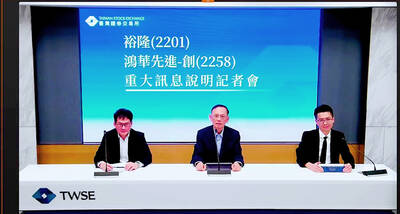
TAIWAN VALUE CHAIN: Foxtron is to fully own Luxgen following the transaction and it plans to launch a new electric model, the Foxtron Bria, in Taiwan next year Yulon Motor Co (裕隆汽車) yesterday said that its board of directors approved the disposal of its electric vehicle (EV) unit, Luxgen Motor Co (納智捷汽車), to Foxtron Vehicle Technologies Co (鴻華先進) for NT$787.6 million (US$24.98 million). Foxtron, a half-half joint venture between Yulon affiliate Hua-Chuang Automobile Information Technical Center Co (華創車電) and Hon Hai Precision Industry Co (鴻海精密), expects to wrap up the deal in the first quarter of next year. Foxtron would fully own Luxgen following the transaction, including five car distributing companies, outlets and all employees. The deal is subject to the approval of the Fair Trade Commission, Foxtron said. “Foxtron will be


 RSS
RSS