


Shares closed marginally lower on Friday after moving in a narrow range throughout the session amid cautious sentiment ahead of the four-day Dragon Boat Festival holiday, dealers said.
With select large-cap stocks such as contract chipmaker Taiwan Semiconductor Manufacturing Co (TSMC, 台積電) and iPhone and iPad assembler Hon Hai Precision Industry Co (鴻海精密) in the doldrums, IC designer firms and some old economy stocks attracted bargain hunting, which lent some support to the broader market, the dealers said.
The TAIEX ended down 6.54 points, or 0.06 percent, at 10,101.95, after moving between 10,072.84 and 10,121.88 on turnover of NT$91.77 billion (US$3.05 billion).
The market opened down 0.18 percent on a mild technical correction from a session earlier, as investors shrugged off a higher Wall Street, where the Dow Jones Industrial Average ended up 0.34 percent overnight, the dealers said.
Caution dominated the local equity market during the trading session, which limited share price fluctuations before some bargain hunters emerged in the last few minutes of the session to help the weighted index recoup part of its losses by the end of trade, they said.
“It was a typical trading day ahead of a prolonged holiday,” Concord Securities Co (康和證券) analyst Kerry Huang said. “So after yesterday’s gains, investors were reluctant to chase prices today amid fears that negative leads will emerge in the global financial markets during the holiday.”
It was no surprise that TSMC, the most heavily weighted stock on the local market, remained slow on Friday, Huang said, but added that the silver lining is that the stock recovered all of its losses on last-ditch buying.
TSMC ended unchanged at NT$207 off an early low of NT$205, with 32.51 million shares changing hands, while Hon Hai, the second-most heavily weighted stock, fell 0.48 percent to end at NT$104.50.
Bucking the downturn on the broader market, Largan Precision Co (大立光), a smartphone camera lens supplier to Apple Inc, gained 0.62 percent to NT$4,835 to remain the most expensive stock in Taiwan.
“Bargain hunters shifted their attention to IC designers such as MediaTek Inc (聯發科) to take advantage of their relatively low valuations,” Huang said.
Among the gaining IC designers, MediaTek rose 0.44 percent to close at NT$229.50 on the main board, while eMemory Technology Inc (力旺) gained 0.39 percent to end at NT$390 on the over-the-counter Taipei Exchange, where the index closed down 0.1 percent at 134.76.
In the old economy sector, retail conglomerate Uni-President Enterprises Corp (統一企業) rose 1.85 percent to end at NT$60.60 amid optimism that the coming summer will boost its beverage sales.
“The main board closed above the 10,000-point mark for the fourth consecutive session today, which means that the level has become the nearest technical support for the weighted index,” Huang said.
Elsewhere in Asia, most stocks fell, paced by a slide in energy and material producers after crude oil held its biggest loss in three weeks following OPEC’s move to prolong supply cuts.
The MSCI Asia Pacific Index on Friday declined 0.01 percent to close at 152.82 in Hong Kong, a 1.34 percent increase from 150.79 on May 19.
Japan’s TOPIX slipped 0.57 percent to 1,569.42, a 0.62 percent increase from a close of 1,559.73 on May 19, as Inpex Corp and other oil explorers slumped after crude in New York slid 4.8 percent on Thursday.
The Nikkei on Friday ended down 0.64 percent at 19,686.84, compared with a close of 19,590.76 a week earlier.
BHP Billiton Ltd and Rio Tinto Ltd dropped, leading to declines in Australia’s equity index.
Samsung Electronics and LG Display Co advanced on Friday, lifting South Korea’s KOSPI to 2,355.30, another record, after closing at 2,288.48 on May 19, an increase of 2.92 percent.
OPEC and its allies agreed to prolong their accord through March next year, but provided no option to continue curbs further into next year.
“Lower oil prices will pressure energy and commodity stocks for some time,” said Tawatchai Asawapornchai, deputy managing director at ASL Securities Co in Bangkok. “Non-energy stocks should still draw some investors’ interest on most Asian countries’ continued economic recovery.”
Additional reporting by staff writer
AI TALENT: No financial details were released about the deal, in which top Groq executives, including its CEO, would join Nvidia to help advance the technology Nvidia Corp has agreed to a licensing deal with artificial intelligence (AI) start-up Groq, furthering its investments in companies connected to the AI boom and gaining the right to add a new type of technology to its products. The world’s largest publicly traded company has paid for the right to use Groq’s technology and is to integrate its chip design into future products. Some of the start-up’s executives are leaving to join Nvidia to help with that effort, the companies said. Groq would continue as an independent company with a new chief executive, it said on Wednesday in a post on its Web
RESPONSE: The Japanese Ministry of Finance might have to intervene in the currency markets should the yen keep weakening toward the 160 level against the US dollar Japan’s chief currency official yesterday sent a warning on recent foreign exchange moves, after the yen weakened against the US dollar following Friday last week’s Bank of Japan (BOJ) decision. “We’re seeing one-directional, sudden moves especially after last week’s monetary policy meeting, so I’m deeply concerned,” Japanese Vice Finance Minister for International Affairs Atsushi Mimura told reporters. “We’d like to take appropriate responses against excessive moves.” The central bank on Friday raised its benchmark interest rate to the highest in 30 years, but Bank of Japan Governor Kazuo Ueda chose to keep his options open rather than bolster the yen,

Even as the US is embarked on a bitter rivalry with China over the deployment of artificial intelligence (AI), Chinese technology is quietly making inroads into the US market. Despite considerable geopolitical tensions, Chinese open-source AI models are winning over a growing number of programmers and companies in the US. These are different from the closed generative AI models that have become household names — ChatGPT-maker OpenAI or Google’s Gemini — whose inner workings are fiercely protected. In contrast, “open” models offered by many Chinese rivals, from Alibaba (阿里巴巴) to DeepSeek (深度求索), allow programmers to customize parts of the software to suit their
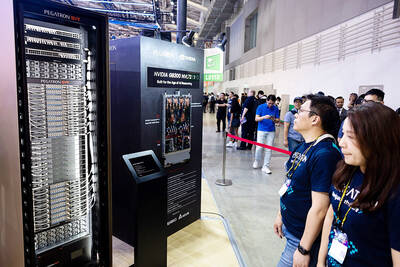
Global server shipments are expected to surge to 15 million units next year, from 4 million units this year, with artificial intelligence (AI) servers accounting for about 30 percent, driven by massive capital spending by major cloud service providers, the Market Intelligence and Consulting Institute (MIC) said on Thursday last week. Major cloud service providers — including Google’s parent company Alphabet Inc, Microsoft Corp, Amazon.com Inc and Meta Platforms Inc — are projected to budget US$450 million for capital expenditure next year, up from US$400 million this year, MIC ICT [information and communications technology] Industry Research Center director Edward Lin


 RSS
RSS