


The US Department of Commerce on Wednesday dramatically raised an anti-dumping duty on carbon and alloy steel plates from Taiwan’s China Steel Corp (CSC, 中鋼) from 6.95 percent to 75.42 percent in an amended final decision that affects imports from eight countries, the Ministry of Economic Affairs said yesterday.
The ruling came one day after the US International Trade Commission initiated an investigation into imports of solar cells and modules, including products from Taiwan, the ministry’s Bureau of Foreign Trade said.
“We think the amended anti-dumping duty indicates a move toward trade protectionism by the US government,” a bureau official, who declined to be named, said by telephone.
The department on April 28 last year began an anti-dumping investigation on imports of carbon and steel alloy cut-to-length plates from eight countries — Taiwan, South Korea, Japan, Italy, Germany, France, Belgium and Austria.
On March 30 this year, it announced its final ruling on the eight countries, with Taiwan facing anti-dumping duties ranging from 3.62 percent to 6.95 percent, the ministry said.
The ruling imposed a 6.95 percent anti-dumping levy on CSC and a tariff of 3.62 percent on Shang Chen Steel Co Ltd (尚承鋼鐵).
However, the department adjusted its final ruling after the US International Trade Commission on May 5 determined that the dumping of carbon and alloy cut-to-length plates had injured US industry, the bureau official said.
Duties on steel producers from France, Germany and South Korea were mildly amended by the department, but the rates on Taiwan, specifically on CSC, were significantly hiked, the official said.
The official said that the department might have changed the rates for CSC mainly because it used the wrong cost data to set the previous rates.
Even so, the official said it is rare that the department would amend its final ruling less than two weeks after the trade commission’s decision.
“It is also uncommon that the scale of the hike would be 10 times higher than the previous decision,” he said.
The official said CSC can file an administrative appeal in the US against the department’s ruling.
The tariff on Shang Chen remains 3.62 percent in the amended final ruling, the official added.
The ministry’s data showed that Taiwan’s total exports of carbon and alloy cut-to-length plates to the US amounted to 24,665 tonnes and was worth US$13.42 million last year.
AI TALENT: No financial details were released about the deal, in which top Groq executives, including its CEO, would join Nvidia to help advance the technology Nvidia Corp has agreed to a licensing deal with artificial intelligence (AI) start-up Groq, furthering its investments in companies connected to the AI boom and gaining the right to add a new type of technology to its products. The world’s largest publicly traded company has paid for the right to use Groq’s technology and is to integrate its chip design into future products. Some of the start-up’s executives are leaving to join Nvidia to help with that effort, the companies said. Groq would continue as an independent company with a new chief executive, it said on Wednesday in a post on its Web
RESPONSE: The Japanese Ministry of Finance might have to intervene in the currency markets should the yen keep weakening toward the 160 level against the US dollar Japan’s chief currency official yesterday sent a warning on recent foreign exchange moves, after the yen weakened against the US dollar following Friday last week’s Bank of Japan (BOJ) decision. “We’re seeing one-directional, sudden moves especially after last week’s monetary policy meeting, so I’m deeply concerned,” Japanese Vice Finance Minister for International Affairs Atsushi Mimura told reporters. “We’d like to take appropriate responses against excessive moves.” The central bank on Friday raised its benchmark interest rate to the highest in 30 years, but Bank of Japan Governor Kazuo Ueda chose to keep his options open rather than bolster the yen,
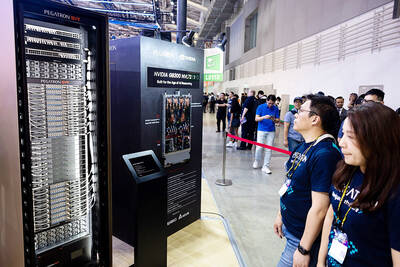
Global server shipments are expected to surge to 15 million units next year, from 4 million units this year, with artificial intelligence (AI) servers accounting for about 30 percent, driven by massive capital spending by major cloud service providers, the Market Intelligence and Consulting Institute (MIC) said on Thursday last week. Major cloud service providers — including Google’s parent company Alphabet Inc, Microsoft Corp, Amazon.com Inc and Meta Platforms Inc — are projected to budget US$450 million for capital expenditure next year, up from US$400 million this year, MIC ICT [information and communications technology] Industry Research Center director Edward Lin
Even as the US is embarked on a bitter rivalry with China over the deployment of artificial intelligence (AI), Chinese technology is quietly making inroads into the US market. Despite considerable geopolitical tensions, Chinese open-source AI models are winning over a growing number of programmers and companies in the US. These are different from the closed generative AI models that have become household names — ChatGPT-maker OpenAI or Google’s Gemini — whose inner workings are fiercely protected. In contrast, “open” models offered by many Chinese rivals, from Alibaba (阿里巴巴) to DeepSeek (深度求索), allow programmers to customize parts of the software to suit their


 RSS
RSS