


Inventec Corp (英業達) yesterday reported that net income last quarter fell to its lowest level since the fourth quarter of 2012, dragged down by foreign exchange losses of NT$1.2 billion (US$39.79 million).
Net profit plummeted 44.87 percent to NT$678 million, from NT$1.23 billion a year earlier, and was 61.69 percent lower than the prior quarter’s NT$1.77 billion, Inventec data showed.
“The New Taiwan dollar sharply appreciated 6 percent in the first quarter, which put immense pressure on Inventec’s profitability,” chief financial officer Yu Chin-pao (游進寶) told an investors’ conference at the firm’s headquarters in Taipei.
Inventec’s loss-making solar power business continued to erode earnings generated from the company’s information and communications technology segment, Yu said.
The firm’s gross margin fell 0.3 percentage points annually to 5.6 percent last quarter, and its operating margin dropped 0.4 percentage points to 1.6 percent due to appreciation of the NT dollar and the solar power business’ lackluster performance, Yu said.
“Inventec expects the effects of appreciation to decrease this quarter,” he said. “Inventec estimates revenue this quarter will climb by a single-digit percentage from last quarter’s NT$99.75 billion, supported by growing orders for servers, handheld devices and the steady demand for commercial PCs.”
“Servers and handheld devices are the main growth engines for Inventec this year, based on an order forecast offered by our clients,” Yu added.
Inventec president Huang Kuo-chun (黃國鈞) said the company’s server business this year is likely to be driven mainly by rising global demand for data centers.
“The cloud-computing demand for artificial intelligence [AI] voice recognition applications is also expected to support the momentum, thanks to the increasing population of AI home products, such as Amazon.com Inc’s Echo,” Huang said.
“Revenue and profit in Inventec’s handheld devices segment are likely to increase by a double-digit percentage this year from last year, based on clients’ new projects,” Inventec’s handheld devices subsidiary Inventec Appliance Corp (英華達) chief executive officer David Ho (何代水) said.
The subsidiary manufactures a wide range of “smart” devices, such smartphones, wireless speakers, wearable devices and wireless earphones. Its clients include China’s Xiaomi Corp (小米), US’s Fitbit Inc and Apple Inc.
Inventec, which assembles Apple’s AirPods, has been rumored as having secured an order to make the US company’s planned AI voice-controlled home assistant, similar to the Amazon Echo, in the second half of this year.
However, Ho declined to confirm the market speculation.
Inventec has two US clients that are to introduce voice-controlled home products this year, expecting shipments to reach peak levels in the third and fourth quarter this year, he said.
Total shipments of Inventec’s handheld devices, including AI home products and earphones, are estimated to surge by more than 10 percent annually to 700 million units this year, Ho said.
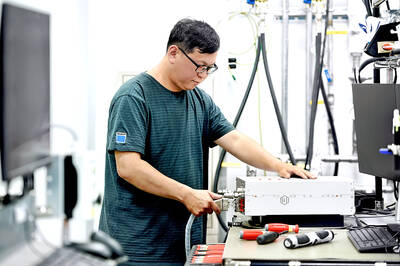
SEMICONDUCTORS: The German laser and plasma generator company will expand its local services as its specialized offerings support Taiwan’s semiconductor industries Trumpf SE + Co KG, a global leader in supplying laser technology and plasma generators used in chip production, is expanding its investments in Taiwan in an effort to deeply integrate into the global semiconductor supply chain in the pursuit of growth. The company, headquartered in Ditzingen, Germany, has invested significantly in a newly inaugurated regional technical center for plasma generators in Taoyuan, its latest expansion in Taiwan after being engaged in various industries for more than 25 years. The center, the first of its kind Trumpf built outside Germany, aims to serve customers from Taiwan, Japan, Southeast Asia and South Korea,
POWERING UP: PSUs for AI servers made up about 50% of Delta’s total server PSU revenue during the first three quarters of last year, the company said Power supply and electronic components maker Delta Electronics Inc (台達電) reported record-high revenue of NT$161.61 billion (US$5.11 billion) for last quarter and said it remains positive about this quarter. Last quarter’s figure was up 7.6 percent from the previous quarter and 41.51 percent higher than a year earlier, and largely in line with Yuanta Securities Investment Consulting Co’s (元大投顧) forecast of NT$160 billion. Delta’s annual revenue last year rose 31.76 percent year-on-year to NT$554.89 billion, also a record high for the company. Its strong performance reflected continued demand for high-performance power solutions and advanced liquid-cooling products used in artificial intelligence (AI) data centers,

Gasoline and diesel prices at domestic fuel stations are to fall NT$0.2 per liter this week, down for a second consecutive week, CPC Corp, Taiwan (台灣中油) and Formosa Petrochemical Corp (台塑石化) announced yesterday. Effective today, gasoline prices at CPC and Formosa stations are to drop to NT$26.4, NT$27.9 and NT$29.9 per liter for 92, 95 and 98-octane unleaded gasoline respectively, the companies said in separate statements. The price of premium diesel is to fall to NT$24.8 per liter at CPC stations and NT$24.6 at Formosa pumps, they said. The price adjustments came even as international crude oil prices rose last week, as traders
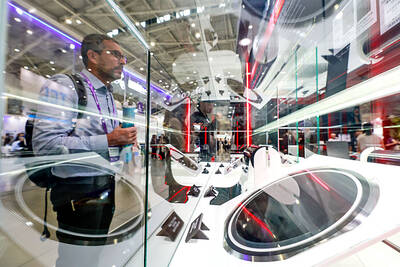
SIZE MATTERS: TSMC started phasing out 8-inch wafer production last year, while Samsung is more aggressively retiring 8-inch capacity, TrendForce said Chipmakers are expected to raise prices of 8-inch wafers by up to 20 percent this year on concern over supply constraints as major contract chipmakers Taiwan Semiconductor Manufacturing Co (TSMC, 台積電) and Samsung Electronics Co gradually retire less advanced wafer capacity, TrendForce Corp (集邦科技) said yesterday. It is the first significant across-the-board price hike since a global semiconductor correction in 2023, the Taipei-based market researcher said in a report. Global 8-inch wafer capacity slid 0.3 percent year-on-year last year, although 8-inch wafer prices still hovered at relatively stable levels throughout the year, TrendForce said. The downward trend is expected to continue this year,


 RSS
RSS