


The Taiwan Institute of Economic Research (TIER, 台灣經濟研究院) yesterday raised its forecast for the nation’s GDP growth this year to 2.04 percent, from its last projection of 1.78 percent, saying that exports would increase as the global economy continues to improve.
The think tank estimated that GDP expanded 2.55 percent in the first quarter, but that growth would slow over the rest of the year as a low-base effect tapers off.
“While GDP growth might rise above 2 percent this year, momentum is likely to weaken each quarter due to a lack of major catalysts,” TIER economist Gordon Sun (孫明德) told a news conference in Taipei.
Exports of electronics, raw materials and machinery equipment — the nation’s main drivers of growth — have benefited from recovering inventory demand as price concerns fade amid stabilizing global crude oil prices, Sun said.
Inventory-building and a low base last year accounted for a 15.1 percent year-on-year surge in exports during the January-to-March period despite it being the slow sales season, the economist said.
Foreign firms would need strong sales over the rest of the year to continue ordering products from Taiwan in a similarly aggressive fashion, Sun said.
Taiwan is home to the world’s largest contract chipmakers, chip designers, electronic component suppliers and machinery vendors.
Sun said he failed to any see encouraging signs on the horizon and that expectations of a drastic boost from the next-generation of iPhones might be without foundation.
Apple Inc is reportedly planning a major redesign for its popular handheld device, which is to be unveiled in the second half of the year.
Sun said he doubted a technological breakthrough would achieve a satisfactory yield rate.
That is why the institute set its GDP growth forecast at 2.3 percent for this quarter, 1.9 percent for the third quarter and 1.47 percent for the final quarter, he said.
Stagnating global crude prices lent support to a guardedly optimistic outlook, Sun said.
On the domestic front, consumer consumption is expected to expand 1.93 percent this year, slightly better than the 1.91 percent the institute predicted three months earlier.
Faster growth would require a noticeable wage increase for the nation’s workers, as wages have been stagnant for more than a decade, Sun said.
The institute did not factor in the Cabinet’s Forward-looking Infrastructure Construction Project, saying that only NT$20 billion (US$663.31 million) is allocated to spent this year and budget implementation tends to be inefficient.
TIER expects the New Taiwan dollar to trade at an average of NT$31.2 against the greenback this year, financial expert Wu Meng-dao (吳孟道) said.
That would suggest a 3.47 percent depreciation going forward, from the closing rate of NT$30.152 in Taipei trading yesterday.
The US Federal Reserve is to hike interest rates further this year, making the US dollar a more attractive investment option, Wu said.
Taiwan’s central bank is likely to hold policy rates unchanged this year in a bid to support the economy, Wu said.
CHIP RACE: Three years of overbroad export controls drove foreign competitors to pursue their own AI chips, and ‘cost US taxpayers billions of dollars,’ Nvidia said China has figured out the US strategy for allowing it to buy Nvidia Corp’s H200s and is rejecting the artificial intelligence (AI) chip in favor of domestically developed semiconductors, White House AI adviser David Sacks said, citing news reports. US President Donald Trump on Monday said that he would allow shipments of Nvidia’s H200 chips to China, part of an administration effort backed by Sacks to challenge Chinese tech champions such as Huawei Technologies Co (華為) by bringing US competition to their home market. On Friday, Sacks signaled that he was uncertain about whether that approach would work. “They’re rejecting our chips,” Sacks
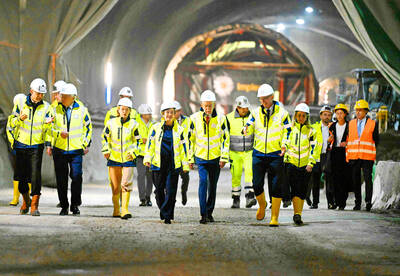
It is challenging to build infrastructure in much of Europe. Constrained budgets and polarized politics tend to undermine long-term projects, forcing officials to react to emergencies rather than plan for the future. Not in Austria. Today, the country is to officially open its Koralmbahn tunnel, the 5.9 billion euro (US$6.9 billion) centerpiece of a groundbreaking new railway that will eventually run from Poland’s Baltic coast to the Adriatic Sea, transforming travel within Austria and positioning the Alpine nation at the forefront of logistics in Europe. “It is Austria’s biggest socio-economic experiment in over a century,” said Eric Kirschner, an economist at Graz-based Joanneum

BUBBLE? Only a handful of companies are seeing rapid revenue growth and higher valuations, and it is not enough to call the AI trend a transformation, an analyst said Artificial intelligence (AI) is entering a more challenging phase next year as companies move beyond experimentation and begin demanding clear financial returns from a technology that has delivered big gains to only a small group of early adopters, PricewaterhouseCoopers (PwC) Taiwan said yesterday. Most organizations have been able to justify AI investments through cost recovery or modest efficiency gains, but few have achieved meaningful revenue growth or long-term competitive advantage, the consultancy said in its 2026 AI Business Predictions report. This growing performance gap is forcing executives to reconsider how AI is deployed across their organizations, it said. “Many companies
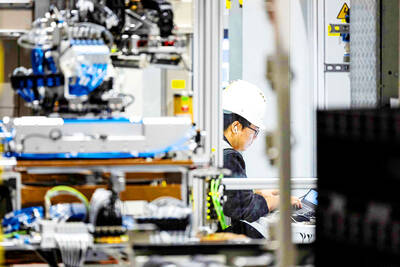
France is developing domestic production of electric vehicle (EV) batteries with an eye on industrial independence, but Asian experts are proving key in launching operations. In the Verkor factory outside the northern city of Dunkirk, which was inaugurated on Thursday, foreign specialists, notably from South Korea and Malaysia, are training the local staff. Verkor is the third battery gigafactory to open in northern France in a region that has become known as “Battery Valley.” At the Automotive Energy Supply Corp (AESC) factory near the city of Douai, where production has been under way for several months, Chinese engineers and technicians supervise French recruits. “They


 RSS
RSS