


Giant Manufacturing Co Ltd (巨大機械), the nation’s largest bicycle maker, yesterday said it expects revenue contribution from electric bikes to reach 10 percent by 2022, compared with last year’s 7 percent.
The target has been set because of robust demand for electric bikes in Europe, despite the company’s gloomy performance last year.
Giant had a difficult year last year, with cumulative revenue down 5.57 percent to NT$57.01 billion (US$1.87 billion) from the previous year, according to a company filing with the Taiwan Stock Exchange.

Photo: CNA
In the first three quarters of last year, the company saw its net profit fall 20 percent year-on-year to NT$2.4 billion, or earnings per share of NT$6.4, the company’s latest data showed.
The company has not yet released its results for the final quarter of last year.
However, in the European market alone, revenue from electric bikes last year soared 50 percent year-on-year, Giant said.
Apart from Europe, the company said it also plans to expand its electric bike business in the US and Australia this year.
“We are planning to introduce electric mountain bikes [to the US market] this year to attract more customers who are fond of outdoor activities,” Giant chairwoman Bonnie Tu (杜綉珍) yesterday told reporters at the Taipei International Cycle Show.
Following a diversified product strategy, Giant is also to launch its first electric bike for female cyclists under its sub-brand Liv in the first half of this year.
Looking ahead, Giant gave a conservative outlook for this year, as the company still has concerns about its business in China.
The decline in sales and profits last year was mainly due to sliding revenue from China, Giant chief executive Young Liu (劉湧昌) said.
Revenue from China contributed 18 percent of the company’s total sales last year, while sales from Europe and the US accounted for 31 percent and 21 percent respectively, company data showed.
The company said it is facing intense competition in China, despite increasing demand for bikes.
Most Chinese customers tend to buy low-priced bikes to commute to work, but Giant mainly provides high-end products, such as road bikes and touring bikes, Liu said.
He said the company is to launch a “special plan” for the Chinese market in the second half of this year, but he declined to provide details.
Shares of Giant, which distributes its products in more than 80 nations, fell 0.27 percent to close at NT$185.5 in Taipei trading yesterday.
Taiwan’s long-term economic competitiveness will hinge not only on national champions like Taiwan Semiconductor Manufacturing Co. (TSMC, 台積電) but also on the widespread adoption of artificial intelligence (AI) and other emerging technologies, a US-based scholar has said. At a lecture in Taipei on Tuesday, Jeffrey Ding, assistant professor of political science at the George Washington University and author of "Technology and the Rise of Great Powers," argued that historical experience shows that general-purpose technologies (GPTs) — such as electricity, computers and now AI — shape long-term economic advantages through their diffusion across the broader economy. "What really matters is not who pioneers

In a high-security Shenzhen laboratory, Chinese scientists have built what Washington has spent years trying to prevent: a prototype of a machine capable of producing the cutting-edge semiconductor chips that power artificial intelligence (AI), smartphones and weapons central to Western military dominance, Reuters has learned. Completed early this year and undergoing testing, the prototype fills nearly an entire factory floor. It was built by a team of former engineers from Dutch semiconductor giant ASML who reverse-engineered the company’s extreme ultraviolet lithography (EUV) machines, according to two people with knowledge of the project. EUV machines sit at the heart of a technological Cold
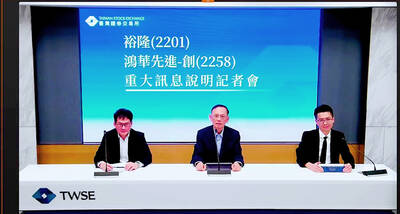
TAIWAN VALUE CHAIN: Foxtron is to fully own Luxgen following the transaction and it plans to launch a new electric model, the Foxtron Bria, in Taiwan next year Yulon Motor Co (裕隆汽車) yesterday said that its board of directors approved the disposal of its electric vehicle (EV) unit, Luxgen Motor Co (納智捷汽車), to Foxtron Vehicle Technologies Co (鴻華先進) for NT$787.6 million (US$24.98 million). Foxtron, a half-half joint venture between Yulon affiliate Hua-Chuang Automobile Information Technical Center Co (華創車電) and Hon Hai Precision Industry Co (鴻海精密), expects to wrap up the deal in the first quarter of next year. Foxtron would fully own Luxgen following the transaction, including five car distributing companies, outlets and all employees. The deal is subject to the approval of the Fair Trade Commission, Foxtron said. “Foxtron will be

INFLATION CONSIDERATION: The BOJ governor said that it would ‘keep making appropriate decisions’ and would adjust depending on the economy and prices The Bank of Japan (BOJ) yesterday raised its benchmark interest rate to the highest in 30 years and said more increases are in the pipeline if conditions allow, in a sign of growing conviction that it can attain the stable inflation target it has pursued for more than a decade. Bank of Japan Governor Kazuo Ueda’s policy board increased the rate by 0.2 percentage points to 0.75 percent, in a unanimous decision, the bank said in a statement. The central bank cited the rising likelihood of its economic outlook being realized. The rate change was expected by all 50 economists surveyed by Bloomberg. The


 RSS
RSS