


If last year was the year of political shocks, this could be the year when their impact on the global economy materializes. Bloomberg’s Misery Index — which combines countries’ inflation and unemployment outlooks for this year — aims to reveal just that.
For the third year in a row, Venezuela’s economic and political problems make it the most miserable in the ranking. The least miserable country is once again Thailand — in large part due to its unique way of calculating employment — and the rest of the ladder features noteworthy moves by the UK, Poland and Mexico, to name a few.
Economic woes have plagued Venezuela for years. Sluggish crude oil prices, the country’s only significant export, have fueled a crisis that has left grocery store shelves empty, hospitals without basic medication and violent crime rampant as desperation leads to anger.
While the country has not reported economic data since 2015, Bloomberg’s Cafe Con Leche Index, which aims to track inflation via the cost of a cup of coffee, shows a price surge of 1,419 percent since mid-August of that year.
Economists estimate that prices would rise almost six-fold this year, according to the median estimate in a Bloomberg survey.
Moving closer to Venezuela’s territory — although no country even comes close to its score of nearly 500 — are a handful of central and eastern European countries.
Poland, which experienced the biggest negative move, clocks in at No. 28 among this year’s 65 economies, from a rank of 45 in last year’s index of actual performance. The higher the ranking, the more miserable the economy.
Although it has seen a steady decline in its unemployment rate since the financial crisis, inflation rose to 1.8 percent in January after Poland’s longest period of deflation on record. Similar price increases in Romania, Estonia, Latvia and Slovakia drove large jumps in the countries’ rankings.
The misery has also deepened in Mexico, according to the index.
After finishing last year at No. 38, it is slated to rise to 31st place as inflation balloons to a forecast of 5 percent this year from an average 2.8 percent last year. A combination of the end of government fuel subsidies and the peso’s 11 percent decline against the US dollar since the US presidential election in November last year is pressuring prices.
The UK’s move by two notches toward more misery comes on the heels of the Brexit vote, which has driven the pound to a more than 30-year low, pushing up the cost of imports and, along with it, inflation. Price growth has been sluggish in the UK since crude oil prices fell at the end of 2014.
Making strides to become less miserable is a diverse cast of characters: Norway, Peru and even China.
Norway’s economic woes could at least lower prices for consumers this year, allowing the country some room to improve on last year’s mediocre performance and become less miserable by 18 spots. Economists see crude oil spending slipping this year while unemployment holds at about 4.8 percent — the latter perhaps a credit to the government’s spending spree.
Peru is also poised to impress with a noteworthy 13-position move toward a happier economy. Again, this is good news for bad reasons: Peru was more miserable than expected last year as a drought sparked food-price inflation and weak domestic demand weighed on the labor market. Economists appear to agree with Peru’s central bank, which sees improvement in investment and trade on the horizon.
Other most-improved nations in the rankings this year are Taiwan, Hong Kong, the Netherlands, China, Ecuador and Russia — each set to move down nine spots or more.
A rosier outlook in China, the world’s second-biggest economy, is a boon for global prospects.

Taiwan Semiconductor Manufacturing Co (TSMC, 台積電) last week recorded an increase in the number of shareholders to the highest in almost eight months, despite its share price falling 3.38 percent from the previous week, Taiwan Stock Exchange data released on Saturday showed. As of Friday, TSMC had 1.88 million shareholders, the most since the week of April 25 and an increase of 31,870 from the previous week, the data showed. The number of shareholders jumped despite a drop of NT$50 (US$1.59), or 3.38 percent, in TSMC’s share price from a week earlier to NT$1,430, as investors took profits from their earlier gains

AI TALENT: No financial details were released about the deal, in which top Groq executives, including its CEO, would join Nvidia to help advance the technology Nvidia Corp has agreed to a licensing deal with artificial intelligence (AI) start-up Groq, furthering its investments in companies connected to the AI boom and gaining the right to add a new type of technology to its products. The world’s largest publicly traded company has paid for the right to use Groq’s technology and is to integrate its chip design into future products. Some of the start-up’s executives are leaving to join Nvidia to help with that effort, the companies said. Groq would continue as an independent company with a new chief executive, it said on Wednesday in a post on its Web

CHINA RIVAL: The chips are positioned to compete with Nvidia’s Hopper and Blackwell products and would enable clusters connecting more than 100,000 chips Moore Threads Technology Co (摩爾線程) introduced a new generation of chips aimed at reducing artificial intelligence (AI) developers’ dependence on Nvidia Corp’s hardware, just weeks after pulling off one of the most successful Chinese initial public offerings (IPOs) in years. “These products will significantly enhance world-class computing speed and capabilities that all developers aspire to,” Moore Threads CEO Zhang Jianzhong (張建中), a former Nvidia executive, said on Saturday at a company event in Beijing. “We hope they can meet the needs of more developers in China so that you no longer need to wait for advanced foreign products.” Chinese chipmakers are in
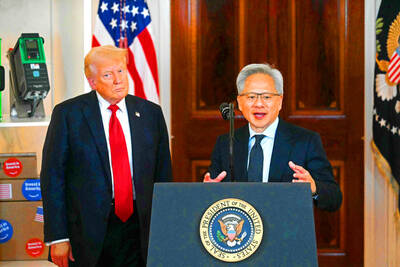
POLICY REVERSAL: The decision to allow sales of Nvidia’s H200 chips to China came after years of tightening controls and has drawn objections among some Republicans US House Republicans are calling for arms-sale-style congressional oversight of artificial intelligence (AI) chip exports as US President Donald Trump’s administration moves to approve licenses for Nvidia Corp to ship its H200 processor to China. US Representative Brian Mast, the Republican chairman of the US House Committee on Foreign Affairs, which oversees export controls, on Friday introduced a bill dubbed the AI Overwatch Act that would require the US Congress to be notified of AI chips sales to adversaries. Any processors equal to or higher in capabilities than Nvidia’s H20 would be subject to oversight, the draft bill says. Lawmakers would have


 RSS
RSS