


Foxconn Technology Group (富士康), the world’s largest contract electronics manufacturer, yesterday acknowledged that it intends to buy Toshiba Corp’s loss-making chip business.
Foxconn chairman Terry Gou (郭台銘) announced the plan during a groudbreaking ceremony for a factory in China.
“We have the experience of [buying] Sharp Corp. We are sincere and confident about [investing in] Toshiba,” Gou told a media briefing after the ceremony at Sakai Display Production Corp’s (SDP) 10.5-generation display factory in Guangzhou, China.
The briefing was live-streamed on the Internet.
It was the first time Gou publicly confirmed the company’s interests in purchasing Toshiba’s memorychip business, after the Japanese firm last month said it plans to sell stakes in its memorychip unit and other businesses, in a bid to alleviate its financial troubles.
After South Korea’s Samsung Electronics Co, Toshiba is the second-largest NAND flash memory chip manufacturer in the world.
The Japanese firm is reportedly to send letters soliciting offers for the memorychip business this week and is seeking bids valued at ¥1.5 trillion (US$13.19 billion), Bloomberg reported yesterday, citing people familiar with the matter.
Potential bidders include Foxconn, South Korea’s SK Hynix Inc, Micron Technology Inc and Western Digital Corp, the report said.
Gou said Foxconn is a client and a partner of Toshiba’s.
The company is going to need more flash memory and solid-state- drive capacity from Toshiba to store its daily manufacturing data, he said.
Foxconn is developing ultra-high-resolution 8K technology, necessitating a massive amount of memory.
“We need the memory products. We need Toshiba,” Gou said.
Gou did not say if Foxconn has officially submitted a bid or how many of Toshiba’s businesses it is willing to buy, however he said: “Money should not be the only thing [for Toshiba] to consider.”
Foxconn can leverage its advantages to financially support Toshiba, assist the firm in its operations and offer resources to help sell its products all over the world, he said.
Since Foxconn is not a chipmaker, monopoly issues would not pose a problem for regulators, Gou said.
Foxconn’s cash and cash equivalents totaled NT$653.09 billion (US$21.23 billion) as of September last year, according to a company filing with the Taiwan Stock Exchange.
The company has not yet released its financial statements for the final quarter of last year.
In related news, SDP, in which Gou holds a more than 50 percent stake, is expected to launch operations at its new 10.5-generation display factory in Guangzhou in 2019 to produce 8K displays and 8K solutions at the earliest, SDP said in a news release.
It has only been 60 days since Gou, on behalf of SDP, struck a 61 billion yuan (US$8.87 billion) investment deal with the Guangzhou City Government on Dec. 30 last year.
The industrial park would be a strategic base for SDP to develop displays, smart TVs and electronics whiteboards, SDP’s statement said.
SDP said the plant is to produce 90,000 display panels per month and the industrial park could generate an annual production value of 92 billion yuan when fully operational.
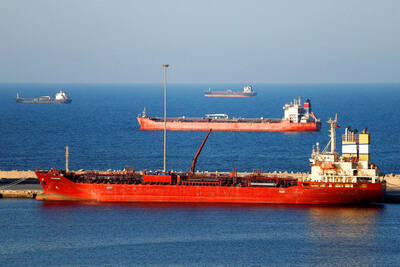
HORMUZ ISSUE: The US president said he expected crude prices to drop at the end of the war, which he called a ‘minor excursion’ that could continue ‘for a little while’ The United Arab Emirates (UAE) and Kuwait started reducing oil production, as the near-closure of the crucial Strait of Hormuz ripples through energy markets and affects global supply. Abu Dhabi National Oil Co (ADNOC) is “managing offshore production levels to address storage requirements,” the company said in a statement, without giving details. Kuwait Petroleum Corp said it was lowering production at its oil fields and refineries after “Iranian threats against safe passage of ships through the Strait of Hormuz.” The war in the Middle East has all but closed Hormuz, the narrow waterway linking the Persian Gulf to the open seas,
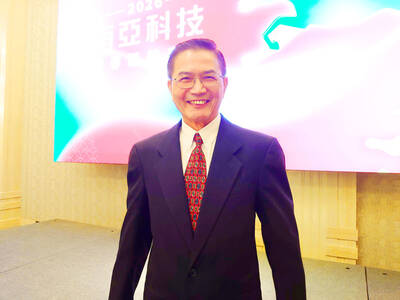
Nanya Technology Corp (南亞科技) yesterday said the DRAM supply crunch could extend through 2028, as the artificial intelligence (AI) boom has led the world’s major memory makers to dramatically reduce production of standard DRAM and allocate a significant portion of their capacity for high-bandwidth memory (HBM) chips. The most severe supply constraints would stretch to the first half of next year due to “very limited” increases in new DRAM capacity worldwide, Nanya Technology president Lee Pei-ing (李培瑛) told a news briefing. The company plans to increase monthly 12-inch wafer capacity to 20,000 in the first half of 2028 after a
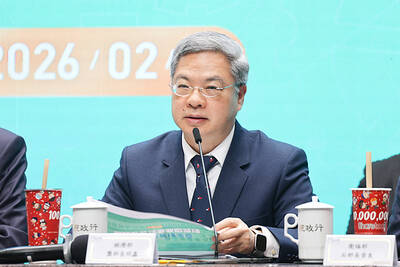
Taiwan has enough crude oil reserves for more than 100 days and sufficient natural gas reserves for more than 11 days, both above the regulatory safety requirement, Minister of Economic Affairs Kung Ming-hsin (龔明鑫) said yesterday, adding that the government would prioritize domestic price stability as conflicts in the Middle East continue. Overall, energy supply for this month is secure, and the government is continuing efforts to ensure sufficient supply for next month, Kung told reporters after meeting with representatives from business groups at the ministry in Taipei. The ministry has been holding daily cross-ministry meetings at the Executive Yuan to ensure
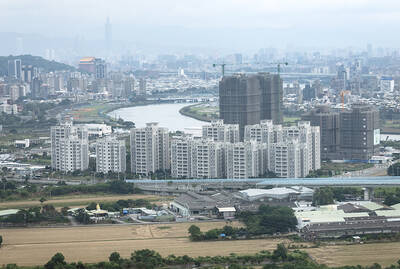
Property transactions in the nation’s six special municipalities plunged last month, as a lengthy Lunar New Year holiday combined with ongoing credit tightening dampened housing market activity, data compiled by local land administration offices released on Monday showed. The six cities recorded a total of 10,480 property transfers last month, down 42.5 percent from January and marking the second-lowest monthly level on record, the data showed. “The sharp drop largely reflected seasonal factors and tighter credit conditions,” Evertrust Rehouse Co (永慶房屋) deputy research manager Chen Chin-ping (陳金萍) said. The nine-day Lunar New Year holiday fell in February this year, reducing


 RSS
RSS