


Shares in Taiwan on Friday closed slightly lower on reduced turnover as investors turned cautious ahead of the 228 Memorial Day holiday long weekend, dealers said.
Selling focused on select large-cap non-high-tech stocks, in particular petrochemical and financial firms, to push down the weighted index, but the semiconductor sector bucked the downturn, bolstering the electronics sector and the broader market, they said.
The weighted index on the Taiwan Stock Exchange ended down 18.84 points, or 0.19 percent, at 9,750.47, after moving between 9,740.18 and 9,784.39. The index was down 0.1 percent from its close of 9,759.76 on Feb. 17.
Turnover on Friday was NT$89.69 billion (US$2.93 billion), down from Thursday’s NT$101.07 billion.
The market opened on Friday down 0.12 percent on follow-through selling from a session earlier, dealers said, adding that it soon regained its footing to vault the weighted index into positive territory, but traded within a narrow range for the rest of the session.
Downward pressure turned more visible late in the session, pushing down certain market heavyweights such as Formosa Petrochemical Corp (台塑石化) and Cathay Financial Holding Co (國泰金控).
Contract chipmaker United Microelectronics Corp (UMC, 聯電) trended sharply higher to offset the selling, dealers said.
“Look at the reduced trading volume. Many investors turned cautious ahead of the four-day holiday, worried that negative leads from global financial markets might pop up while Taiwan’s market is closed,” KGI Securities Co (凱基證券) analyst Phil Chu said.
The stock exchange is to reopen for trading on Wednesday.
“The late-session selling largely reflected the index adjustments by MSCI Inc after a quarterly index review,” Chu said.
The adjustments took effect after the market closed on Friday.
Taiwan’s weighting in the MSCI All-Country Asia ex-Japan Index was cut from 14.27 percent to 14.24 percent, while the nation’s weightings in the MSCI All-Country World Index and MSCI Emerging Markets Index were left unchanged at 1.29 percent and 12.06 percent respectively.
The old economy and financial sectors suffered relatively heavy downward pressure during the session, as investors continued to pocket gains built in recent sessions, Chu said.
In the old economy sector, Formosa Petrochemical fell 1.83 percent on Friday to close at NT$107.00 and Formosa Chemicals & Fibre Corp (台化) lost 0.31 percent to end at NT$97.20, while food maker Uni-President Enterprise Corp (統一企業) gained 0.18 percent to close at NT$54.60.
In the financial sector, which ended on Friday down 0.16 percent, Cathay Financial closed 0.72 lower at NT$48.25 and Mega Financial Holding Co (兆豐金控) fell 0.83 percent to close at NT$23.90.
Yuanta Financial Holding Co (元大金控) ended up 1.56 percent at NT$13.00.
“Fortunately, the semiconductor sector fared well, with UMC leading the gains to prevent the broader market from falling further,” Chu said.
UMC, the second-largest contract chipmaker in the nation, soared 8.51 percent to close at NT$12.75 after the company on Thursday said that it had begun commercial production with its 14-nanometer process, giving investors hope of higher earnings in the future.
Rival Taiwan Semiconductor Manufacturing Co (台積電), the world’s largest contract chipmaker, gained 0.27 percent to end at NT$189.00.
The semiconductor subindex closed up 0.30 percent.
“The main board still faced stiff technical resistance ahead of 9,800 points, but the weighted index has seen technical support at about 9,700 points,” Chu said. “In other words, the market remained in consolidation mode.”
Elsewhere, investors adopted a cautious tone at the end of a positive week for Asian stocks.
Hong Kong stocks fell for a second day, while Tokyo shares dropped even as the yen retreated after a two-day gain.
A fifth weekly gain for Asian shares that has helped push the value of global equities above US$70 trillion is losing momentum as money managers grapple with political uncertainty and the US Federal Reserve’s schedule for lifting borrowing costs.
Federal Reserve Bank of Dallas President Robert Kaplan urged his colleagues at the US central bank to seize opportunities to raise interest rates, even as he said they should keep their options open ahead of next month’s policy meeting.
“There are those out there thinking: ‘Well, markets have had such a big run-up, it’s time to take a bit of money off the table,”’ said Shane Oliver, Sydney-based head of investment strategy at AMP Capital Investors Ltd, which managed about US$120 billion as of December last year. “It wouldn’t surprise me to see a bit of consolidation or correction and maybe we’re starting to see signs of that.”
Markets from stocks to currencies were subjected to intraday fluctuations this week, as investors hang on each word from central bank officials and politicians.
In addition to concerns about interest rates and US President Donald Trump’s economic policies, traders are also watching developments in French presidential elections and the UK’s Brexit plans.
“As the market waits for details on US tax cuts, it’s more likely that officials’ comments affect the market,” Sompo Japan Nipponkoa Asset Management portfolio manager Kenji Ueno said. “US fiscal policy is moving toward expansion, but the administration may be trying to cool off some of the expectation.”
Japan’s TOPIX on Friday lost 0.4 percent. The gauge rose 0.4 percent for the week.
Australia’s S&P/ASX 200 Index retreated 0.8 percent.
BHP Billiton declined 5.9 percent for the week in Sydney, the biggest loss since May last year.
Hong Kong’s Hang Seng dropped 0.4 percent, retreating for a second day after reaching the highest since August 2015.
The Hang Seng China Enterprises Index lost 0.9 percent, paring the week’s advance.
Baidu Inc (百度) surged in after-hours trading in New York as profit topped estimates.
Yields on 10-year US Treasuries were little changed at 2.38 percent, after dropping four basis points on Thursday.
Australia 10-year yields fell six basis points to 2.73 percent.
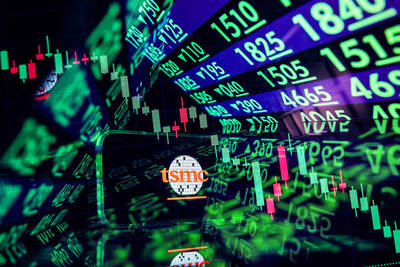
Taiwan Semiconductor Manufacturing Co (TSMC, 台積電) last week recorded an increase in the number of shareholders to the highest in almost eight months, despite its share price falling 3.38 percent from the previous week, Taiwan Stock Exchange data released on Saturday showed. As of Friday, TSMC had 1.88 million shareholders, the most since the week of April 25 and an increase of 31,870 from the previous week, the data showed. The number of shareholders jumped despite a drop of NT$50 (US$1.59), or 3.38 percent, in TSMC’s share price from a week earlier to NT$1,430, as investors took profits from their earlier gains
AI TALENT: No financial details were released about the deal, in which top Groq executives, including its CEO, would join Nvidia to help advance the technology Nvidia Corp has agreed to a licensing deal with artificial intelligence (AI) start-up Groq, furthering its investments in companies connected to the AI boom and gaining the right to add a new type of technology to its products. The world’s largest publicly traded company has paid for the right to use Groq’s technology and is to integrate its chip design into future products. Some of the start-up’s executives are leaving to join Nvidia to help with that effort, the companies said. Groq would continue as an independent company with a new chief executive, it said on Wednesday in a post on its Web

CHINA RIVAL: The chips are positioned to compete with Nvidia’s Hopper and Blackwell products and would enable clusters connecting more than 100,000 chips Moore Threads Technology Co (摩爾線程) introduced a new generation of chips aimed at reducing artificial intelligence (AI) developers’ dependence on Nvidia Corp’s hardware, just weeks after pulling off one of the most successful Chinese initial public offerings (IPOs) in years. “These products will significantly enhance world-class computing speed and capabilities that all developers aspire to,” Moore Threads CEO Zhang Jianzhong (張建中), a former Nvidia executive, said on Saturday at a company event in Beijing. “We hope they can meet the needs of more developers in China so that you no longer need to wait for advanced foreign products.” Chinese chipmakers are in
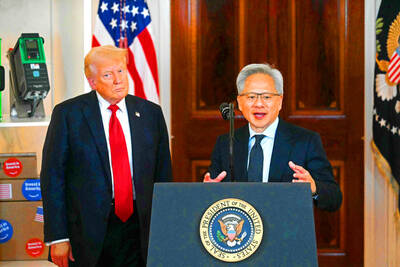
POLICY REVERSAL: The decision to allow sales of Nvidia’s H200 chips to China came after years of tightening controls and has drawn objections among some Republicans US House Republicans are calling for arms-sale-style congressional oversight of artificial intelligence (AI) chip exports as US President Donald Trump’s administration moves to approve licenses for Nvidia Corp to ship its H200 processor to China. US Representative Brian Mast, the Republican chairman of the US House Committee on Foreign Affairs, which oversees export controls, on Friday introduced a bill dubbed the AI Overwatch Act that would require the US Congress to be notified of AI chips sales to adversaries. Any processors equal to or higher in capabilities than Nvidia’s H20 would be subject to oversight, the draft bill says. Lawmakers would have


 RSS
RSS