


US President Donald Trump’s administration this week is to begin laying groundwork for a trade deal between the US and the UK that would take effect after Britain leaves the EU, a White House aide said.
British Prime Minister Theresa May last week said that she would move to cleanly separate her country’s economy from Europe’s and enact immigration controls before negotiating new trade deals with the continent and other countries, an approach deemed a “hard Brexit.”
Trump officials believe their talks with the British government encouraged May to be more aggressive in exiting the union.
Two of Trump’s senior advisers, Steve Bannon and the president’s son-in-law Jared Kushner, met with UK Secretary of Foreign Affairs Boris Johnson in New York on Jan. 8. The three are preparing for the future pact, the aide said, requesting anonymity because the discussions are not public.
Bannon, US National Security Adviser Michael Flynn and other administration officials have also met with British defense and intelligence leaders, the aide said.
The British embassy in Washington had no immediate comment.
May and Mexican President Enrique Pena Nieto will make visits to the US this month to meet with Trump, White House officials said.
May is to meet with Trump on Friday, White House Deputy Press Secretary Sarah Huckabee said on Saturday.
Pena Nieto is to meet with Trump on Tuesday next week, White House Press Secretary Sean Spicer said.
Neither provided further details on the meetings.
Trade, immigration and Trump’s campaign promise to build a wall on the southern US border loom large in the president’s relations with Mexico.
Brexit, the campaign against Islamic State terrorism, the Syrian civil war and sanctions against Russia are key issues in relations between the Trump administration and the UK.
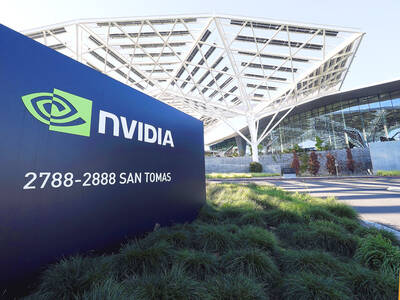
CHIP RACE: Three years of overbroad export controls drove foreign competitors to pursue their own AI chips, and ‘cost US taxpayers billions of dollars,’ Nvidia said China has figured out the US strategy for allowing it to buy Nvidia Corp’s H200s and is rejecting the artificial intelligence (AI) chip in favor of domestically developed semiconductors, White House AI adviser David Sacks said, citing news reports. US President Donald Trump on Monday said that he would allow shipments of Nvidia’s H200 chips to China, part of an administration effort backed by Sacks to challenge Chinese tech champions such as Huawei Technologies Co (華為) by bringing US competition to their home market. On Friday, Sacks signaled that he was uncertain about whether that approach would work. “They’re rejecting our chips,” Sacks

NATIONAL SECURITY: Intel’s testing of ACM tools despite US government control ‘highlights egregious gaps in US technology protection policies,’ a former official said Chipmaker Intel Corp has tested chipmaking tools this year from a toolmaker with deep roots in China and two overseas units that were targeted by US sanctions, according to two sources with direct knowledge of the matter. Intel, which fended off calls for its CEO’s resignation from US President Donald Trump in August over his alleged ties to China, got the tools from ACM Research Inc, a Fremont, California-based producer of chipmaking equipment. Two of ACM’s units, based in Shanghai and South Korea, were among a number of firms barred last year from receiving US technology over claims they have

It is challenging to build infrastructure in much of Europe. Constrained budgets and polarized politics tend to undermine long-term projects, forcing officials to react to emergencies rather than plan for the future. Not in Austria. Today, the country is to officially open its Koralmbahn tunnel, the 5.9 billion euro (US$6.9 billion) centerpiece of a groundbreaking new railway that will eventually run from Poland’s Baltic coast to the Adriatic Sea, transforming travel within Austria and positioning the Alpine nation at the forefront of logistics in Europe. “It is Austria’s biggest socio-economic experiment in over a century,” said Eric Kirschner, an economist at Graz-based Joanneum

OPTION: Uber said it could provide higher pay for batch trips, if incentives for batching is not removed entirely, as the latter would force it to pass on the costs to consumers Uber Technologies Inc yesterday warned that proposed restrictions on batching orders and minimum wages could prompt a NT$20 delivery fee increase in Taiwan, as lower efficiency would drive up costs. Uber CEO Dara Khosrowshahi made the remarks yesterday during his visit to Taiwan. He is on a multileg trip to the region, which includes stops in South Korea and Japan. His visit coincided the release last month of the Ministry of Labor’s draft bill on the delivery sector, which aims to safeguard delivery workers’ rights and improve their welfare. The ministry set the minimum pay for local food delivery drivers at


 RSS
RSS