


Far EasTone Telecommunications Co (遠傳電信) yesterday said it aims to add 1 million 4G users to its customer base this year to stave of the threat of revenue stagnation amid intensifying market competition.
That would bring the nation’s No. 3 telecom operator’s total number of 4G subscribers to 5.5 million.
The company’s 4.5 million 4G users as of the end of last year made up 62 percent of its mobile service subscribers.
Far EastTone forecast the nation’s 4G penetration rate this year would climb to between 70 percent and 75 percent of mobile users from last year’s 60 percent.
Far EasTone said that profits from its 4G service helped it raise its average revenue per user from NT$896 per month in 2015 to NT$901 per month in the third quarter of last year.
“The telecom industry is reaching a plateau in terms of revenue. It is very challenging. Market competition is very fierce,” Far EastTone president Yvonne Li (李彬) said yesterday. “Growth will come from new services such as digital services, or providing information and communication technology services for corporate clients.”
Commenting on the company’s plans to end the minimum payment of NT$689 per month for unlimited 4G services on Feb. 1, Li said “market competition is an important consideration.”
Due to fierce competition, Taiwan’s five telecoms operators decided to extend flat rates for 4G services — common during the 3G era — even though unlimited-rate plans are inhibiting their profits. All players including the nation’s biggest phone company Chunghwa Telecom Co (中華電信) are hesitant about scrapping flat rate plans.
“We believe offering tiered charges based on usage it is a long-term trend,” Li said.
Last year, Far EasTone posted NT$94.34 billion (US$2.95 billion) in revenue, down 3.03 percent from 2015’s NT$97.29 billion, according to company figures.
Net income last year dropped slightly to NT$11.41 billion, or NT$3.5 per share, compared with NT$11.49 billion, or earnings of NT$3.52 per share, in 2015.
Last year’s earnings per share beat the company’s forecast of NT$3.4 per share.
Taiwan Mobile Co (台灣大哥大), the nation’s No. 2 telecom company, yesterday said net income dropped to NT$15.32 billion last year, from NT$15.69 billion in 2015. Earnings per share fell to NT$5.63 last year from NT$5.76 the previous year.
The company’s revenue last year inched up 0.44 percent to NT$116.65 billion from 2015’s NT$116.14 billion.
Chunghwa Telecom yesterday said net income contracted 6.5 percent annually to NT$40.03 billion last year from NT$42.81 billion in 2015, while earnings per share fell to NT$5.16 from NT$5.52.
Revenue shrank 0.8 percent year-on-year to NT$230 billion last year from 2015’s NT$231.8 billion, the firm said.

Taiwan Semiconductor Manufacturing Co (TSMC, 台積電) last week recorded an increase in the number of shareholders to the highest in almost eight months, despite its share price falling 3.38 percent from the previous week, Taiwan Stock Exchange data released on Saturday showed. As of Friday, TSMC had 1.88 million shareholders, the most since the week of April 25 and an increase of 31,870 from the previous week, the data showed. The number of shareholders jumped despite a drop of NT$50 (US$1.59), or 3.38 percent, in TSMC’s share price from a week earlier to NT$1,430, as investors took profits from their earlier gains

In a high-security Shenzhen laboratory, Chinese scientists have built what Washington has spent years trying to prevent: a prototype of a machine capable of producing the cutting-edge semiconductor chips that power artificial intelligence (AI), smartphones and weapons central to Western military dominance, Reuters has learned. Completed early this year and undergoing testing, the prototype fills nearly an entire factory floor. It was built by a team of former engineers from Dutch semiconductor giant ASML who reverse-engineered the company’s extreme ultraviolet lithography (EUV) machines, according to two people with knowledge of the project. EUV machines sit at the heart of a technological Cold
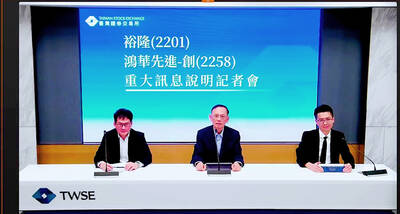
TAIWAN VALUE CHAIN: Foxtron is to fully own Luxgen following the transaction and it plans to launch a new electric model, the Foxtron Bria, in Taiwan next year Yulon Motor Co (裕隆汽車) yesterday said that its board of directors approved the disposal of its electric vehicle (EV) unit, Luxgen Motor Co (納智捷汽車), to Foxtron Vehicle Technologies Co (鴻華先進) for NT$787.6 million (US$24.98 million). Foxtron, a half-half joint venture between Yulon affiliate Hua-Chuang Automobile Information Technical Center Co (華創車電) and Hon Hai Precision Industry Co (鴻海精密), expects to wrap up the deal in the first quarter of next year. Foxtron would fully own Luxgen following the transaction, including five car distributing companies, outlets and all employees. The deal is subject to the approval of the Fair Trade Commission, Foxtron said. “Foxtron will be
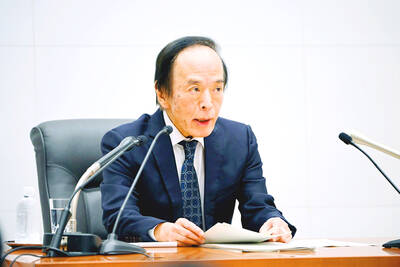
INFLATION CONSIDERATION: The BOJ governor said that it would ‘keep making appropriate decisions’ and would adjust depending on the economy and prices The Bank of Japan (BOJ) yesterday raised its benchmark interest rate to the highest in 30 years and said more increases are in the pipeline if conditions allow, in a sign of growing conviction that it can attain the stable inflation target it has pursued for more than a decade. Bank of Japan Governor Kazuo Ueda’s policy board increased the rate by 0.2 percentage points to 0.75 percent, in a unanimous decision, the bank said in a statement. The central bank cited the rising likelihood of its economic outlook being realized. The rate change was expected by all 50 economists surveyed by Bloomberg. The


 RSS
RSS