


Chunghwa Telecom Co (中華電信) yesterday said it would explore new partnerships, including forming a joint venture with a peer in Southeast Asia as the nation’s biggest telecom searches for new growth engines overseas.
The overseas expansion plan is in line with the government’s “new southbound policy” as President Tsai Ing-wen’s (蔡英文) administration encourages Taiwanese enterprises to divert their investments from China to ASEAN member states to better manage operational risks, Chunghwa Telecom chairman David Cheng (鄭優) told reporters.
Cheng unveiled his blueprint for Chunghwa Telecom’s business outlook at his first media appearance after assuming his new job at the company yesterday.

Photo: CNA
“Taiwanese businesses will not only need to be bankrolled when expanding to ASEAN, but they will also need telecom services,” Cheng said. “It is our hope to form a partnership [with an ASEAN telecom].”
The company’s longstanding cooperation with Vietnam Military Telecommunications Corp (Viettel) sets a good model for new partnerships, Cheng said.
Other forms of tie-up would also be considered, he said.
In 2008, Chunghwa Telecom created its first overseas joint venture with Viettel.
Viettel-CHT Co Ltd, which is 30 percent owned by Chunghwa Telecom, offers broadband leasing, Web hosting and disaster recovery services. Viettel controls the remaining 70 percent.
Aside from Viettel, Chunghwa Telecom also operates a branch in Singapore and plans to open one in Thailand.
“The overseas expansion will help the company expand its businesses to new areas,” Cheng said. “As the market is very competitive, we have to explore new areas for growth.”
In addition to overseas expansion, Chunghwa Telecom is focused on developing digital convergence as the company’s profits get squeezed amid intensifying competition from its rivals and cable TV operators, Cheng said.
“We have to seize on new business opportunities and adapt to new business models as the industry ushers in a new era of digital convergence,” Cheng said.
As part of its efforts to boost digital convergence, the company plans to increase and enrich the digital content it offers to Internet TV and over-the-top subscribers, he said.
He said that growing the company’s net profit would be his focus.
Chunghwa Telecom’s net profit rose to a four-year high last year, with earnings per share of NT$5.52.
Macquarie Research said that for next year, it expects the nation’s top three telecommunication firms to strive for a stable operating environment, while dealing with the potential nuisance created by the two smaller telecoms.
The investment agency holds a cautious outlook on the nation’s telecom sector.
Former Chunghwa Telecom chairman Rick Tsai (蔡力行) said the company’s market value has surged by about NT$100 billion to NT$799 billion since January 2013 when he took the post.
Company shareholders have received cash dividends totaling NT$15 per share over the past three years, representing about a 10 percent return on their investment, he said.

HORMUZ ISSUE: The US president said he expected crude prices to drop at the end of the war, which he called a ‘minor excursion’ that could continue ‘for a little while’ The United Arab Emirates (UAE) and Kuwait started reducing oil production, as the near-closure of the crucial Strait of Hormuz ripples through energy markets and affects global supply. Abu Dhabi National Oil Co (ADNOC) is “managing offshore production levels to address storage requirements,” the company said in a statement, without giving details. Kuwait Petroleum Corp said it was lowering production at its oil fields and refineries after “Iranian threats against safe passage of ships through the Strait of Hormuz.” The war in the Middle East has all but closed Hormuz, the narrow waterway linking the Persian Gulf to the open seas,

Apple Inc increased iPhone production in India by about 53 percent last year and now makes a quarter of its marquee devices there, reflecting the US company’s efforts to avoid tariffs on China. The company assembled about 55 million iPhones in India last year, up from 36 million a year earlier, people familiar with the matter said, asking not to be named because the numbers aren’t public. Apple makes about 220 million to 230 million iPhones a year globally, with India’s share of the total increasing rapidly. Apple has accelerated its expansion in the world’s most populous country in recent years, bolstered

HEADWINDS: The company said it expects its computer business, as well as consumer electronics and communications segments to see revenue declines due to seasonality Pegatron Corp (和碩) yesterday said it aims to grow its artificial intelligence (AI) server revenue more than 10-fold this year from last year, driven by orders from neocloud solutions clients and large cloud service providers. The electronics manufacturing service provider said AI server revenue growth would be driven primarily by the Nvidia Corp GB300 server platform. Server shipments are expected to increase each quarter this year, with the second half likely to outperform the first half, it said. The AI server market is expected to broaden this year as more inference applications emerge, which would drive demand for system-on-chip, application-specific integrated circuits
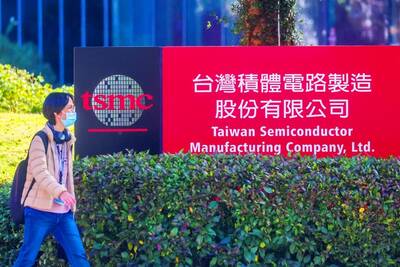
PROJECTION: TSMC said it expects strong growth this year, with revenue in US dollars projected to grow by about 30 percent, outperforming the industry Taiwan Semiconductor Manufacturing Co (TSMC, 台積電) yesterday reported consolidated sales last month reached NT$317.66 billion (US$9.98 billion), the highest ever for the month of February, driven by robust demand for chips built using the company’s advanced 3-nanometer (3nm) process. Last month’s figure was up 22.2 percent from a year earlier, but fell 20.8 percent from January, the world’s largest contract chipmaker said in a statement. For the first two months of the year, TSMC posted cumulative sales of NT$718.91 billion, up 29.9 percent from a year earlier. Analysts attributed the growth to sustained global demand for artificial intelligence (AI) products


 RSS
RSS