


Standard Chartered Bank yesterday opened a flagship digital branch in Taipei, the first iWealth center in the Asia-Pacific region, as the British banking group is seeking to better serve customers who increasingly carry out transactions online.
The iWealth center comes as part of the group’s efforts to invest US$1.5 billion over the next three years to provide customers digital solutions amid growing pressure from non-financial challengers vying for market share.
“We spent US$2 million setting up the digital hub in Taipei to demonstrate our commitment to the local market, which ranks on par with Singapore and Hong Kong in terms of importance,” Standard Chartered Taiwan chief executive officer John Tan (陳銘僑) told an opening ceremony.
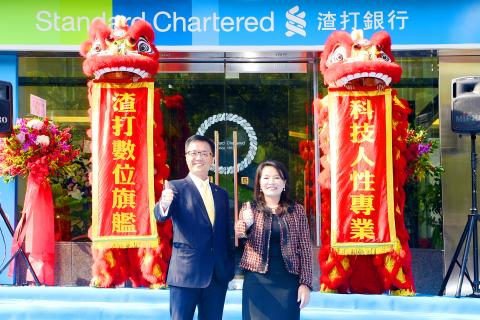
Photo: Taipei Times
The sleek-looking iWealth center is targeting affluent Taiwanese customers with net worth of NT$3 million (US$94,274) and above. They can sip expensive tea, read magazines and swipe through iPads when they visit the facility for financial consultation after booking a reservation through the bank’s Web site.
The iWealth service will be extended to other cities in Taiwan, starting with Taichung in central Taiwan in the first half of next year, Tan said.
The bank has trained numerous personnel to offer clients one-stop professional assistance on wealth management, financial analysis, asset allocations and other business needs, said Kate Lin (林素真), the lender’s retailing banking head.

Photo: Taipei Times
The digital hub aims to help customers benefit from the latest banking technology, as internal data show more than 60 percent of the bank’s customers limit their online transactions to cash withdrawals, savings deposits and other basic activities, Lin said, adding that iWealth offers much more.
All VIP rooms at the digital hub are equipped with three screens, with one displaying personal account details and the other two displaying information on market development and wealth management solutions, Lin said.
Customers can conduct cash withdrawals and other traditional banking transactions at the digital branch if they want, Lin said.
The iWealth center also gives clients access to a video banking platform earlier launched elsewhere.
With video banking, clients would be able to speak with banking consultants over a secure video connection, Lin said.
The new channel should allow clients to do almost anything they can in a branch via video, from signing up for a new card to finding a mortgage, Lin said, adding priority banking clients can use video banking to consult face-to-face with investment advisers to explore new wealth management opportunities.
“We are investing in technology that makes banking secure, simple and personal for our clients,” Lin said.
In addition to video banking, the bank’s retail clients — and prospective clients — will be able to connect with banking consultants through online chat and audio links on Standard Chartered’s Web site, Lin said.
The provision of expensive tea is intended especially to pamper female clients, who account for more than a majority of the bank’s clientele, Lin said, adding that Taiwanese consume 1.1kg of tea each year.
Sherri Chuang (莊琇媛), deputy director-general of banking bureau at the Financial Supervisory Commission, who participated the opening ceremony, said the commission has encouraged financial innovations.
Digitalization is necessary for the banking industry as more than 80 percent of clients have stopped visiting physical banks and prefer conducting business over the Internet, Chuang said.
The digital branch lends support to Standard Chartered Bank’s plans to deepen its presence in Taiwan after opening its first branch in 1985, Chuang said.
The Asia-focused bank hired 3,000 employees in Taiwan after announcing plans last year to cut 15,000 jobs to improve its finances, company data showed.


Taiwanese firms have increased investment in the Philippines in recent years as Manila’s ties with Washington deepen and global supply chains continue to shift away from China, an expert at the Chung-Hua Institution for Economic Research (CIER, 中華經濟研究院) said yesterday. The Philippines had not been among Taiwanese investors’ top choices in Southeast Asia, CIER Taiwan ASEAN Studies Center director Kristy Hsu (徐遵慈) said at a seminar in Taipei. However, Taiwan’s investment in the country has grown significantly since the COVID-19 pandemic, reaching US $257 million last year, a high in recent years, she said. Although Taiwan’s total investment in the Philippines still lags
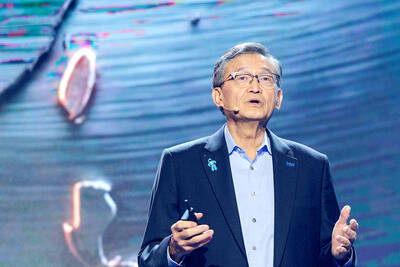
Intel Corp regards Taiwan Semiconductor Manufacturing Co (TSMC, 台積電) as a longstanding partner, as the US chipmaker would continue outsourcing production of advanced chips to TSMC, Intel chief executive officer Lip-Bu Tan (陳立武) said yesterday. “I don’t look at people as competitors. I look at the collaboration... Nvidia is also, you know, a good friend,” Tan told a news conference following his keynote speech at the Computex trade show in Taipei. “It’s a very trusted partnership for us... We are a big, top customer for them, and we’re going to continue doing that,” he said, referring to TSMC, the world’s largest foundry
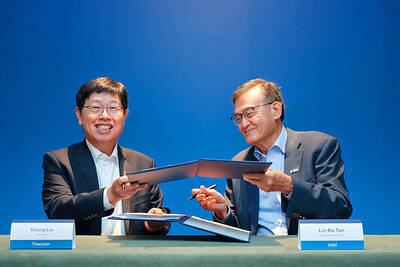
Hon Hai Precision Industry Co (鴻海精密) yesterday said it would work with US chipmaker Intel Corp to jointly develop and deploy next-generation artificial intelligence (AI) infrastructure and intelligent computing platforms in a move to capture booming demand for AI computing systems. Hon Hai, also known as Foxconn Technology Group (富士康), said in a statement that the partnership would combine its global manufacturing scale, system integration expertise and AI data center deployment capabilities with Intel’s strengths in processor architecture, silicon technologies and software ecosystem. The companies said they plan to work on equipment used in AI data centers, including server racks powered by

Artificial intelligence (AI) agents would supplant smartphones as the center of people’s digital lives, fundamentally reshaping personal devices and driving a major computing upgrade cycle, Qualcomm Inc CEO Cristiano Amon said yesterday. In his keynote speech for this year’s Computex trade show in Taipei, Amon said that the rise of "agentic AI" — AI systems capable of reasoning, planning and carrying out tasks autonomously — would transform how people interact with technology across phones, PCs, vehicles and wearable devices. Describing the technology as the next major evolution in computing, Amon said that "2026 is the year of agents.” For decades, smartphones have sat


 RSS
RSS