


The consumer price index (CPI) gained 1.97 percent last month from a year earlier, the fastest rise in eight months, as vegetable and fruit prices remained high due to continued supply shortages caused by typhoons in September, the Directorate-General of Budget, Accounting and Statistics (DGBAS) said yesterday.
The increase in the headline inflationary gauge might not spur the central bank to raise interest rates later this month, as such a move could derail the economy’s fragile recovery, economists said.
“Of major consumer items, the food category posed the biggest increase of 6.42 percent as the effect of bad weather lingered, pushing fruit and vegetable costs up by 37.53 and 9.56 percent respectively,” DGBAS Deputy Director Tsai Yu-tai (蔡鈺泰) told a news conference.
Together, fruit and vegetable price hikes lifted CPI by 1.44 percentage points last month, more than offsetting the benefits of cheaper electricity and gas costs, Tsai said.
As food costs account for 25 percent of CPI makeup, people with low incomes felt the pinch more, Tsai said.
The readings translate to a 2.35 percent rise in spending for low-income households and a 0.55 percent increase for people with higher incomes, Tsai said.
The inflationary measure after seasonal adjustment inched up 0.29 percent, suggesting mild and stable consumer prices, the DGBAS report said.
Core CPI, a more reliable indicator of long-term inflationary trends because it excludes volatile items, registered a 0.84 percent advance, easing from a 0.96 percent increase a month earlier, the report said.
Transportation and communications costs increased 0.5 percent, up for the third consecutive month, after international crude and raw material prices recovered from two years of sof prices, Tsai said.
CPI rose 1.36 percent from a year earlier, while core CPI averaged 0.84 percent, comfortably below the 2 percent alarm for monetary tightening, Mega Securities Co (兆豐證券) economist Lucas Lee (李志安) said.
“The benign CPI would allow the central bank room to keep interest rates unchanged for the coming six months to support economic growth, despite a likely rate hike by the US Federal Reserve later this month,” Lee said by telephone.
Healthy economic data in the US merit the monetary move, Lee said, adding that US president-elect Donald Trump’s policy plans could affect GDP growth.
The wholesale price index — a measure of production costs — fell 0.28 percent last month from a year earlier, the smallest decline in 27 months, Tsai said.
Export prices rose 0.52 percent in US dollar terms last month, as selling prices for plastic and chemical products picked up, the statistics agency said.
The trend will lend support to the nation’s exports showing last month, which Mega Securities forecast to show a 9 percent increase from a year earlier.
The Ministry of Finance is to unveil export data for last month today.
For the first 11 months of the year, WPI fell 3.39 percent from the same time last year, the report said.
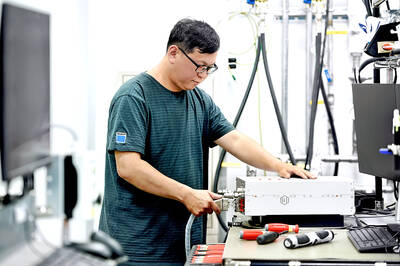
SEMICONDUCTORS: The German laser and plasma generator company will expand its local services as its specialized offerings support Taiwan’s semiconductor industries Trumpf SE + Co KG, a global leader in supplying laser technology and plasma generators used in chip production, is expanding its investments in Taiwan in an effort to deeply integrate into the global semiconductor supply chain in the pursuit of growth. The company, headquartered in Ditzingen, Germany, has invested significantly in a newly inaugurated regional technical center for plasma generators in Taoyuan, its latest expansion in Taiwan after being engaged in various industries for more than 25 years. The center, the first of its kind Trumpf built outside Germany, aims to serve customers from Taiwan, Japan, Southeast Asia and South Korea,

Gasoline and diesel prices at domestic fuel stations are to fall NT$0.2 per liter this week, down for a second consecutive week, CPC Corp, Taiwan (台灣中油) and Formosa Petrochemical Corp (台塑石化) announced yesterday. Effective today, gasoline prices at CPC and Formosa stations are to drop to NT$26.4, NT$27.9 and NT$29.9 per liter for 92, 95 and 98-octane unleaded gasoline respectively, the companies said in separate statements. The price of premium diesel is to fall to NT$24.8 per liter at CPC stations and NT$24.6 at Formosa pumps, they said. The price adjustments came even as international crude oil prices rose last week, as traders

SIZE MATTERS: TSMC started phasing out 8-inch wafer production last year, while Samsung is more aggressively retiring 8-inch capacity, TrendForce said Chipmakers are expected to raise prices of 8-inch wafers by up to 20 percent this year on concern over supply constraints as major contract chipmakers Taiwan Semiconductor Manufacturing Co (TSMC, 台積電) and Samsung Electronics Co gradually retire less advanced wafer capacity, TrendForce Corp (集邦科技) said yesterday. It is the first significant across-the-board price hike since a global semiconductor correction in 2023, the Taipei-based market researcher said in a report. Global 8-inch wafer capacity slid 0.3 percent year-on-year last year, although 8-inch wafer prices still hovered at relatively stable levels throughout the year, TrendForce said. The downward trend is expected to continue this year,
Taiwan Semiconductor Manufacturing Co (TSMC, 台積電), which supplies advanced chips to Nvidia Corp and Apple Inc, yesterday reported NT$1.046 trillion (US$33.1 billion) in revenue for last quarter, driven by constantly strong demand for artificial intelligence (AI) chips, falling in the upper end of its forecast. Based on TSMC’s financial guidance, revenue would expand about 22 percent sequentially to the range from US$32.2 billion to US$33.4 billion during the final quarter of 2024, it told investors in October last year. Last year in total, revenue jumped 31.61 percent to NT$3.81 trillion, compared with NT$2.89 trillion generated in the year before, according to


 RSS
RSS