


The sun is setting on Japan’s clean energy boom, despite projects like a massive floating solar farm near Tokyo, as the government cuts subsidies and bets on nuclear and coal-fired power, critics say.
Workers at the floating power station, one of the world’s biggest, have just finished laying about 50,000 interconnected panels on a vast dam reservoir.
Taking up space equivalent to several Tokyo Dome-sized baseball stadiums, the vast carpet of panels would supply power to about 5,000 homes from early 2018.
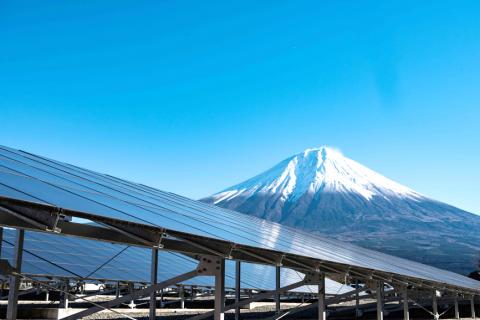
Photo: AFP/Solar Frontier Company
The project is the centerpiece of a solar-dominated wave of “renewable” energy investments that followed the 2011 Fukushima Dai-ichi nuclear disaster.
The accident forced the shutdown of reactors that had supplied about one-quarter of resource-poor Japan’s energy.
To plug the gap, electricity providers have been obliged since 2012 to buy power generated from “green” suppliers, including solar, at above-market rates — known as feed-in tariffs — fixed by the government each year.
However, “renewable” energy investments have plateaued and are set to fall in the coming years as Tokyo cuts back subsidies while commodities including coal, oil and natural gas remain cheap.
Japan is also facing a shortage of land for new solar installations.
Kyocera, which is behind the floating farm south of Tokyo, is building a solar plant on an abandoned golf course.
“Several dynamics in the Japanese power sector have shifted since [2012] — such as weakening government support, cheaper fuel alternatives and electricity sector reform — which have all contributed to the slowdown in growth,” BMI Research said in a report.
Some say Japan’s solar potential sits squarely on the roofs of millions of homes.
“There is still a big potential for the Japanese market,” said Atsuhiko Hirano, head of Solar Frontier, a unit of Japanese oil giant Showa Shell. “Utility-scale projects have been the driver so far. In contrast, the residential market has not grown so much. So there is still much more area where we can grow... We are pushing the government to go further.”
Solar accounts for a small fraction of Japan’s energy mix — 3.3 percent last year.
However, Tokyo has said it wants renewables — also including hydro and wind power — to account for 22 to 24 percent of the total by 2030.
However, critical government support appears to be waning as Tokyo drives a push to restart mothballed atomic reactors — an unpopular move among the nuclear-wary public.
The pro-nuclear drive is supported by utilities, which complained about being forced to buy and distribute subsidized power, especially with oil and natural gas prices at multi-year lows.
Japan is also raising eyebrows with plans to invest billions of US dollars at home and abroad in new power plants fired by cheap coal — even as it calls for more “green” power at home.
That includes half a dozen large coal-fired power stations within about 100km of Tokyo, which Greenpeace has branded “simply insane” over health concerns posed by air pollution.
Coal is also the biggest climate change culprit, generating more carbon pollution per unit of energy generated than oil or gas.
Within the G7 club of rich nations, Japan is alone in investing heavily in coal-fired energy on its own soil, with more than 40 new power plants in the pipeline.
That sets it apart from even big polluters, such as China and India, which are pushing away from coal-fired power — although US president-elect Donald Trump has vowed to bring back coal and refocus US energy policy on fossil fuels.
“Japan is betting its economy and energy security on risky coal investments,” said Taylor Dimsdale, Washington-based head of research at energy think-tank E3G.
“The coal development pipeline in the rest of the G7 countries has dried up with no further plants expected beyond a handful of projects that are already under construction.”
Critics say they do not have much hope for Tokyo’s long-term commitment to “renewable” energy.
“After the Fukushima disaster there was an infatuation with ‘renewable’ energy and the government was clearly pressing the accelerator,” said Kimiko Hirata, international director for the Japanese non-governmental organization Kiko Network. “However, since then, I feel like it’s putting the brakes on that policy and concentrating its focus on revising nuclear power and building new coal-fired power plants.”

SECOND-RATE: Models distilled from US products do not perform the same as the original and undo measures that ensure the systems are neutral, the US’ cable said The US Department of State has ordered a global push to bring attention to what it said are widespread efforts by Chinese companies, including artificial intelligence (AI) start-up DeepSeek (深度求索), to steal intellectual property from US AI labs, according to a diplomatic cable. The cable, dated Friday and sent to diplomatic and consular posts around the world, instructs diplomatic staff to speak to their foreign counterparts about “concerns over adversaries’ extraction and distillation of US AI models.” Distillation is the process of training smaller AI models using output from larger, more expensive ones to lower the costs of training a powerful new
Micron Technology Inc is a driving force pushing the US Congress to pass legislation that would put new export restrictions on equipment its Chinese competitors use to make their chips, according to people familiar with the matter. A US House of Representatives panel yesterday was to vote on the “MATCH Act,” a bill designed to close gaps in restrictions on chipmaking equipment. It would also pressure foreign companies that sell equipment to Chinese chipmaking facilities to align with export curbs on US companies like Lam Research Corp and Applied Materials Inc. The bill targets facilities operated by China’s ChangXin Memory Technologies Inc

Singapore-based ride-hailing and delivery giant Grab Holdings’ planned acquisition of Foodpanda’s Taiwan operations has yet to enter the formal review stage, as regulators await supplementary documents, the Fair Trade Commission (FTC) said yesterday. Acting FTC Chairman Chen Chih-min (陳志民) told the legislature’s Economics Committee that although Grab submitted its application on March 27, the case has not been officially accepted because required materials remain incomplete. Once the filing is finalized, the FTC would launch a formal probe into the deal, focusing on issues such as cross-shareholding and potential restrictions on market competition, Chen told lawmakers. Grab last month announced that it would acquire
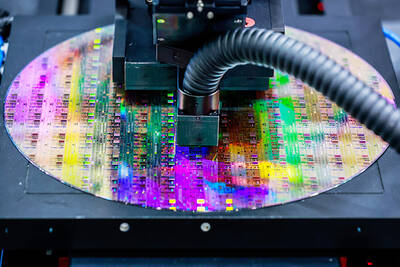
The artificial intelligence (AI) boom has triggered a seismic reshuffling of global equity markets, with Taiwan and South Korea muscling past European nations one by one. With its stock market now valued at nearly US$4.3 trillion, Taiwan surpassed the UK, Europe’s biggest market, earlier this month, data compiled by Bloomberg showed. South Korea is about US$140 billion away from doing the same. The tech-heavy Asian markets have shot past Germany and France in the past seven months. The shift is largely down to massive gains in shares of three companies that provide essential hardware for AI: Taiwan Semiconductor Manufacturing Co (TSMC, 台積電),


 RSS
RSS