


Oil extended its biggest gain in nine months and crude producers rallied after OPEC approved the first supply cuts in eight years, with focus now shifting to how strictly it will implement its bid to ease a record glut.
Prices of oil futures added as much as 1.6 percent in New York and traded at more than US$50 for the first time since Oct. 27. Prices surged 9.3 percent on Wednesday, posting the largest gain since February amid record volumes.
OPEC agreed to reduce collective production to 32.5 million barrels per day, Iranian Oil Minister Bijan Namdar Zanganeh said in Vienna on Wednesday.
The deal, designed to drain record global oil inventories, overcame disagreements between the group’s three largest producers — Saudi Arabia, Iran and Iraq — and ended a flirtation with free markets that started in 2014.
“The market will no longer see a sudden plunge in oil prices,” Kiwoom Securities Co market strategist Seo Sang-young said by telephone from Seoul. “The biggest winners from the agreement are US shale producers, who will expand production as prices rally.”
West Texas Intermediate (WTI) for January delivery rose as much as US$0.80 to US$50.24 per barrel on the New York Mercantile Exchange (NYME), ending US$4.21 higher to close at US$49.44 as aggregate trading volume on the NYME rose to a record 2.5 million contracts, according to data compiled by Bloomberg.
Brent for February settlement added as much as US$0.89, or 1.7 percent, to US$52.73 per barrel on the London-based ICE Futures Europe exchange. The January contract jumped US$4.09, or 8.8 percent, to expire on Wednesday at US$50.47 per barrel. The global benchmark traded at a US$1.54 premium to WTI.
Saudi Arabia, which raised oil production to a record this year, is to reduce output by 486,000 barrels to 10.058 million per day, an OPEC document shows.
Iraq, the group’s second-largest producer, agreed to cut by 210,000 barrels per day from October levels. The country had previously pushed for special consideration, citing the urgency of its offensive against the Islamic State group.
The accord comes into effect at the start of next year and is to last for six months. The pact also calls for an additional 600,000 barrels per day reduction from non-OPEC suppliers.
Non-member Russia is to cut by as much as 300,000 barrels per day “conditional on its technical abilities,” Russian Energy Minister Alexander Novak said in Moscow.
Goldman Sachs forecasts a further upside in WTI crude to US$55 and US$56.50 for Brent, and the market might shift to a deficit in the first half of next year, analysts including Damien Courvalin wrote in a report.
Full compliance with stated output targets by OPEC and non-member producers could add an additional US$6 per barrel to its price forecast, the bank said.
If the group maintains the agreed cuts, oil could trade in the US$50 to US$60 range, Morgan Stanley said.
Asian equities rallied the most in three weeks after OPEC reached the deal. Australia’s Santos Ltd shares surged about 12 percent, Japan’s Inpex Corp rose 10 percent and China’s CNOOC Ltd (中國海洋石油) climbed 6 percent.

CHIP RACE: Three years of overbroad export controls drove foreign competitors to pursue their own AI chips, and ‘cost US taxpayers billions of dollars,’ Nvidia said China has figured out the US strategy for allowing it to buy Nvidia Corp’s H200s and is rejecting the artificial intelligence (AI) chip in favor of domestically developed semiconductors, White House AI adviser David Sacks said, citing news reports. US President Donald Trump on Monday said that he would allow shipments of Nvidia’s H200 chips to China, part of an administration effort backed by Sacks to challenge Chinese tech champions such as Huawei Technologies Co (華為) by bringing US competition to their home market. On Friday, Sacks signaled that he was uncertain about whether that approach would work. “They’re rejecting our chips,” Sacks
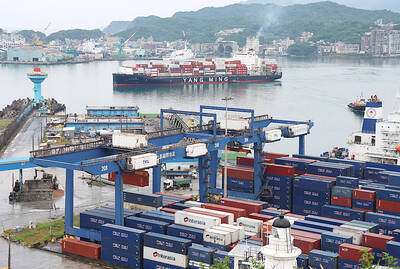
Taiwan’s exports soared 56 percent year-on-year to an all-time high of US$64.05 billion last month, propelled by surging global demand for artificial intelligence (AI), high-performance computing and cloud service infrastructure, the Ministry of Finance said yesterday. Department of Statistics Director-General Beatrice Tsai (蔡美娜) called the figure an unexpected upside surprise, citing a wave of technology orders from overseas customers alongside the usual year-end shopping season for technology products. Growth is likely to remain strong this month, she said, projecting a 40 percent to 45 percent expansion on an annual basis. The outperformance could prompt the Directorate-General of Budget, Accounting and

NATIONAL SECURITY: Intel’s testing of ACM tools despite US government control ‘highlights egregious gaps in US technology protection policies,’ a former official said Chipmaker Intel Corp has tested chipmaking tools this year from a toolmaker with deep roots in China and two overseas units that were targeted by US sanctions, according to two sources with direct knowledge of the matter. Intel, which fended off calls for its CEO’s resignation from US President Donald Trump in August over his alleged ties to China, got the tools from ACM Research Inc, a Fremont, California-based producer of chipmaking equipment. Two of ACM’s units, based in Shanghai and South Korea, were among a number of firms barred last year from receiving US technology over claims they have

BARRIERS: Gudeng’s chairman said it was unlikely that the US could replicate Taiwan’s science parks in Arizona, given its strict immigration policies and cultural differences Gudeng Precision Industrial Co (家登), which supplies wafer pods to the world’s major semiconductor firms, yesterday said it is in no rush to set up production in the US due to high costs. The company supplies its customers through a warehouse in Arizona jointly operated by TSS Holdings Ltd (德鑫控股), a joint holding of Gudeng and 17 Taiwanese firms in the semiconductor supply chain, including specialty plastic compounds producer Nytex Composites Co (耐特) and automated material handling system supplier Symtek Automation Asia Co (迅得). While the company has long been exploring the feasibility of setting up production in the US to address


 RSS
RSS