


Quanta Computer Inc (廣達), the world’s largest server and notebook computer manufacturer, plans to expand its server operations in the US in the face of rising demand and US president-elect Donald Trump’s campaign vow to boost US manufacturing, a company executive said.
Quanta Cloud Technology (QCT, 雲達科技), its server subsidiary, plans to expand the production capacity of its two US plants in the next three years, Mike Yang (楊晴華), president of QCT and a senior vice president and general manager at Quanta Computer, said in a report by Nikkei Asian Review.
Yang said that QCT has the “upper hand” should Trump’s campaign promise become policy, as the company already has server assembly facilities in Fremont, California, and Nashville, Tennessee.
The demand for more domestic data centers is expected to grow if Trump adopts a protectionist approach in manufacturing, which would help support Quanta’s revenue growth, Yang said in the report.
The company plans to double its server assembly facilities, output and headcount in the US in the next three years, Yang said.
Quanta said in a filing with the Taiwan Stock Exchange on Friday last week that it plans to give QCT a cash injection of US$10 million to fund its operations’ expansion.
Quanta’s cloud-computing segment — which includes server, storage, switch and Internet-of-Things (IoT) devices — has been an important revenue growth driver amid a declining notebook industry.
The segment accounted for between 30 and 35 percent of the firm’s total revenue of NT$628.73 billion (US$19.72 billion) in the first three quarters of the year, with sales growing by a double-digit percentage from the same time last year, Quanta said.
Its cloud-computing clients include Google, Amazon.com Inc, Microsoft Corp and Facebook Inc.
“We expect revenue from this segment to continue increasing by a double-digit percentage next year, supported by the rising demand from telecom operators, enterprises and technology ‘unicorns,’” a Quanta investor relations official said by telephone yesterday.
Company chairman Barry Lam (林百里) on Nov. 10 told a news conference that the cloud-computing segment would remain Quanta’s main growth driver next year.
Inventec Corp (英業達), a smaller rival of Quanta in the server business, is mulling the possibility of reopening its server assembly line at its branch in Houston, Texas, in view of a potential change in US manufacturing policy.
Inventec mainly assembles servers for its US clients at its plant in Mexico, which employs 1,200 and has a monthly production capacity of 35,000 units, its investor relations official said.
“If Trump’s vow becomes policy, Inventec would likely reopen its assembly line in Houston to meet clients’ needs, despite a possible increase in labor costs,” the official said by telephone.
Inventec’s server business accounted for 35 percent of its total revenue of NT$111.65 billion last quarter.
Revenue from this segment surged 20 percent in the first three quarters of the year compared with a year earlier, the company said.
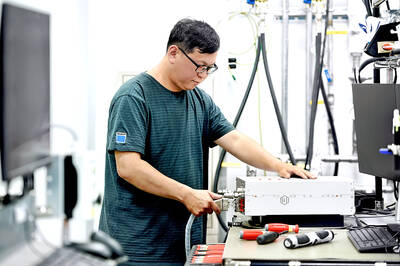
SEMICONDUCTORS: The German laser and plasma generator company will expand its local services as its specialized offerings support Taiwan’s semiconductor industries Trumpf SE + Co KG, a global leader in supplying laser technology and plasma generators used in chip production, is expanding its investments in Taiwan in an effort to deeply integrate into the global semiconductor supply chain in the pursuit of growth. The company, headquartered in Ditzingen, Germany, has invested significantly in a newly inaugurated regional technical center for plasma generators in Taoyuan, its latest expansion in Taiwan after being engaged in various industries for more than 25 years. The center, the first of its kind Trumpf built outside Germany, aims to serve customers from Taiwan, Japan, Southeast Asia and South Korea,

Gasoline and diesel prices at domestic fuel stations are to fall NT$0.2 per liter this week, down for a second consecutive week, CPC Corp, Taiwan (台灣中油) and Formosa Petrochemical Corp (台塑石化) announced yesterday. Effective today, gasoline prices at CPC and Formosa stations are to drop to NT$26.4, NT$27.9 and NT$29.9 per liter for 92, 95 and 98-octane unleaded gasoline respectively, the companies said in separate statements. The price of premium diesel is to fall to NT$24.8 per liter at CPC stations and NT$24.6 at Formosa pumps, they said. The price adjustments came even as international crude oil prices rose last week, as traders
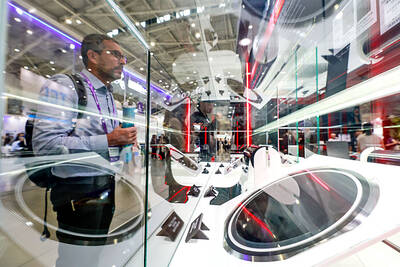
SIZE MATTERS: TSMC started phasing out 8-inch wafer production last year, while Samsung is more aggressively retiring 8-inch capacity, TrendForce said Chipmakers are expected to raise prices of 8-inch wafers by up to 20 percent this year on concern over supply constraints as major contract chipmakers Taiwan Semiconductor Manufacturing Co (TSMC, 台積電) and Samsung Electronics Co gradually retire less advanced wafer capacity, TrendForce Corp (集邦科技) said yesterday. It is the first significant across-the-board price hike since a global semiconductor correction in 2023, the Taipei-based market researcher said in a report. Global 8-inch wafer capacity slid 0.3 percent year-on-year last year, although 8-inch wafer prices still hovered at relatively stable levels throughout the year, TrendForce said. The downward trend is expected to continue this year,
Taiwan Semiconductor Manufacturing Co (TSMC, 台積電), which supplies advanced chips to Nvidia Corp and Apple Inc, yesterday reported NT$1.046 trillion (US$33.1 billion) in revenue for last quarter, driven by constantly strong demand for artificial intelligence (AI) chips, falling in the upper end of its forecast. Based on TSMC’s financial guidance, revenue would expand about 22 percent sequentially to the range from US$32.2 billion to US$33.4 billion during the final quarter of 2024, it told investors in October last year. Last year in total, revenue jumped 31.61 percent to NT$3.81 trillion, compared with NT$2.89 trillion generated in the year before, according to


 RSS
RSS