


Working in the shadow of Beijing’s looming skyscrapers, Yin Xueqiang (尹學強) weighs a pile of cardboard and old shoe racks in a dusty scrapyard, the latest casualty of a crackdown on migrant workers in China’s capital.
Last week, security guards blocked the road Yin and fellow scrap collectors took to enter the yard. The authorities had posted signs this month giving the collectors 10 days to leave.
“The city government is trying to get us migrant workers to leave Beijing. They say there are too many of us and not enough space,” said Yin, who hails from China’s central province of Henan.

Photo: Reuters
As authorities try to rein in Beijing’s growing population and capitalize on skyrocketing land prices, scrap collectors say they are being pushed out, despite playing a vital role in China’s unique recycling ecosystem.
Unlike many Western cities, where local authorities run recycling programs, in Beijing, entrepreneurial migrant workers drive a significant part of the effort.
They cycle around the city collecting cardboard, plastic and other scrap before selling it on to rubbish traders, who then resell it to factories as scrap.

Photo: Reuters
“Beijingers wouldn’t be able to survive for even a day without us,” Yin said, weighing piles of plastic on a rusty scale before handing a few dollars to a fellow collector, who pedaled away on a motorized tricycle.
“Who is going to collect all the rubbish? Who is going to recycle it all? Do you think Beijingers would be willing to do this kind of work?” Yin said.
Yin, whose efforts can bring in 3,000 to 5,000 yuan (US$434 to US$723) a month, has been in Beijing for more than 10 years. He moved to the scrap yard three years ago.
Few of his friends from Henan are left in Beijing, as it gets harder to make a living in the expensive city. Yin said he is considering going home or moving to a scrapyard further away from the city center.
A generation of young consumers has come of age in China lacking the recycling habits of parents and grandparents who suffered hardships before the economy began opening up in the late 1970s.
This absence of the impulse to recycle, along with astronomical economic growth, swift urbanization and surging consumption, led China to overtake the US as the world’s largest generator of waste in 2004, the World Bank says.
By 2025, China is on track to produce around 1.4 million tonnes of waste every day, but as scrap collectors shift into other industries, whether voluntarily or after being compelled by the authorities, the country is burying or burning more waste.
“Over the past few years, I’ve taken Americans, Japanese, visitors from several developed countries to scrapyards in Beijing and their reaction is: ‘This recycling system is excellent, why isn’t more being done to preserve it?’” said Chen Liwen (陳立雯), who has studied China’s scrap collectors.
Dong Dingxia, 50, who left her farm, accompanied by her husband, to collect wooden scrap in Beijing after her children departed for university, puzzled over the same question.
“I don’t understand why we’re being kicked out. It won’t be good if rubbish starts piling up around the city,” she said, while stripping foam from old wooden chairs. “But I guess what I think doesn’t matter.”


Taiwan’s foreign exchange reserves fell below the US$600 billion mark at the end of last month, with the central bank reporting a total of US$596.89 billion — a decline of US$8.6 billion from February — ending a three-month streak of increases. The central bank attributed the drop to a combination of factors such as outflows by foreign institutional investors, currency fluctuations and its own market interventions. “The large-scale outflows disrupted the balance of supply and demand in the foreign exchange market, prompting the central bank to intervene repeatedly by selling US dollars to stabilize the local currency,” Department of Foreign

Intel Corp is joining Elon Musk’s long-shot effort to develop semiconductors for Tesla Inc, Space Exploration Technologies Corp and xAI, marking a surprising twist in the chipmaker’s comeback bid. Intel would help the Terafab project “refactor” the technology in a chip factory, the company said on Tuesday in a post on X, Musk’s social media platform. That is a stage in the development process that typically helps make chips more powerful or reliable. The chipmaker’s shares jumped 4.2 percent to US$52.91 in New York trading on Tuesday. The Terafab project is a grand plan by Musk to eventually manufacture his own chips for
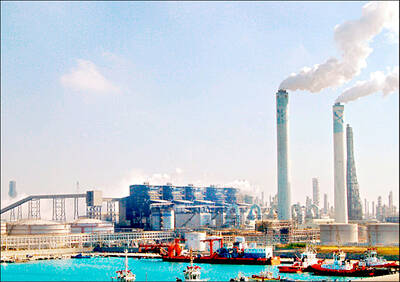
Taiwan Power Co (Taipower, 台電) yesterday said it plans to resume operations at two coal-fired power generators for three months to boost security of electricity supply as liquefied natural gas (LNG) supply risks are running high due to the Middle East conflict. The two coal-fired power generators are at Mailiao Power Plant in Yunlin County’s Mailiao Township (麥寮). The plant, operated by Formosa Plastics Group (台塑集團), supplied electricity to Taipower’s power grid until the end of last year. Taipower’s decision came about one month after Minister of Economic Affairs Kung Ming-hsin (龔明鑫) on March 10 said that the nation had no imminent

Some robotaxi passengers were left stranded in the middle of fast-moving traffic in a major Chinese city after their driverless vehicles stopped running, according to police and media reports on Wednesday. A preliminary investigation indicates more than 100 robotaxis came to a halt because of a “system malfunction,” police in the city of Wuhan said in a statement, without elaborating. No injuries were reported. One passenger told Chinese media that their robotaxi stopped after turning a corner. An instruction on a screen read: “Driving system malfunction. Staff are expected to arrive in 5 minutes.” After no one showed up, the passenger pushed


 RSS
RSS