


Taiwan and the EU are aiming to cooperate over online intellectual property rights (IPR) protection, Vice Minister of Economic Affairs Wang Mei-hua (王美花) said on Friday.
Wang, who recently attended a Taiwan-EU economic and trade consultation conference in Brussels, said that EU officials at the meeting praised Taiwan’s achievements in IPR protection and expressed the hope that both sides would work more closely together at a time when the Internet is playing a bigger role in people’s daily lives.
EU officials said that due to Taiwan’s efforts on IPR protection, many European firms feel comfortable investing in the Taiwan market, Wang said.
As the EU has been impressed by Taiwan’s efforts, the European bloc has agreed to hold a bilateral consultation conference on IPR protection with Taipei once per year, compared with a frequency of twice per year in the past, she said.
The EU wants to work with Taiwan to carry out raids on cyberattacks against IPR, in a bid to provide enterprises with better protection, she said.
The economic and trade consultation meeting also addressed the possibility of Taiwan and the EU cooperating in a wide range of industries, such as offshore wind power development, “smart” machinery production and circular economy projects, Wang said.
A circular economy is an industrial economy that promotes greater resource productivity in order to reduce waste, avoid pollution and boost energy efficiency.
Taiwan is gearing up to develop its offshore wind power industry and as a result, several European industrial giants, including Siemens AG of Germany, DONG Energy AS of Denmark and France’s Eolfi SA, have expressed the willingness to invest in that sector in Taiwan, Wang said.
As for the circular economy, the EU sees the emerging industry as having great potential for growth and sees Taiwan developing downstream, midstream and upstream supply chains for the sector, Wang said, adding that both sides are looking forward to working together.
However, the EU expressed concerns over Taiwan’s quarantine procedures for agriculture and livestock product imports, saying that the process takes too long, and urging authorities to streamline the system, Wang said.
The ministry would inform the Council of Agriculture and the Ministry of Health and Welfare of the EU’s concerns, Wang added.


Taiwan’s foreign exchange reserves fell below the US$600 billion mark at the end of last month, with the central bank reporting a total of US$596.89 billion — a decline of US$8.6 billion from February — ending a three-month streak of increases. The central bank attributed the drop to a combination of factors such as outflows by foreign institutional investors, currency fluctuations and its own market interventions. “The large-scale outflows disrupted the balance of supply and demand in the foreign exchange market, prompting the central bank to intervene repeatedly by selling US dollars to stabilize the local currency,” Department of Foreign

Intel Corp is joining Elon Musk’s long-shot effort to develop semiconductors for Tesla Inc, Space Exploration Technologies Corp and xAI, marking a surprising twist in the chipmaker’s comeback bid. Intel would help the Terafab project “refactor” the technology in a chip factory, the company said on Tuesday in a post on X, Musk’s social media platform. That is a stage in the development process that typically helps make chips more powerful or reliable. The chipmaker’s shares jumped 4.2 percent to US$52.91 in New York trading on Tuesday. The Terafab project is a grand plan by Musk to eventually manufacture his own chips for
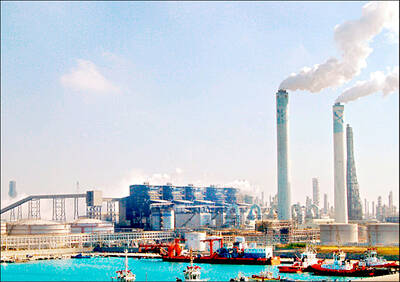
Taiwan Power Co (Taipower, 台電) yesterday said it plans to resume operations at two coal-fired power generators for three months to boost security of electricity supply as liquefied natural gas (LNG) supply risks are running high due to the Middle East conflict. The two coal-fired power generators are at Mailiao Power Plant in Yunlin County’s Mailiao Township (麥寮). The plant, operated by Formosa Plastics Group (台塑集團), supplied electricity to Taipower’s power grid until the end of last year. Taipower’s decision came about one month after Minister of Economic Affairs Kung Ming-hsin (龔明鑫) on March 10 said that the nation had no imminent

Some robotaxi passengers were left stranded in the middle of fast-moving traffic in a major Chinese city after their driverless vehicles stopped running, according to police and media reports on Wednesday. A preliminary investigation indicates more than 100 robotaxis came to a halt because of a “system malfunction,” police in the city of Wuhan said in a statement, without elaborating. No injuries were reported. One passenger told Chinese media that their robotaxi stopped after turning a corner. An instruction on a screen read: “Driving system malfunction. Staff are expected to arrive in 5 minutes.” After no one showed up, the passenger pushed


 RSS
RSS