


US online sales surged on Black Friday, with Amazon.com Inc offering the steepest discounts among e-commerce sites as it set the agenda for what has traditionally been the biggest shopping day of the year for brick-and-mortar retailers.
In-store shopping began to pick up in the afternoon, but the increase in customer traffic paled in comparison with the jump in online sales, analysts said.
Macy’s Inc Web site saw such heavy traffic that it had to delay customers from entering the site at three different times.
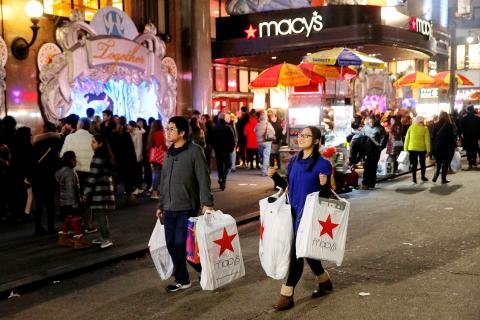
Photo: Reuters
Online sales on Friday hit US$1.70 billion as of 3pm EDT, according to Adobe Digital Index, after reaching US$1.13 billion for the day on Thursday, up almost 14 percent from a year ago.
The US-based National Retail Federation has said it expects total sales this holiday season to increase by 3.6 percent to US$655.8 billion, mainly due to the rise in online shopping.
This weekend’s shopping could reflect signs of faster economic growth in the fourth quarter this year. Nationwide US retail sales rose 0.8 percent last month, driven by a 1.5 percent jump in receipts at online retailers.
The lowest unemployment rate in eight years, 4.9 percent for last month, and a rise in hourly wage rates of 2.8 percent for the year, the biggest increase since 2009, are fueling consumer confidence and spending power.
“All of this adds up to the consumer feeling better about their current situation and I’m hoping they ... buy all of their gifts from Macy’s,” Macy’s CEO Terry Lundgren told reporters.
The deepest average discounts for Black Friday came from leading online retailer Amazon, with an average of 42 percent off, compared with 33 percent off at Wal-Mart Stores Inc, 35 percent at Target Corp and 36 percent at Best Buy Co, according to e-commerce analytics firm Clavis Insight.
Amazon said Black Friday would surpass last year in terms of the number of items ordered on its Web site.
The Seattle-based company declined to provide specifics.
Both Target and Wal-Mart, two of the country’s biggest brick-and-mortar retailers, said Thanksgiving online sales were some of their best ever.
Online customer traffic could be up 20 percent over Black Friday from a year ago, Cowen & Co analysts forecast in a note, while store traffic is likely to fall 3 percent to 4 percent this year on Black Friday.
“We expect negative [store] traffic given [the] earlier start this year of the holiday selling season and rise of mobile, which could be as much as 60 percent or more of all traffic, and consumer exhaustion from a saturated promotional environment,” the analysts said.
At many malls, more consumers turned up as the day progressed.
US president-elect Donald Trump also stepped into the online sales excitement. On Friday morning, Trump’s online store announced it was offering a 30 percent discount deal on all campaign products, including a US$149 Christmas ornament.
“President-elect Trump loves a great deal,” a promotional e-mail said.
For years, Black Friday has started the holiday shopping season in the US, with retailers offering steep discounts. However, its popularity has been on the wane with the rise of online shopping and cheap deals throughout the year.
The holiday shopping season, which runs through Dec. 25, can account for as much as 40 percent of retailers’ annual sales.


Taiwan’s foreign exchange reserves fell below the US$600 billion mark at the end of last month, with the central bank reporting a total of US$596.89 billion — a decline of US$8.6 billion from February — ending a three-month streak of increases. The central bank attributed the drop to a combination of factors such as outflows by foreign institutional investors, currency fluctuations and its own market interventions. “The large-scale outflows disrupted the balance of supply and demand in the foreign exchange market, prompting the central bank to intervene repeatedly by selling US dollars to stabilize the local currency,” Department of Foreign

Intel Corp is joining Elon Musk’s long-shot effort to develop semiconductors for Tesla Inc, Space Exploration Technologies Corp and xAI, marking a surprising twist in the chipmaker’s comeback bid. Intel would help the Terafab project “refactor” the technology in a chip factory, the company said on Tuesday in a post on X, Musk’s social media platform. That is a stage in the development process that typically helps make chips more powerful or reliable. The chipmaker’s shares jumped 4.2 percent to US$52.91 in New York trading on Tuesday. The Terafab project is a grand plan by Musk to eventually manufacture his own chips for

Taiwan Power Co (Taipower, 台電) yesterday said it plans to resume operations at two coal-fired power generators for three months to boost security of electricity supply as liquefied natural gas (LNG) supply risks are running high due to the Middle East conflict. The two coal-fired power generators are at Mailiao Power Plant in Yunlin County’s Mailiao Township (麥寮). The plant, operated by Formosa Plastics Group (台塑集團), supplied electricity to Taipower’s power grid until the end of last year. Taipower’s decision came about one month after Minister of Economic Affairs Kung Ming-hsin (龔明鑫) on March 10 said that the nation had no imminent

Some robotaxi passengers were left stranded in the middle of fast-moving traffic in a major Chinese city after their driverless vehicles stopped running, according to police and media reports on Wednesday. A preliminary investigation indicates more than 100 robotaxis came to a halt because of a “system malfunction,” police in the city of Wuhan said in a statement, without elaborating. No injuries were reported. One passenger told Chinese media that their robotaxi stopped after turning a corner. An instruction on a screen read: “Driving system malfunction. Staff are expected to arrive in 5 minutes.” After no one showed up, the passenger pushed


 RSS
RSS