


Advanced Semiconductor Engineering Inc (ASE, 日月光半導體) yesterday received approval from the Fair Trade Commission (FTC) for its NT$128.7 billion (US$4.04 billion) bid to acquire Siliconware Precision Industries Co (SPIL, 矽品精密), clearing a major hurdle to finalize one of Taiwan’s biggest acquisition deals.
The approval bodes well for the world’s largest chip tester and packager to obtain approvals from competition watchdogs in China and the US to complete the transaction before the bid expires on Dec. 31 next year.
ASE applied to the agencies in September to seek final approvals.
Yesterday’s approval did not come easily. The nation’s competition watchdog in July began a new round of reviews over the deal after ASE and SPIL in May agreed to form an industrial holding company via a friendly takeover bid, instead of a hostile acquisition launched in August last year.
Based on the agreement, ASE plans to create ASE Industrial Holding Co Ltd (日月光投資控股) by the end of next year. The new entity is to own 100 percent of ASE and SPIL, while both firms would remain separate legal entities.
“The merger would bring greater benefits to the overall economy than the limitations it would set on [market] competition,” the commission said in a statement released yesterday. “So, the agency will not forbid the merger of the two firms.”
The commission said the information and opinions it collected showed that the merger would not significantly hamper market competition.
“As there are more than 70 chip testers and packagers around the world, market competition will only intensify,” the statement said.
ASE and SPIL hold a combined 29.2 percent share of the world’s chip testing and packaging market in terms of revenue, according to market researcher Gartner Inc.
The combination of the companies would help enhance their competitiveness, as they can avoid investing in the same technologies and improve their operational efficiency in the wake of the merger, the commission said.
The merger would also help ASE and SPIL fend off growing competition from global rivals and would thereby benefit the economy, it said.
The approval came after the commission’s concern over the deal’s potential effects on the nation’s semiconductor industry supply chain dissipated.
The agency last month extended the review period for 60 days to next month to conduct more public hearings to mitigate concerns.
The commission said it needed to collect more information and opinions from ASE’s and SPIL’s clients and material suppliers about the transaction.
ASE yesterday said in a statement that “the FTC’s approval will have positive effects on the global semiconductor industry and has set a new milestone for Taiwan’s semiconductor industry.”
The commission’s speedy review would also help maintain the industry’s competitive edge, ASE said.
ASE shares yesterday rose 0.3 percent to NT$33.45, while SPIL’s stock price was flat at NT$46. The TAIEX increased 0.35 percent.


Taiwan’s foreign exchange reserves fell below the US$600 billion mark at the end of last month, with the central bank reporting a total of US$596.89 billion — a decline of US$8.6 billion from February — ending a three-month streak of increases. The central bank attributed the drop to a combination of factors such as outflows by foreign institutional investors, currency fluctuations and its own market interventions. “The large-scale outflows disrupted the balance of supply and demand in the foreign exchange market, prompting the central bank to intervene repeatedly by selling US dollars to stabilize the local currency,” Department of Foreign

Intel Corp is joining Elon Musk’s long-shot effort to develop semiconductors for Tesla Inc, Space Exploration Technologies Corp and xAI, marking a surprising twist in the chipmaker’s comeback bid. Intel would help the Terafab project “refactor” the technology in a chip factory, the company said on Tuesday in a post on X, Musk’s social media platform. That is a stage in the development process that typically helps make chips more powerful or reliable. The chipmaker’s shares jumped 4.2 percent to US$52.91 in New York trading on Tuesday. The Terafab project is a grand plan by Musk to eventually manufacture his own chips for
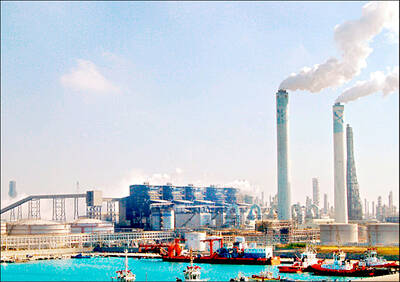
Taiwan Power Co (Taipower, 台電) yesterday said it plans to resume operations at two coal-fired power generators for three months to boost security of electricity supply as liquefied natural gas (LNG) supply risks are running high due to the Middle East conflict. The two coal-fired power generators are at Mailiao Power Plant in Yunlin County’s Mailiao Township (麥寮). The plant, operated by Formosa Plastics Group (台塑集團), supplied electricity to Taipower’s power grid until the end of last year. Taipower’s decision came about one month after Minister of Economic Affairs Kung Ming-hsin (龔明鑫) on March 10 said that the nation had no imminent

Some robotaxi passengers were left stranded in the middle of fast-moving traffic in a major Chinese city after their driverless vehicles stopped running, according to police and media reports on Wednesday. A preliminary investigation indicates more than 100 robotaxis came to a halt because of a “system malfunction,” police in the city of Wuhan said in a statement, without elaborating. No injuries were reported. One passenger told Chinese media that their robotaxi stopped after turning a corner. An instruction on a screen read: “Driving system malfunction. Staff are expected to arrive in 5 minutes.” After no one showed up, the passenger pushed


 RSS
RSS