


Hon Hai Group (鴻海集團) yesterday unveiled a digital signage system in the main lobby of the Taipei Railway Station to tap into the rapidly evolving multimedia advertising market.
Installation of the system was overseen by Hon Hai subsidiary, LinkOOH (萬相雲媒), which was established with capitalization of NT$50 million (US$1.58 million) as part of the conglomerate’s efforts to leverage the organizations resources to stimulate innovation.
Taiwan’s advertisement market is valued at about NT$60 billion, of which the market for advertisement installations at public spaces is estimated at about NT$4 billion, Hon Hai vice president Lu Fang-ming (呂芳銘) told reporters at a news conference in Taipei.
He also said that Hon Hai has not ruled out holding an initial public offering for LinkOOH.
The system is made up of more than 200 55-inch commercial digital signage display panels with 4K resolution made by Sharp Corp, which is controlled by a cloud-based platform developed by LinkOOH.
“The system at Taipei Railway Station was installed at a cost of about NT$80 million, and we expect LinkOOH to break even before the end of next year,” Lu said.
Multimedia advertising is rapidly evolving and the field has been converging with other digital trends, such as social media, he said.
LinkOOH provides a platform for brands, sales channels and creative agencies to join forces in forming a new advertising ecosystem, Lu said.
Participants in the ecosystem can take advantage of LinkOOH’s cloud-based platform to deploy an interactive marketing experience for the large crowds that make their way through the railway station each day, Lu said.
One of LinkOOH’s first clients is Uni-President Enterprises Corp (統一企業), which is promoting a new beverage with an interactive display that invites passersby to play a fruit-chopping game on the giant displays by triggering motion sensors.
While applications currently deployed on the system are still very basic, Lu said that LinkOOH and Hon Hai aim to provide partners with a full array of tools, such as augmented reality technology, contextual and location awareness, and big data analysis to create new and compelling advertising experiences.
Lu also outlined plans to integrate various “smart” capabilities for the platform that would selectively broadcast advertisements according to passersby demographic and preferences, as well as delivering tailored promotional discounts to maximize customer stickiness for brand operations.
“We hope to connect the many screens used by consumers, whether they are on desktops, mobile devices or large digital signs,” Lu said.

Cairo’s new monorail slices across the city skyline, running above the familiar chaos of blaring horns and aging buses’ exhaust fumes that mark rush hour below. The US$4.5 billion monorail, opened this month, is among Egypt’s most prominent new transport projects, part of a debt-funded infrastructure drive criticized for sapping state finances while bringing limited benefits to most of the country’s 109 million people. “It feels like you’re in a different country,” said Ramy Sayed, a restaurant manager, aboard a driverless Innovia 300 train. “No noise, no traffic, we’re not used to this.” The eastern line runs 56km from the bustling middle-class
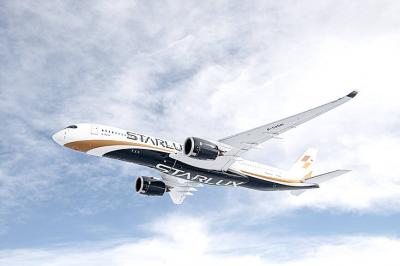
Starlux Airlines Co (星宇航空) today unveiled a long-haul network expansion plan at a shareholders’ meeting in Taipei, including direct flights to Barcelona, Spain, and Zurich, Switzerland, as well as a service connecting Taipei, Sydney and New Zealand. Starlux is to become the first Taiwanese carrier to offer non-stop services to the two European cities, while the inaugural oceanic route is expected to expand transit opportunities within the Australia-New Zealand market, Starlux said. Flight services to Chicago, Dallas, Washington and New York are under evaluation, the airline added. Prior to the shareholders’ meeting, the airline earlier this year announced that it would be

Taiwanese firms have increased investment in the Philippines in recent years as Manila’s ties with Washington deepen and global supply chains continue to shift away from China, an expert at the Chung-Hua Institution for Economic Research (CIER, 中華經濟研究院) said yesterday. The Philippines had not been among Taiwanese investors’ top choices in Southeast Asia, CIER Taiwan ASEAN Studies Center director Kristy Hsu (徐遵慈) said at a seminar in Taipei. However, Taiwan’s investment in the country has grown significantly since the COVID-19 pandemic, reaching US $257 million last year, a high in recent years, she said. Although Taiwan’s total investment in the Philippines still lags

Taiwanese prosecutors suspect that three people successfully smuggled at least one shipment of Nvidia Corp artificial intelligence (AI) chips to China after first exporting them to Japan, people familiar with the matter said. The trio was detained last week by the Keelung District Prosecutors’ Office for allegedly falsifying documents related to exports of Super Micro Computer Inc servers containing advanced Nvidia chips, which the US has barred from sale to China without a license from Washington. The move marked Taiwan’s first public crackdown on AI chip diversion after years of pressure from the US to take a more active role in curtailing


 RSS
RSS