

The official manufacturing purchasing managers’ index (PMI) was 54.5 last month, marking its eighth consecutive month of expansion, although growth slowed from September’s reading of 56.5, the Chung-Hua Institution for Economic Research (CIER, 中華經濟研究院) said yesterday.
The PMI is a gauge of the health of the manufacturing industry, with scores above 50 indicating expansion and scores below the threshold suggesting contraction.
The recovery failed to extend to service-oriented firms, with the non-manufacturing index sliding to 49.4, despite the high sales season, ending four months of gains.
“The manufacturing industry is still on course for recovery, despite the slowdown in pace,” CIER president Wu Chung-shu (吳中書) told reporters.
Of the six major manufacturing industries, all but electrical and machinery equipment suppliers stepped up purchasing activity to meet growing demand, both domestically and from abroad, the report said.
The sub-index on new business orders was 55, down from September’s 59.3, while new export orders were 54.7, down from 56.6, the report said.
The data suggest that high-
season sales might have peaked for Taiwanese firms in the upstream supply chain of global consumer electronics brands.
The private Nikkei Taiwan Manufacturing PMI showed similar results, with a reading of 52.7.
“Taiwan’s manufacturing industry saw a solid start to the fourth quarter, with the upturn looking broad-based and sustainable,” said Annabel Fiddes, an economist at IHS Markit, which compiles the Nikkei survey.
However, companies are cautious about payroll expansion, with the employment index rising only marginally, the Nikkei report said.
Input costs rose significantly, but firms raised output charges modestly to stay competitive and win customers, the report said.
Chemical products, electronics and food makers are upbeat about business performance, while basic materials, transportation, tool and machinery equipment vendors expect business to slow, CIER said.
The six-month outlook index was 51.8, down from 53.5 in September, Wu said.
The confidence level is weaker in non-manufacturing sectors, with the six-month index registering 39.4, the CIER report said.
The sluggish turnover on the local bourse is worrying for financial and insurance service providers, while a sharp decline in the number of tourists is unfavorable for hotels, restaurants and retailers, Wu said.

INFRINGEMENT: The investigation comes after a complaint from Vicor Corp, with the company seeking a limited exclusion order as well as cease-and-desist orders, the ITA said The US International Trade Commission (USITC) has launched a Section 337 investigation naming Taiwanese technology companies, including Hon Hai Precision Industry Co (鴻海), Delta Electronics Inc (台達電) and Quanta Computer Inc (廣達), as respondents. The Ministry of Economic Affairs (MOEA) pledged assistance if needed. The USITC said on Friday in a statement that it had voted to institute an investigation under Section 337 of the US Tariff Act of 1930 into certain vertical power delivery systems, related components and computing devices incorporating such systems. The investigation covers 20 companies from Taiwan, China, Germany and the US, the commission said, adding that it

IN GOOD FAITH: Lai said he appreciates Micron’s commitment to Taiwan and that it would continue expanding its investment in the country, while also working with labor President William Lai (賴清德) yesterday called for US memory maker Micron Technology Inc and its workers to negotiate “sincerely” ahead of a possible strike by the company’s union in Taiwan. Last week, a Taiwanese union representing workers at Micron said it had secured authorization from its members to strike over a dispute concerning the company’s bonus scheme, escalating a labor conflict at the chipmaker’s largest manufacturing hub. Micron employs about 15,000 people in Taiwan and has said it invested more than NT$1.6 trillion (US$49.6 billion) in the country. Speaking in Taichung at the opening of a new Micron advanced assembly and testing facility,
A man charged along with Super Micro Computer Inc co-founder Yih-Shyan “Wally” Liaw (廖益賢) of conspiring to send cutting-edge chips to China in violation of US export controls pleaded guilty, court documents said. Ting-Wei “Willy” Sun (孫廷瑋), a former outside contractor described by US authorities as a “fixer” who allegedly aided in the sales, pleaded guilty on Thursday at a hearing in federal court in New York as part of an agreement with prosecutors, court filings showed. Prosecutors claimed the men were part of a scheme to send Nvidia Corp-powered servers to an unnamed Southeast Asian company and then divert them to
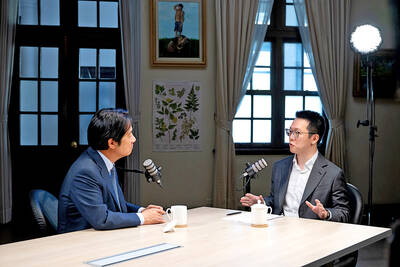
Taiwan should not rule out any energy source or abandon environmental sustainability in favor of ideology and short-term benefits, President William Lai (賴清德) said in an interview, calling for a “professional assessment” of whether nuclear power should be reintroduced into Taiwan’s energy mix. In an online interview with influencer Yu Ting-hao (游庭皓) that aired yesterday, Lai reiterated his position on nuclear power. SHIFT Lai’s remarks marked a shift from the Democratic Progressive Party’s (DPP’s) longstanding opposition to nuclear power. As premier from 2017 to 2019, Lai pushed for more gas-fired power capacity while sticking to the DPP’s nuclear free homeland ideology and rejected the


 RSS
RSS