


Taiwan Optical Platform Co (台灣數位光訊) yesterday said it plans to acquire a 65 percent stake in Eastern Broadcasting Co (EBC, 東森電視) for NT$11.12 billion (US$351.1 million) in a bid to expand its presence in the nation’s broadcasting market.
The announcement came less than two weeks after DMG Entertainment dropped its NT$18.9 billion bid to acquire EBC due to drawn-out reviews by local regulators.
“We are a local cable TV system operator. We have been interested in acquiring EBC since Carlyle Group expressed its intention to unload its stakes,” Taiwan Optical Platform chairman Rocky Chien (簡森垣) told a news conference.
Taiwan Optical Platform provides as Internet broadband access service, online gaming, e-learning, VoIP service and wireless broadband service. The deal will help the company enhance its digital contents and improve its position in the cable TV market, the Taichung-based Taiwan Optical Platform said.
EBC operates 10 TV channels, including two news channels, in Taiwan and elsewhere.
Taiwan Optical Platform is the nation’s fifth-largest cable TV system operator, with 295,600 subscribers, or about 5.8 percent of the total 5.11 million.
The company said it has signed a share purchase agreement with Carlyle Group to buy its 61 percent stake in EBC.
The agreement is due to expire in March next year and can be extended by three months.
Taiwan Optical Platform said it also plans to buy another 4 percent stake from EBC employees.
The company said it plans to issue new shares and seek loans from banks to fund the deal.
DMG’s decision to drop its EBC bid gave Taiwan Optical Platform leeway to acquire the cable TV firm. DMG has been under scrutiny by the National Communications Commission (NCC) and the Investment Commission due to concerns that Chinese investors could be involved in the transaction. The regulators have been reviewing the case since it was submitted in December last year.
The deal between Taiwan Optical Platform and Carlyle Group came as a surprise for Eastern Media International Corp (東森國際) and is expected to undermine Eastern Media’s plan to regain control over EBC.
Eastern Media, which sold its 61 percent stake in EBC to the Washington-based Carlyle in 2006, yesterday said it has been raising capital to buy back EBC shares after the DMG deal fell through.
Eastern Media holds a 21.5 percent stake in EBC.
The company said that it is considering taking legal action over the deal, as it has priority to make a bid for EBC stakes based on an agreement signed with Carlyle Group in 2006.
Taiwan Optical Platform’s offer needs to be approved by the NCC, the Investment Commission and the Fair Trade Commission before it can be finalized.
Commenting on concerns over potential competition, Chien said it should not be a serious concern, given Taiwan Optical Platform’s small market share.
The company looks to shrink the gap with the nation’s fourth-biggest cable provider, Taiwan Fixed Network (台灣固網), as the number of its subscribers would jump to about 500,000 if its acquisition bid obtains regulatory approval. Its market share would rise to about 10 percent.
The Investment Commission said it has not received any applications from Taiwan Optical Platform or Carlyle, but it is possible that it will approve Taiwan Optical Platform’s planned investment in EBC.
“The case is less complicated than DMG Entertainment executive officer Dan Mintz’s planned acquisition of EBC, as the buyer is not a foreign investor,” commission executive secretary Emile Chang (張銘斌) said by telephone.
Chang said the commission needs to examine whether Carlyle has violated any regulations in Taiwan.
The commission is likely to allow the bid if the NCC approves it, Chang said.
Additional reporting by Lauly Li

ENERGY ISSUES: The TSIA urged the government to increase natural gas and helium reserves to reduce the impact of the Middle East war on semiconductor supply stability Chip testing and packaging service provider ASE Technology Holding Co (日月光投控) yesterday said it planned to invest more than NT$100 billion (US$3.15 billion) in building a new advanced chip testing facility in Kaohsiung to keep up with customer demand driven by the artificial intelligence (AI) boom. That would be included in the company’s capital expenditure budget next year, ASE said. There is also room to raise this year’s capital spending budget from a record-high US$7 billion estimated three months ago, it added. ASE would have six factories under construction this year, another record-breaking number, ASE chief operating officer Tien Wu

The EU and US are nearing an agreement to coordinate on producing and securing critical minerals, part of a push to break reliance on Chinese supplies. The potential deal would create incentives, such as minimum prices, that could advantage non-Chinese suppliers, according to a draft of an “action plan” seen by Bloomberg. The EU and US would also cooperate on standards, investments and joint projects, as well as coordinate on any supply disruptions by countries like China. The two sides are additionally seeking other “like-minded partners” to join a multicountry accord to help create these new critical mineral supply chains, which feed into

For weeks now, the global tech industry has been waiting for a major artificial intelligence (AI) launch from DeepSeek (深度求索), seen as a benchmark for China’s progress in the fast-moving field. More than a year has passed since the start-up put Chinese AI on the map in early last year with a low-cost chatbot that performed at a similar level to US rivals. However, despite reports and rumors about its imminent release, DeepSeek’s next-generation “V4” model is nowhere in sight. Speculation is also swirling over the geopolitical implications of which computer chips were chosen to train and power the new
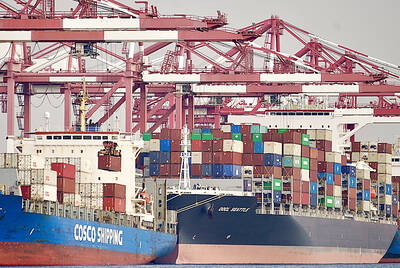
TECH WINNERS: Taiwan and South Korea reported robust trade, which suggests that they have critical advantages in the rapidly expanding AI supply chain, an official said Exports last month surged to a new high, as booming demand tied to artificial intelligence (AI) infrastructure fueled shipments of advanced technology components, underscoring the nation’s pivotal role in the global semiconductor supply chain. Outbound shipments climbed to US$80.18 billion, the highest ever for a single month, rising 61.8 percent from a year earlier and marking the 29th consecutive month of growth, the Ministry of Finance said yesterday. “The surge was driven primarily by global investment in AI infrastructure,” Department of Statistics Director-General Beatrice Tsai (蔡美娜) said. The mass production of next-generation AI computing systems has accelerated procurement across the semiconductor supply


 RSS
RSS